
Top Business Leaders Redefining Public Relations in 2025
The Rise of a Reputation Strategist
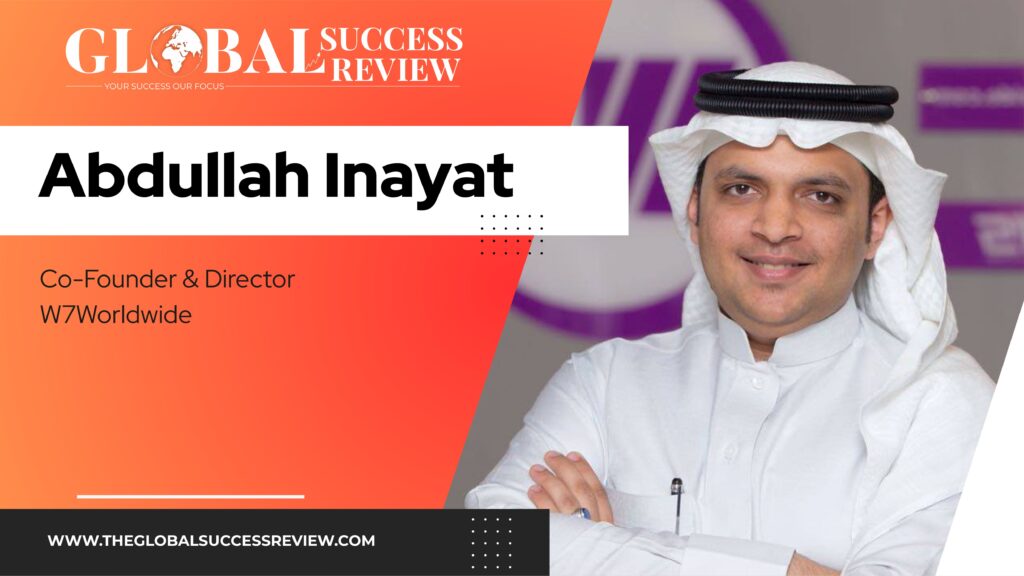
In the heart of the Middle East, where industries are in constant flux and markets demand resilience, Abdullah Inayat has emerged as one of the region’s foremost voices on reputation management. As the Co-Founder & Director of W7Worldwide, Abdullah has spent years shaping how organizations confront risk, manage crises, and build credibility in a hyper-connected age.
For Abdullah, public relations was never just about generating publicity or placing headlines. It was about trust. It was about creating narratives that endure long after the press coverage fades. Most of all, it was about protecting reputations in moments of uncertainty, something that many companies fail to prepare for until it’s too late.
“W7Worldwide was built on the belief that communication in the Middle East had to evolve beyond publicity,” Abdullah shares. “From day one, reputation management was at the heart of our mission, helping organizations earn trust, safeguard credibility, and build resilience in the face of risk.”
That mission has not only redefined the standards of corporate communication in the region, but it has also positioned Abdullah as a global thought leader in one of the most pressing challenges of our time: protecting the intangible yet priceless currency of reputation.
Vision Meets Risk
Abdullah’s journey into reputation management stemmed from a clear understanding of how fragile public trust has become in the digital era. In the past, companies had days, sometimes weeks- to craft a response to reputational threats. Today, a crisis can escalate worldwide in minutes.
For him, reputation management is not reactive—it is proactive.
“Reputation management is no longer a reactive process; it’s a proactive strategy,” he explains. “It means anticipating risks, aligning stakeholders, and ensuring leadership narratives remain authentic and credible even under scrutiny. In a hyper-connected world, reputation is the most valuable, and most vulnerable, asset any organization has.”
This vision has guided W7Worldwide since its inception. It is also what sets Abdullah apart: his ability to blend foresight, cultural intelligence, and strategic communication into a framework that safeguards clients in times of calm and anchors them during storms.
The Power of Executive Positioning
Among Abdullah’s many contributions to modern communication, one concept stands out: executive positioning. He describes it as more than just visibility for CEOs or senior leaders; it is about creating trust in leadership itself.
“When leaders are visible, authentic, and culturally intelligent, they inspire employees, reassure investors, and stabilize market perception,” he notes. “In times of crisis, well-positioned executives become anchors of credibility, turning potential risks into opportunities for reassurance.”
This philosophy is particularly critical in the Middle East, where leadership perception is deeply tied to cultural and national identity. By guiding leaders to speak with authenticity, W7Worldwide has helped organizations build resilience at the top, where it matters most.
Stakeholders at the Center
Reputation is not built in a vacuum. Abdullah emphasizes that stakeholder engagement often determines how crises unfold. His approach is meticulous, mapping every stakeholder group, customers, employees, regulators, investors, and media, and tailoring communication strategies for each.
“By listening, engaging, and aligning with expectations early, we minimize reputational damage when crises arise,” he explains.
This philosophy has redefined the way many Middle Eastern organizations approach communication. Instead of seeing PR as a one-way broadcast, Abdullah has pushed companies to adopt a dialogue-driven model, where stakeholder trust is earned consistently, not only in moments of crisis.
Crisis as Opportunity
“A crisis is not defined by the event itself but by how you respond,” Abdullah insists.
At W7Worldwide, this response is rooted in preparation and foresight. From scenario planning and real-time monitoring to equipping executives with ready-to-go messaging, his firm ensures that clients are not caught off guard.
But beyond survival, Abdullah believes that crises present an opportunity to demonstrate accountability, resilience, and leadership. In fact, some of W7Worldwide’s most celebrated campaigns, like their Ramadan and Hajj initiatives, were built around sensitive cultural moments that required not just communication expertise but also emotional intelligence.
Campaigns that Build Trust
Two initiatives stand out as testaments to W7Worldwide’s reputation and expertise.
The first, “Communicating the Unifying Spirit of Ramadan,” went far beyond storytelling. It highlighted the values of compassion, unity, and generosity during one of the most sacred times of the year, positioning clients as aligned with cultural values while reinforcing public trust.
The second, their Hajj campaign, carried an even greater weight. Balancing spirituality, sensitivity, and national preparedness, the campaign not only reassured millions of pilgrims but also showcased the Kingdom’s readiness to the world.
“Both campaigns reinforced how proactive communication mitigates reputational risk,” Abdullah reflects. They also showcased W7Worldwide’s ability to translate cultural nuance into reputational strength, a rare skill in today’s fast-paced PR world.
Technology and Cultural Intelligence
Of course, no conversation about reputation management in 2025 is complete without acknowledging the role of technology. Abdullah recognizes that digital platforms can amplify risks within minutes.
To counter this, W7Worldwide deploys tools like AI-driven analytics, sentiment tracking, and narrative mapping. Yet, Abdullah is quick to caution against over-reliance on technology alone.
“Technology gives us speed, but cultural intelligence ensures our responses are human, authentic, and resonant,” he explains.
This balance, between data and humanity, algorithms and authenticity, is at the core of his firm’s success.
Values that Lead
At the heart of Abdullah’s leadership lies three guiding values: integrity, agility, and purpose.
“In crisis scenarios, integrity builds trust, agility ensures swift response, and purpose keeps communication authentic,” he shares.
These values are not just principles on paper; they are the DNA of W7Worldwide. They shape the way teams respond under pressure, how clients experience the firm’s service, and how the company positions itself as a trusted partner in turbulent times.
Lessons from Missteps
Asked about the biggest mistakes organizations make, Abdullah is candid: waiting too long to act.
“Silence or slow responses create an information vacuum that stakeholders fill with speculation,” he warns. “The biggest mistake is treating reputation as an afterthought instead of embedding it into business strategy.”
This insight is particularly relevant in an age where misinformation spreads faster than truth. Abdullah’s mantra, ‘respond early, respond authentically,’ has saved clients from reputational collapse time and again.
Risks That Will Define the Future
Looking ahead, Abdullah identifies three forces that will shape reputation management in the years to come: geopolitical shifts, misinformation, and rising societal expectations.
Companies that fail to align with environmental, social, and governance (ESG) standards or ignore cultural sensitivities will find themselves increasingly exposed.
“The winners will be those who treat reputation as a living, strategic asset,” he asserts. “Reputation will no longer be a defensive tool; it will be the driver of trust and global competitiveness.”
A Legacy in the Making
For Abdullah, his work is not just about managing risks today but about redefining the future of reputation management in the Middle East.
“I want to redefine how Middle Eastern organizations approach reputation, not as a defensive tool, but as a driver of leadership, trust, and global competitiveness,” he says.
His ultimate legacy? Proving that with foresight, cultural intelligence, and innovation, reputation can become both a shield and a source of opportunity.
Final Word
As 2025 unfolds, Abdullah Inayat stands at the forefront of a communication revolution in the Middle East. He is not just a PR professional, he is a strategist, a risk manager, and above all, a guardian of trust.
From mapping stakeholder expectations to guiding executives through crises, from harnessing AI to embracing cultural nuance, Abdullah is rewriting the rules of reputation management. His story is a reminder that in today’s world, leadership is not only about building organizations but also about safeguarding the trust that sustains them.
At a time when misinformation spreads faster than facts and public trust is harder to earn than ever, leaders like Abdullah Inayat are showing the world that reputation, once dismissed as intangible, is now the most powerful asset of all.
