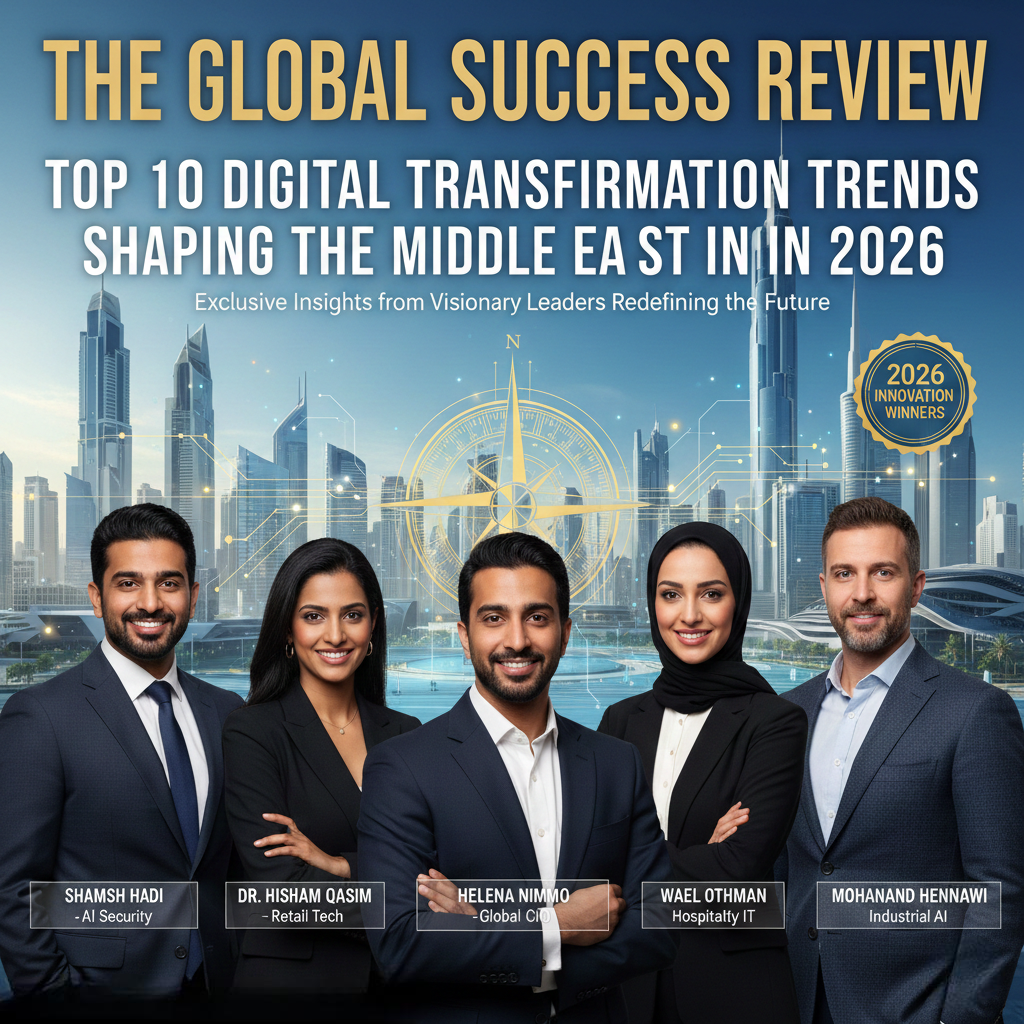
Top 10 Digital Transformation Trends Shaping the Middle East in 2026

Top-10-Digital-Transformation-Trends-Shaping-the-Middle-East-in-2026_The-Global-Success-Review-Magazine

The Middle East has officially moved past the “adoption” phase and into a period of unprecedented digital maturity. Driven by ambitious national visions like Saudi Arabia’s Vision 2030 and the UAE’s “We the UAE 2031,” 2026 marks a year where technology is no longer a support function; it is the core of every successful enterprise.

From the industrial hubs of NEOM to the financial centers of Dubai, here are the top 10 trends defining digital transformation this year.

1. The Rise of Sovereign AI and Arabic LLMs

In 2026, the Middle East is leading the way in “Sovereign AI.” Governments and private sectors are prioritizing localized Artificial Intelligence that understands regional dialects and cultural nuances. We are seeing a massive shift toward Arabic Large Language Models (LLMs) to ensure data privacy and cultural relevance in automated services.

2. Hyper-Automation in Industrial Operations

As leaders like Mohannad Hennawi at NAFFCO have demonstrated, industrial sectors are embracing hyper-automation. By integrating AI with Robotic Process Automation (RPA), companies are achieving “lights-out” manufacturing and logistics, drastically reducing human error in high-stakes environments.

3. Cognitive Cities and Smart Infrastructure

The concept of “Smart Cities” has evolved into Cognitive Cities. These urban centers use real-time data and IoT to predict needs before they arise, optimizing traffic flow, energy consumption, and public safety. NEOM and Masdar City remain the global blueprints for this transformation.

4. The Transition to Green-Tech and Sustainable Innovation

With a global eye on sustainability, 2026 sees the integration of “Green IT.” Digital transformation is now measured by its carbon footprint. Leaders like Amin Ali are proving that digital growth and eco-innovation must go hand-in-hand to secure long-term investment.

5. Cybersecurity as a Boardroom Priority

As digital footprints expand, so does the threat landscape. Cybersecurity is no longer just an IT issue; it is a strategic business pillar. The focus has shifted to Resilience and Red Teaming, with experts like Shamsh Hadi and John Stigerwalt leading the charge in protecting blockchain and cloud assets.

6. The “Phygital” Revolution in Retail and Hospitality

Retailers and hotel groups are merging the physical and digital worlds. Whether it’s through AI-driven personalization in automotive showrooms (as seen with Hussam Baghdadi) or seamless guest governance in hospitality (championed by Wael Othman), the “Phygital” experience is the new gold standard.

7. Blockchain 2.0: Beyond Cryptocurrency

Blockchain has found its true home in the Middle East’s legal and supply chain sectors. In 2026, we see widespread use of Smart Contracts to automate everything from real estate transactions to international shipping, ensuring transparency and reducing legal bottlenecks.

8. Cloud-First and Serverless Architectures

The region has seen a massive migration to the cloud. 2026 is the year of Serverless Computing, allowing startups and enterprises to scale instantly without the overhead of physical infrastructure, a trend accelerated by regional hubs for AWS, Google Cloud, and Microsoft Azure.

9. EdTech and the Continuous Learning Culture

The talent gap is being bridged by sophisticated EdTech platforms. Corporate learning is now experiential and AI-driven. Visionaries like Andrew Stotter-Brooks and Aditya Berlia are utilizing digital tools to ensure the workforce stays ahead of the rapid tech curve.

10. Data Democratization and Predictive Analytics

The final trend is the shift from “collecting data” to “democratizing” it. Businesses are putting powerful analytics tools in the hands of all employees, not just data scientists. This allows for real-time, data-backed decision-making at every level of the organization.


Conclusion: The Road Ahead

The digital transformation in the Middle East is not just about technology; it’s about leadership and vision. As we feature the most prominent figures in The Global Success Review, it is clear that those who adapt to these ten trends will be the ones defining the global economy in 2026 and beyond.


Letest Covers

Top 10 Digital Transformation Trends Shaping the Middle East in 2026

Top-10-Digital-Transformation-Trends-Shaping-the-Middle-East-in-2026_The-Global-Success-Review-Magazine

The Middle East has officially moved past the “adoption” phase and into a period of unprecedented digital maturity. Driven by ambitious national visions like Saudi Arabia’s Vision 2030 and the UAE’s “We the UAE 2031,” 2026 marks a year where technology is no longer a support function; it is the core of every successful enterprise.

From the industrial hubs of NEOM to the financial centers of Dubai, here are the top 10 trends defining digital transformation this year.

1. The Rise of Sovereign AI and Arabic LLMs

In 2026, the Middle East is leading the way in “Sovereign AI.” Governments and private sectors are prioritizing localized Artificial Intelligence that understands regional dialects and cultural nuances. We are seeing a massive shift toward Arabic Large Language Models (LLMs) to ensure data privacy and cultural relevance in automated services.

2. Hyper-Automation in Industrial Operations

As leaders like Mohannad Hennawi at NAFFCO have demonstrated, industrial sectors are embracing hyper-automation. By integrating AI with Robotic Process Automation (RPA), companies are achieving “lights-out” manufacturing and logistics, drastically reducing human error in high-stakes environments.

3. Cognitive Cities and Smart Infrastructure

The concept of “Smart Cities” has evolved into Cognitive Cities. These urban centers use real-time data and IoT to predict needs before they arise, optimizing traffic flow, energy consumption, and public safety. NEOM and Masdar City remain the global blueprints for this transformation.

4. The Transition to Green-Tech and Sustainable Innovation

With a global eye on sustainability, 2026 sees the integration of “Green IT.” Digital transformation is now measured by its carbon footprint. Leaders like Amin Ali are proving that digital growth and eco-innovation must go hand-in-hand to secure long-term investment.

5. Cybersecurity as a Boardroom Priority

As digital footprints expand, so does the threat landscape. Cybersecurity is no longer just an IT issue; it is a strategic business pillar. The focus has shifted to Resilience and Red Teaming, with experts like Shamsh Hadi and John Stigerwalt leading the charge in protecting blockchain and cloud assets.

6. The “Phygital” Revolution in Retail and Hospitality

Retailers and hotel groups are merging the physical and digital worlds. Whether it’s through AI-driven personalization in automotive showrooms (as seen with Hussam Baghdadi) or seamless guest governance in hospitality (championed by Wael Othman), the “Phygital” experience is the new gold standard.

7. Blockchain 2.0: Beyond Cryptocurrency

Blockchain has found its true home in the Middle East’s legal and supply chain sectors. In 2026, we see widespread use of Smart Contracts to automate everything from real estate transactions to international shipping, ensuring transparency and reducing legal bottlenecks.

8. Cloud-First and Serverless Architectures

The region has seen a massive migration to the cloud. 2026 is the year of Serverless Computing, allowing startups and enterprises to scale instantly without the overhead of physical infrastructure, a trend accelerated by regional hubs for AWS, Google Cloud, and Microsoft Azure.

9. EdTech and the Continuous Learning Culture

The talent gap is being bridged by sophisticated EdTech platforms. Corporate learning is now experiential and AI-driven. Visionaries like Andrew Stotter-Brooks and Aditya Berlia are utilizing digital tools to ensure the workforce stays ahead of the rapid tech curve.

10. Data Democratization and Predictive Analytics

The final trend is the shift from “collecting data” to “democratizing” it. Businesses are putting powerful analytics tools in the hands of all employees, not just data scientists. This allows for real-time, data-backed decision-making at every level of the organization.


Conclusion: The Road Ahead

The digital transformation in the Middle East is not just about technology; it’s about leadership and vision. As we feature the most prominent figures in The Global Success Review, it is clear that those who adapt to these ten trends will be the ones defining the global economy in 2026 and beyond.