Dr. Balakrishna P. Shetty: Reimagining Healthcare Through Intelligence, Integrity, and Integration
By The Global Success Review Editorial Team
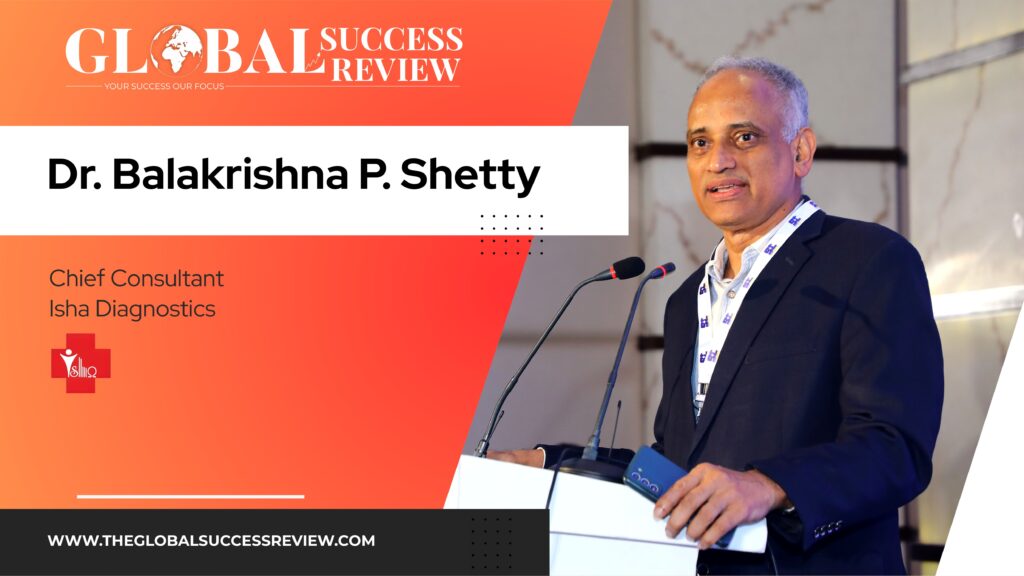
In an era when healthcare systems across the world are struggling to balance cost, access, technology, and human touch, a new category of leaders is emerging, those who do not merely adopt innovation but fundamentally rethink the philosophy of care. Among them, Dr. Balakrishna P. Shetty stands out as a bold architect of integrated, patient-centered healthcare transformation.
As a consultant radiologist, global academic leader, education reformer, and Founder of ISHA Diagnostics in Bengaluru, Dr. Shetty has spent decades challenging conventional medical thinking. His work spans advanced imaging, tele-consultation, preventive health models, education reform, and what he calls “intellectual Aatma Nirbharta”, India’s intellectual self-reliance in healthcare and research.
At a time when medicine is becoming increasingly fragmented and expensive, Dr. Shetty’s mission is clear: deliver world-class diagnostics and therapeutic insight that is affordable, non-invasive, and deeply humane.
This is the story of a physician-leader who believes the future of healthcare will not be built by technology alone, but by wisdom, restraint, and systems that respect the body’s natural intelligence.
From Global Medical Powerhouses to India’s Healthcare Frontlines
Dr. Shetty’s journey is rooted in both global exposure and national commitment. After receiving advanced training and gaining clinical experience at some of the world’s most respected institutions, including MD Anderson Cancer Centre, Texas Children’s Hospital, Saint Luke’s Health System, Houston Methodist Hospital, Cleveland Clinic, and Yale New Haven Hospital, he made a decision that would define his legacy.
He returned to India.
Rather than continuing a comfortable career within the Western healthcare ecosystem, Dr. Shetty chose to build capacity where he believed the impact could be transformational. This decision led to the establishment of ISHA Diagnostics in Bengaluru, which has since evolved into one of the city’s leading diagnostic centers.
His vision was never limited to creating another imaging facility. Instead, he sought to prove a powerful hypothesis:
High-quality healthcare does not have to be prohibitively expensive.
ISHA Diagnostics: Where Affordability Meets Advanced Technology
Under Dr. Shetty’s leadership, ISHA Diagnostics has built a reputation for combining globally comparable technology with cost structures that dramatically improve accessibility.
The center’s model demonstrates a striking contrast to many Western systems. Investigations that often cost thousands of dollars abroad are delivered in India at a fraction of the price, without compromising quality.
Dr. Shetty recalls a particularly telling moment. A patient from the United States visited ISHA Diagnostics for a mammogram. Initially prepared to navigate complex insurance procedures, she was surprised to learn the test cost approximately INR 800 (around USD 10). Rather than proceeding with insurance, she paid immediately, astonished by both the affordability and efficiency.
Stories like this are not exceptions; they reflect the core philosophy behind ISHA Diagnostics:
- World-class imaging
- Internationally trained physicians
- Transparent pricing
- Patient-first accessibility
Even advanced studies such as Total Body MRI, often financially out of reach in many countries- are offered at costs that make medical travel to India a viable option for global patients.
For Dr. Shetty, this is not simply about pricing. It is about healthcare equity through intelligent system design.
The MR PET Breakthrough: No Radiation, No Contrast
One of Dr. Shetty’s most significant clinical innovations is the advancement and promotion of MR PET imaging protocols, a technology approach he describes as a major step toward safer diagnostics.
Traditional imaging modalities such as PET-CT often involve radiation exposure and contrast dye injections. While effective, these approaches can pose risks, particularly for vulnerable populations.
Dr. Shetty’s MR PET model emphasizes:
- No radiation
- No injection
- No contrast dye
- Whole-body disease detection capability
This approach is particularly beneficial for:
- Pregnant women
- Children
- Patients with renal or hepatic failure
- Individuals requiring repeated imaging
Because the technique avoids cumulative radiation exposure, it can be repeated safely when clinically necessary, an important advantage in long-term disease monitoring.
In Dr. Shetty’s view, the future of diagnostics must prioritize precision with minimal biological burden. Technology should reduce harm, not merely improve detection.
Simplifying Complexity: The “Good, Bad, Ugly” Disease Framework
Modern medicine has become increasingly sophisticated, but also increasingly confusing for patients and even clinicians. Dr. Shetty observed that the explosion of imaging technologies and constantly evolving classification systems was creating what he refers to as VOMIT, Victim of Modern Imaging Technology.
To address this confusion, he introduced a strikingly simple yet clinically meaningful framework: Good, Bad, Ugly classification.
Good Lesions
These are incidental findings that are stable and unlikely to cause harm, such as benign scars, moles, or healed internal changes. In many cases, they require no intervention beyond observation or cosmetic management.
Bad Lesions
These appear potentially problematic and may progress if left unattended. They require monitoring, follow-up imaging, or targeted treatment depending on the underlying cause.
Ugly Lesions
These demonstrate aggressive characteristics and should be removed promptly without unnecessary procedural delays.
What makes this framework powerful is its patient-centric philosophy. Rather than treating imaging findings in isolation, the model evaluates the patient as a whole system.
Dr. Shetty believes this approach:
- Reduces overtreatment
- Minimizes patient anxiety
- Prevents unnecessary invasive procedures
- Preserves the body’s natural healing capacity
In an age of hyper-diagnosis, his model calls for clinical wisdom alongside technological capability.
The “No Biopsy” Perspective: A Debate-Shaping View
Perhaps one of Dr. Shetty’s most thought-provoking positions is his advocacy for minimizing unnecessary biopsies in certain focal tumors.
His concern centres on the possibility that needle biopsy may breach the protective capsule surrounding some tumors, theoretically allowing cellular spread. With advances in AI-driven imaging, including MRI, CT, and ultrasound, he argues that many malignancies can now be assessed non-invasively through markers such as:
- Vascularity
- Cell density
- Growth velocity (doubling time)
Using these indicators, tumours can be stratified within the Good–Bad–Ugly framework to guide clinical decision-making.
While acknowledging that biopsy remains an important tool in modern oncology, Dr. Shetty advocates for judicious, case-specific use, emphasizing that the least invasive effective pathway should always be considered first.
His broader message is clear: diagnostic courage must be balanced with biological respect.
Rethinking Neck Pain: Why Surgery Is Often Avoidable
Another area where Dr. Shetty has challenged conventional practice is spinal care, particularly cervical spine conditions.
According to his clinical experience and interpretation of available data, 95% to 99% of neck pain cases do not require surgery. Many patients present with MRI findings such as cervical spondylitis or osteophytes, yet these imaging results often do not correlate directly with the patient’s pain source.
True surgical candidates, he emphasizes, are rare and must meet strict clinical-radiological correlation criteria.
Instead, he advocates for:
- Physiotherapy
- CT-guided pain management
- Lifestyle modification
- Stress reduction
He also highlights an often-overlooked factor: muscle tension and psychological stress frequently amplify neck pain.
In his philosophy, modern medicine must resist the impulse toward premature intervention and instead allow the body’s natural inflammatory resolution mechanisms, often active over six to eight weeks, to do their work.
Understanding Lumps, Thyroid Nodules, and Prostate Concerns
Across multiple organ systems, Dr. Shetty applies a consistent principle: not every abnormal finding is dangerous.
Body Lumps
Most swellings, he explains, represent the body’s healing response and are contained within immune-generated capsules. Advanced imaging can help distinguish benign from aggressive patterns without immediate invasive testing.
Thyroid Nodules
Using high-resolution ultrasound and TI-RADS classification, nodules can be stratified effectively. Only lesions demonstrating aggressive features or rapid growth require urgent intervention.
Prostate Evaluation
Elevated PSA levels often trigger anxiety and invasive procedures. Dr. Shetty emphasizes age-adjusted interpretation and the role of multi-parametric MRI with PI-RADS scoring to guide management more intelligently.
Across these domains, his message remains consistent:
Patience, precision imaging, and clinical context must guide intervention, not fear.
Know My Health: Building a Digital Diagnostic Ecosystem
Recognizing the growing importance of patient data ownership and continuity of care, Dr. Shetty launched Know My Health, a digital platform that allows patients to upload and manage their health records.
The platform aims to:
- Integrate diagnostic reports
- Enable expert review
- Improve continuity of care
- Empower patients with accessible medical data
In an increasingly fragmented healthcare landscape, such platforms represent a shift toward patient-centered digital ecosystems.
Redefining Affordability: The Pay-What-You-Can Model
One of Dr. Shetty’s most socially impactful initiatives challenges a core assumption in modern healthcare, that ability to pay should determine access to diagnostics.
At ISHA Diagnostics, patients receive full transparency regarding investigation costs. However, through a secure QR-based system, they are allowed to pay what they can reasonably afford, without any compromise in diagnostic quality.
This model is built on three pillars:
- Trust
- Dignity
- Inclusive access
Importantly, the scope and quality of care remain identical regardless of payment level.
In Dr. Shetty’s words, this is not discounted care; it is inclusive care.
Transforming Therapeutic Care: Immunotherapy and Regenerative Medicine
Beyond diagnostics, Dr. Shetty has been active in advancing therapeutic innovation, particularly in oncology support.
His work includes promoting day-care immunotherapy models designed to enhance the patient’s own immune system to combat cancer and degenerative conditions.
He has also explored:
- Stem cell therapy
- Dendritic cell therapy
- Integrated immune support strategies
The underlying philosophy is consistent with his broader approach: strengthen the body’s internal defense mechanisms rather than relying solely on external interventions.
Intellectual Aatma Nirbharta: India’s Knowledge Independence
Dr. Shetty is a strong advocate for what he calls intellectual self-reliance in Indian healthcare and education.
Through initiatives such as D.I.R.E. (Defense of Indian Research and Education), he aims to:
- Defend Indian scientific contributions
- Promote indigenous research
- Reduce overdependence on Western journals
- Align curricula with Indian health priorities
- Build international research centers within India
His position is not anti-globalization. Rather, it reflects a GLOCAL philosophy, global knowledge with local implementation.
WORKATHON and University Social Responsibility
Perhaps one of his most distinctive contributions lies in educational reform.
Rejecting the traditional emphasis on walkathons or marathons, Dr. Shetty promotes the concept of WORKATHON, structured social engagement that builds intellectual and social responsibility among students.
Through University Social Responsibility (USR) programs, initiatives include:
- Safe delivery projects in tribal regions
- Empowerment programs for young women
- Rural education initiatives (PLEASE project)
- GREEN Graduation tree adoption program
- Telemedicine outreach
- Preventive health education
The GREEN Graduation initiative is particularly symbolic: medical students plant a sapling in their first year and nurture it throughout their course, with the grown plant featured on their graduation certificate.
For Dr. Shetty, this represents education rooted in responsibility to society and the environment.
A Global Voice for Affordable, Integrated Healthcare
Dr. Shetty’s influence extends well beyond India. He has spoken at major global platforms including:
- World Health Organization forums
- World Bank discussions
- USAID initiatives
- Consortium of Universities for Global Health
- University College London engagements
Across these forums, his message remains consistent: healthcare systems must become affordable, technology-enabled, and human-centered simultaneously.
Defining Success: Beyond Personal Recognition
Unlike many high-profile healthcare leaders, Dr. Shetty defines success in institutional rather than personal terms.
For him, true success is measured by:
- Institutional resilience
- Student empowerment
- Improved patient outcomes
- Societal impact
Personal accolades, he insists, are secondary.
This philosophy reflects a leadership style rooted in systems thinking and long-term impact.
The Legacy He Intends to Build
When asked about the legacy he hopes to leave behind, Dr. Shetty’s vision is both ambitious and deeply human.
He aims to help build institutions that are:
- Globally respected
- Technologically advanced
- Socially responsible
- Deeply humane
More importantly, he hopes future generations of healthcare professionals will learn to serve with:
- Knowledge
- Integrity
- Compassion
In a world increasingly driven by speed, scale, and commercialization, Dr. Balakrishna P. Shetty represents a different archetype of healthcare leadership, one that insists innovation must remain anchored in ethics, accessibility, and respect for the human body’s innate intelligence.
Final Word: A Visionary for India’s Integrated Healthcare Future
As India’s healthcare ecosystem continues to evolve, leaders like Dr. Shetty are redefining what progress truly means.
It is not merely about more machines, more procedures, or more data.
It is about:
- Smarter diagnostics
- Gentler interventions
- Empowered patients
- Responsible education
- And systems designed for equity
Through ISHA Diagnostics, Know My Health, educational reforms, and his global advocacy, Dr. Balakrishna P. Shetty is quietly, but powerfully- reshaping the conversation around modern medicine.
And as The Global Success Review Magazine recognizes India’s Most Visionary Integrated Healthcare Leaders to Watch in 2026, his work stands as a compelling reminder:
The future of healthcare will belong to those who can integrate technology, humanity, and wisdom into one coherent system.