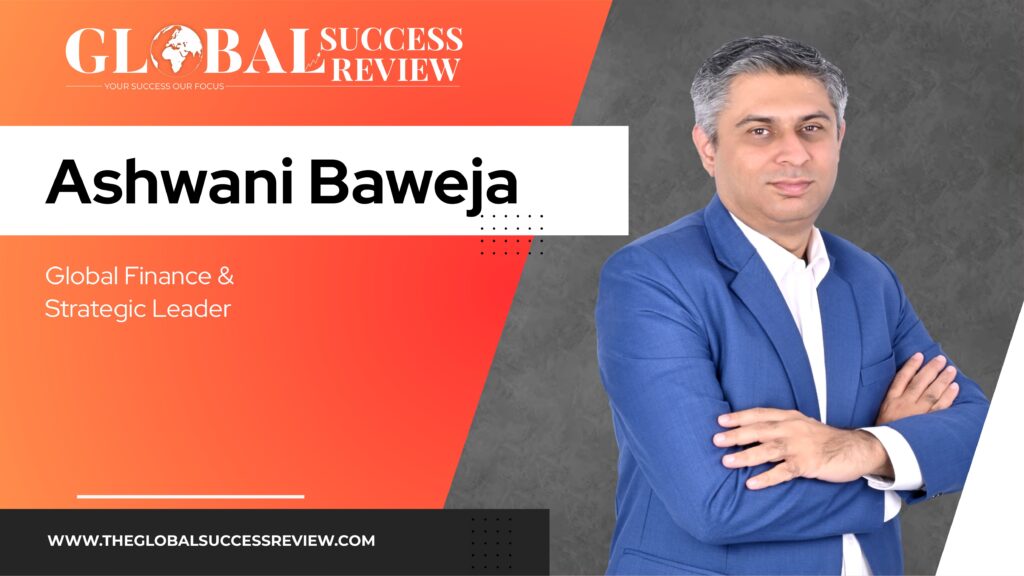
Ashwani Baweja: Building Global Finance Leadership Through People, Purpose, and Strategic Precision
In a world where finance is often viewed through the lens of reporting, compliance checklists, and quarterly outcomes, Ashwani Baweja represents a broader view of what finance leadership can be. Over a career spanning more than 24 years, across Africa, Europe, the Middle East, and Asia, he has worked across corporate finance, restructuring, and finance transformation, with a focus on building strong teams and scalable finance platforms..
Ashwani is not only focused on the numbers. He is a strategic architect, a business partner, and a people-first leader who believes that sustainable value is created not by control, but by trust; not by rigidity, but by clarity; and not by short-term wins, but by future-ready systems and empowered teams.
As a senior finance leader steering corporate finance for multi-vertical global conglomerates operating in over 50 countries, his work has consistently centered on strengthening the finance backbone that supports growth, decision-making,, governance, and long-term value creation.
It is this rare blend of executional depth, global exposure, and people-first leadership that positions him among The Most Visionary Global Finance & Business Leaders to Watch.
Where It All Began: Leadership Rooted in Trust and Delegation
Ashwani’s leadership journey did not begin with titles or grand ambitions. It began with a simple but powerful lesson early in his career: people matter. During his formative years at Max Healthcare, he worked under a manager who instilled a powerful belief:
Teams are not just support systems; they are the real engine of growth.
That early exposure shaped how he viewed leadership. He learnt the importance of “opening the fist,” and trusting capable people, delegating responsibility, and allowing teams to grow into their roles. The lesson was simple, yet transformative: when leaders invest in people and allow them to grow, organisational success follows naturally.
That philosophy became Ashwani’s anchor as his career expanded across businesses, geographies, industries, and increasingly complex responsibilities. It’s conscious leadership choice, one that builds accountability, confidence, and long-term capability. Over the years, this foundation has influenced how he builds teams, grooms second-line leaders, and creates finance organisations that can scale without becoming fragile.
This early grounding in trust and delegation laid the foundation for what would later become his structured leadership philosophy. It also explains why people development remains central to his work, even as he operates at a global, board-facing level today
A Global Lens: Leadership Shaped Across Continents
Ashwani’s leadership philosophy has been shaped significantly by international exposure. Having worked across Africa, Europe, the Middle East, and Asia, he has experienced first-hand how leadership expectations, communication styles, and organisational maturity vary across cultures and markets.
Early international assignments reinforced an important lesson: leadership cannot be applied uniformly across geographies. What works in one market may not translate effectively into another. Cultural context, local realities, and people dynamics play a critical role in how teams respond and perform. Ashwani learned that leadership cannot be universalised. Over time, this awareness helped him develop a more adaptive and empathetic leadership approach.
This global exposure strengthened his ability to balance business objectives with human considerations. Whether building teams, implementing systems, or driving change, he places significant emphasis on understanding local contexts before imposing global frameworks. That balance has allowed him to build trust across regions and align diverse teams toward common goals.
Working across emerging and developed markets gave him a deeper appreciation of human capital. He has often observed that while organisations frequently speak about people as their greatest assets, the realities of decision-making can sometimes tell a different story as they often get discussed as costs in boardrooms.
Bridging this gap, Ashwani believes, requires leaders who genuinely understand people, not just performance metrics. His global exposure reinforced a fundamental truth: human capital is the most valuable capital any organisation possesses.
Defining Visionary Financial Leadership in a Volatile World
In today’s rapidly changing economic landscape and shifting business models, Ashwani defines visionary finance leadership as the ability to think ahead in terms of people, systems, strategic direction stauing close to the business, and prepare for change before it becomes urgent.
For him, finance is no longer a back-office function or a scorekeeping role. This requires staying close to operations, understanding commercial realities, and engaging meaningfully with business leaders. Strong governance and discipline are essential, but they must coexist with agility and growth. In volatile environments, finance leaders are required to make decisions with incomplete information, assess trade-offs carefully, and support the business without slowing it down unnecessarily.
A finance leader must constantly look at least two years ahead, anticipating shifts in talent, technology, business models, and capital structures, while ensuring that growth remains sustainable and governed.
Visionary finance leadership is not about bold statements or predictions. It is about building resilience into the organisation through capable teams, robust processes, and clear decision frameworks so that the business can respond confidently to change when it arrives.
Making money, Ashwani notes, is never easy. Respecting that complexity while enabling better decisions is what defines your finance leadership.
The 3D Formula and the Rise of 3S Teams
At the heart of Ashwani’s leadership model lies a simple yet powerful framework which he has built over the years and he calls it as the 3D Formula:
- Delegation
- Developing a strong second line
- Developing a future-ready talent pipeline
For him, delegation is not about letting go of responsibility, but about building ownership and accountability within teams. He believes that leaders who hold on too tightly eventually limit both their teams and themselves. By trusting people with meaningful responsibility, he enables teams to grow in confidence and capability.
Developing a strong second line is equally critical. Ashwani places significant emphasis on creating reliable backups for key roles, ensuring continuity and resilience. This focus reduces dependency on individuals and allows organisations to scale without becoming fragile.
The third element is developing a long-term talent pipeline; this reflects his belief that leadership strength is measured by succession, not tenure. He actively invests time in identifying potential, providing exposure, and preparing teams for future roles rather than immediate vacancies.
This approach over the years has enabled him to build what he proudly refers to as 3S Teams: Successful, Sustainable, and Scalable.
For Ashwani, this is not a theoretical model, but a leadership practice shaped through years of building and rebuilding finance teams across geographies.
Balancing Discipline and Growth: Finance as a Risk Balancer
Ashwani does not view finance as a function designed to slow the business down. Instead, he sees it as a critical balancer, one that enables growth while ensuring discipline and sustainability. In his view, the role of finance is not to eliminate risk (they cant’t), but to understand it, quantify it, and manage it intelligently.
Monitoring early warning signals, understanding business positions, and raising proactive flags are essential , but they only add value when grounded with operational understanding of the business. Without context, finance risks becoming reactive rather than supportive.
Ashwani also emphasises that discipline and growth are not opposite forces. Strong governance, clear controls, and transparency provide the foundation on which sustainable growth can occur. When finance establishes trust through accuracy and consistency, it earns the credibility needed to support business decisions.
The balance between discipline and growth, he notes, defines effective finance leadership.
Finance as a True Business Partner
For Ashwani, finance is neither a policeman nor a passive observer – it is beyond the excel sheets.
A true business partnership begins with understanding how value is created and protected, from product movement and customer dynamics to operational risks and margin pressures. This requires finance leaders to step out of conference rooms and spend time on the ground – in plants, warehouses, trading desks, and field operations.
Finance leaders must see the business behind the spreadsheets. By staying close to operations, finance gains context. Numbers begin to tell a fuller story, one that reflects commercial realities, operational constraints, and market dynamics. This proximity allows finance to move from hindsight reporting to forward-looking insights.
By engaging directly with operations, challenging assumptions constructively, and supporting execution, finance earns trust and becomes a genuine strategic & trusted advisor. This mindset shift, getting closer to the business, transforms finance from a function into a growth multiplier.
Trust at the Highest Levels: CEOs, Boards, and Stakeholders
Trust, Ashwani believes, is built through consistency, transparency, and sound judgement. For CEOs, boards, and global stakeholders, confidence in the finance function comes not only from accuracy of numbers, but from the quality of insight and clarity that accompanies them.
A trusted finance function does not merely highlight issues; it drives solutions, enables growth, and maintains strong governance. Over time, this credibility becomes one of the most valuable assets an organisation can build.
He believes that effective engagement with boards and senior stakeholders requires a clear understanding of roles. Boards carry a fiduciary responsibility to act in the best interests of shareholders and stakeholders, while relying heavily on management teams to run the business on a day-to-day basis. Clear, honest, and timely communication between the two is essential. His work with investors, audit committees, and boards reinforces the importance of clear, honest, and timely communication, grounded in facts and long-term value creation.
A Defining Moment: Lessons From the Deep End
One of the most defining moments in Ashwani’s career came during his time at Olam, when he was asked to present directly to the Global CEO of the cocoa business during a country visit. At the time, he was leading country finance and had limited exposure to discussions at that level. There was little preparation or coaching, and the expectations were significantly higher than he had anticipated.
The discussions were intense, direct, and uncompromising. Moving beyond numbers to a true business narrative proved challenging, and the feedback that followed was difficult to absorb. It was a moment that made clear there would be no safety net and that leadership at senior levels demands far deeper commercial understanding and confidence.
Rather than discouraging him, the experience became a turning point. It forced Ashwani to reflect deeply on how he approached finance leadership. He realised that technical competence alone was not enough. To be effective at a CEO level, he needed to understand the business end-to-end its value drivers, operational realities, risks, and strategic trade-offs.
Over the following year, he spent significant time with operations, strengthened his commercial understanding, and fundamentally changed how he prepared for senior-level discussions. When the CEO returned the next year, the conversations were markedly different confident, constructive, and focused on value creation rather than explanation.
It was a pivotal transition that reshaped how Ashwani viewed finance leadership and reinforced a commonly held belief: while CFOs can often step into CEO roles, the reverse is rarely true. The lesson was hard-earned, learned under pressure, and instrumental in shaping his evolution into a strategic global finance leader.
Leading at Scale: Complexity Across 50+ Countries
Today, Ashwani leads corporate finance for a global conglomerate operating across more than 50 countries. This scale and size brings different level of complexity.
At this scale, he identifies two major challenges: people and change management.
People – having the right individuals in the right roles, with clarity on responsibilities and expectations, is critical. Skills and experience matter, but mindset and adaptability are equally important when operating in a global environment.
Change management is another constant challenge. Whether it involves restructuring, system implementation, or leading transformation, change must be introduced thoughtfully and communicated clearly. Ashwani emphasises the importance of explaining the “why” behind decisions. Without that understanding, even well-designed initiatives struggle to gain traction.
People, he emphasises, must be taken along the journey.
Structuring for Value Creation and Protection
Ashwani approaches financial structuring with a clear principle: structures must serve the business, not the other way around. For him, effective structuring is about enabling growth while safeguarding long-term value, rather than chasing short-term efficiencies in isolation.
His guiding principle is simple:
every structure must create value and protect it.
Ultimately, his approach is to structure balances value creation with value protection. When done thoughtfully, structures become enablers – supporting strategic objectives, strengthening governance, and providing clarity to stakeholders rather than adding complexity
Restructuring, M&A, and the Human Dimension
For Ashwani, restructuring and M&A are never just financial exercises. While value creation and protection remain central, he believes the long-term success of any restructuring or transaction depends equally on how people are handled through the process.
He has seen that even well-structured deals can struggle if the human dimensions are overlooked. Changes to reporting lines, roles, systems, and expectations can create uncertainty if not addressed carefully. He places strong emphasis on communication, clarity, and pacing during periods of change.
Post-merger integration, in particular, is where intentions are tested. Aligning teams, systems, and cultures requires more than timelines and checklists. It demands patience, listening, and the ability to balance speed with stability. Taking people along in the journey helps reduce friction and allows the organisation to focus on execution rather than disruption.
When people understand the purpose behind change and see a clear path forward, integration becomes smoother and outcomes more durable.
Finance Transformation: Technology With Purpose
For Ashwani, technology is an enabler, but mindset defines success.
The most difficult part of finance transformation is not system selection, but understanding the current state of people and processes. Any transformation must match organisational maturity and simplify operations rather than complicate them. Transformation efforts must therefore align with the organisation’s maturity on an as-is basis. In some cases, a phased approach allows teams to adapt and build confidence; in others, more decisive change is required. The key lies in making deliberate choices rather than adopting solutions for their own sake.
The Future of Finance: AI, Automation, and Relevance
Ashwani sees automation and AI as natural evolutions of the finance function rather than disruptive threats. In his view, automation releases finance professionals from manual processes and enabling deeper analysis, insight generation, and business partnership.
He believes that as routine processes such as record-to-report, order-to-cash, and procure-to-pay become increasingly automated, the role of finance will continue to shift toward insight generation, judgment, and business partnership. This transition places greater emphasis on analytical thinking, commercial understanding, and communication skills.
AI, he notes, is a tool, not a threat. The real risk lies in being unprepared to use it effectively. Finance professionals who adapt will remain highly relevant in the decade ahead.
For Ashwani, the future of finance is not about replacing people with machines, but about equipping people with better tools to make clearer decisions and support businesses more effectively.
Legacy: People, Platforms, and Long-Term Value
When asked about legacy, Ashwani’s answer is clear and grounded.
People are his greatest legacy.
Beyond that, strong systems, clear structures, and future-ready platforms that continue to support growth long after he moves on. Throughout his career, he has placed strong emphasis on building capable teams, developing future leaders, and creating reliable second-line leadership. For him, success is not defined by personal tenure, but by whether organisations remain resilient, well-governed, and capable of navigating change independently.
Leadership, to him, is not about personal recognition; it is about building something that lasts. Ultimately, his view of legacy is practical rather than symbolic. If teams continue to perform, decisions remain grounded, and systems support the business effectively over time, then leadership has served its purpose.
A Leader to Watch
Ashwani Baweja’s journey reflects the evolution of modern finance leader shaped by experience, complexity, and continuous learning.. From building finance functions at the ground level to leading corporate finance across global, multi-country organisations, his career has been defined by thoughtful execution rather than quick wins.
In a global economy defined by complexity and change, leaders like Ashwani remind us that the strongest financial strategies are built on people, trust, and purpose. What distinguishes his leadership is not a single transaction or role, but the consistency with which he applies core principles – clarity, discipline, people development, and long-term thinking. Whether navigating restructuring, transformation, or growth, his focus remains on building organisations that are resilient, well-governed, and prepared for the future.
In that sense, he represents a profile worth watching – not because of noise or visibility, but because of the depth of experience, judgment, and perspective he brings to the role of modern finance leadership. And that is precisely why he stands among The Most Visionary Global Finance & Business Leaders to Watch.