Architect of Integrity, Champion of Quality, and the Voice Redefining Education Compliance
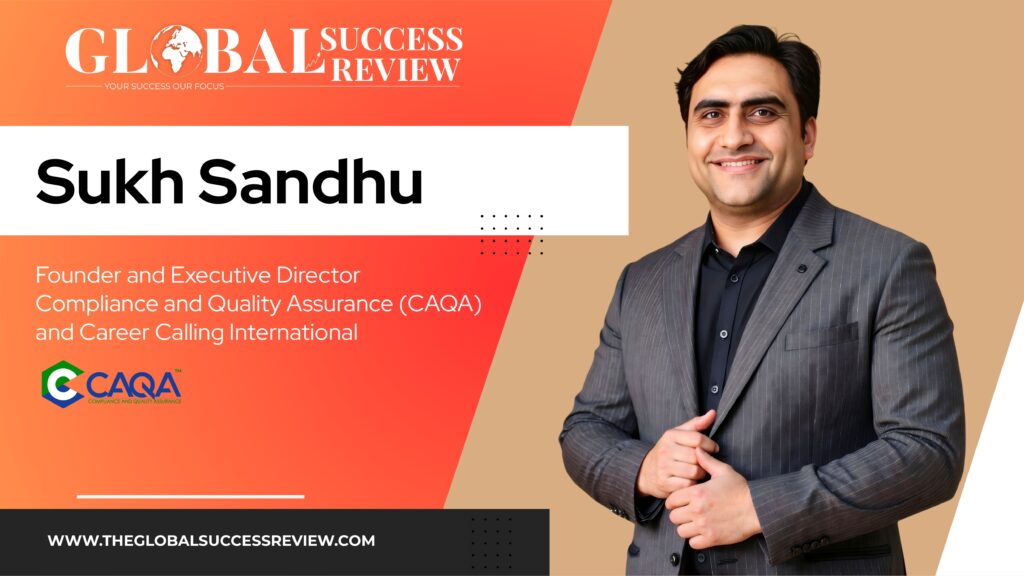
In an era where education systems are being redefined by technology, global mobility, and increasing regulatory scrutiny, few leaders stand at the intersection of vision, governance, and transformation as powerfully as Sukh Sandhu. As the Founder and Executive Director of Compliance and Quality Assurance (CAQA) and Career Calling International, Sandhu has spent more than three decades shaping the very frameworks that determine how education delivers on its promise.
While many leaders in the education sector focus on expansion, innovation, or branding, Sandhu has built his legacy around something far more fundamental, and often overlooked: integrity. In his world, compliance is not a bureaucratic necessity. It is the foundation upon which trust, quality, and sustainability are built.
Recognised as one of “The Most Inspiring Education and Training Industry Leaders in Australia to Watch in 2026,” Sandhu represents a rare breed of leader, one who not only understands the complexity of modern education systems but has actively shaped how they evolve. His influence spans continents, institutions, and disciplines, making him one of the most authoritative voices in compliance, governance, and quality assurance today.
From Haryana to the Global Stage: A Journey Rooted in Purpose
Sukh Sandhu’s journey begins in Haryana, India, where he was raised in a family deeply connected to public service. Both his parents were government employees, and this environment instilled in him an early appreciation for institutions as instruments of societal progress. Education, in particular, was not merely encouraged, it was revered.
This foundational belief would later become the guiding principle of his career.
As a young professional, Sandhu’s exposure to international systems began early. Working with a US-based organisation in his formative years, he quickly recognised that education systems across the world varied not just in structure, but in their ability to deliver on their promise. Later, his experience in Canada and eventual move to Australia approximately three decades ago further deepened this perspective.
What he observed was both inspiring and concerning.
On one hand, education had the potential to transform lives, empower communities, and drive economic growth. On the other hand, gaps in governance, inconsistent quality standards, and weak compliance frameworks often undermined that potential. It was this contradiction, the gap between what education promised and what it delivered, that defined his mission.
Rather than accepting the system as it was, Sandhu chose to rebuild it from within.
Building Institutions That Matter: The Birth of CAQA and Career Calling International
Upon entering Australia’s Vocational Education and Training (VET) sector, Sandhu identified a critical gap. While many institutions were passionate about delivering education, they struggled to navigate the increasingly complex regulatory landscape.
Compliance was often treated as an afterthought, something to address during audits rather than embed into daily operations.
Sandhu saw an opportunity where others saw complexity.
By founding Compliance and Quality Assurance (CAQA) and Career Calling International, he created organisations that would go on to become cornerstones of compliance excellence and professional development in the education sector.
Under his leadership, these organisations evolved into a multi-division enterprise, offering services that span compliance consultancy, training resources, governance frameworks, and digital innovation. With over 77,900 resources and tools developed, CAQA has become one of the most comprehensive providers of compliance solutions in Australia and beyond.
But Sandhu’s vision extended beyond services.
He sought to change how the sector thinks about compliance.
Redefining Leadership in Regulated Environments
At the heart of Sandhu’s success lies a leadership philosophy that is both simple and profound:
accountability, empathy, and evidence.
In highly regulated sectors like VET and higher education, leaders often face a tension between operational efficiency and regulatory obligation. Many choose to treat compliance as a cost centre, an unavoidable expense to be minimised.
Sandhu rejects this mindset entirely.
For him, compliance is not a burden. It is the backbone of institutional integrity.
His leadership approach, what he describes as a “systems-first, people-always” philosophy, ensures that every framework, policy, and procedure serves a dual purpose: meeting regulatory standards while enhancing organisational effectiveness.
This balance is critical.
Too often, institutions either over-engineer compliance systems that hinder operations or underinvest in them, exposing themselves to regulatory risk. Sandhu’s approach ensures that compliance becomes a driver of excellence rather than an obstacle to it.
Equally important is his emphasis on transparency. In a field where credibility is everything, Sandhu leads by example, embracing audits, publishing insights, and addressing governance challenges head-on.
In doing so, he has redefined what it means to lead in a regulated environment.
“Compliance Is a Mirror of Values”: A Philosophy That Shapes Institutions
One of Sandhu’s most powerful insights is his assertion that “compliance is a mirror of values.”
While mission statements and strategic plans often reflect an organisation’s aspirations, compliance documents reveal its reality. Assessment validation records, complaints handling procedures, and trainer supervision protocols provide a clear picture of what an institution truly prioritises.
This perspective has profound implications.
For Sandhu, building sustainable educational institutions requires alignment between values, systems, and daily practices. When these elements are aligned, compliance becomes a natural outcome rather than a forced exercise.
He has witnessed both ends of the spectrum.
Institutions with beautifully articulated visions that fail under regulatory scrutiny because their values are not embedded in practice. And smaller providers with limited resources that achieve exceptional quality because their leadership genuinely believes in what they deliver.
The difference, he argues, lies not in scale or funding, but in authenticity and alignment.
A Career Defined by Milestones, and Meaning
Sandhu’s professional journey is marked by a series of milestones that reflect both ambition and impact.
From his early work in web development and training with a US-based organisation to his roles as CEO of international colleges and National Compliance and Quality Assurance Manager across RTOs, TAFEs, and universities, each step has contributed to a deep, multi-dimensional understanding of education systems.
His experience with the Australian Skills Quality Authority (ASQA) as a Business Systems Project Official provided invaluable insight into regulatory processes, further strengthening his ability to bridge the gap between institutions and regulators.
Beyond organisational leadership, Sandhu has also made significant contributions to the sector through thought leadership and innovation.
As the Editor-in-Chief of VET Sector Magazine, he has built a platform that reaches over 100,000 readers, providing critical analysis of regulatory developments and industry trends. His creation of Sukh Radio, Australia’s first online Hindi and Punjabi radio station, reflects his commitment to cultural connection and community engagement.
Each achievement, however, is part of a larger narrative.
For Sandhu, success is not measured by titles or accolades, but by the scale of impact, the number of institutions strengthened, the quality of education improved, and the lives transformed.
The Power of Lifelong Learning
If there is one aspect of Sandhu’s profile that stands out as extraordinary, it is his commitment to lifelong learning.
Holding 10 Master’s degrees across disciplines such as law, IT, compliance, risk management, marketing, and education, Sandhu exemplifies the very principle he advocates.
But his pursuit of knowledge is not about credentials.
It is about interdisciplinary insight.
Each field he studies enhances his understanding of others. Law sharpens his approach to compliance. IT informs his perspective on data and governance. Migration law deepens his understanding of international education pathways.
This holistic approach enables him to address complex challenges with a level of depth and nuance that few can match.
As a doctoral candidate researching compliance and governance using Dialogical Processes Theory, Sandhu continues to push the boundaries of knowledge in his field.
His message is clear:
to lead in education, one must remain a student.
Lessons from the Frontlines of Education
Having worked across every layer of the education system, Sandhu has distilled his experience into three key lessons.
First, quality is a collective responsibility. The actions of one provider can impact the credibility of the entire sector. Maintaining standards requires a shared commitment to integrity.
Second, compliance and quality are inseparable. While it is possible to be compliant without being excellent, true excellence cannot exist without compliance.
Third, people matter more than systems. Even the most sophisticated frameworks will fail without capable, committed professionals to implement them.
These insights underpin his work and inform his approach to every project, partnership, and initiative.
Challenges That Shaped a Leader
No career of this magnitude is without challenges.
For Sandhu, one of the most persistent has been the sector’s historical reluctance to treat compliance as a strategic function. Changing this mindset required not only expertise but also patience, persistence, and proof.
Another challenge has been protecting intellectual property in an industry where replication is common. With tens of thousands of resources developed, safeguarding innovation has required both legal and strategic measures.
Perhaps the most complex challenge, however, has been maintaining a critical voice while sustaining professional relationships.
As a thought leader, Sandhu has not shied away from questioning regulatory approaches or advocating for reform. While this has occasionally created friction, he remains committed to the belief that honest critique is essential for progress.
Driving Innovation in a Transforming Sector
Today, Sandhu’s work is focused on addressing two major forces shaping the future of education:
regulatory transformation and technological disruption.
The implementation of the Standards for RTOs 2025 marks a significant shift from documentation-based compliance to outcomes-focused quality assurance. This requires institutions to demonstrate not just that they have policies, but that those policies deliver real results.
At the same time, the rise of artificial intelligence is redefining how education is delivered, assessed, and monitored.
Sandhu is at the forefront of both developments.
Through CAQA, he is helping institutions transition to the new standards while developing AI governance frameworks that ensure responsible adoption. His work emphasises that innovation must be accompanied by integrity, transparency, and accountability.
Common Gaps, and How to Address Them
Drawing from thousands of audits, Sandhu identifies recurring gaps in the sector.
The most significant is the disconnect between documented systems and actual practice. Many institutions invest heavily in policies but fail to embed them into daily operations.
Other critical gaps include insufficient assessment validation, lack of trainer currency, and weak governance frameworks.
The solution, he argues, lies in integration and self-assurance.
Compliance must be embedded into workflows, validation must be continuous, and institutions must develop the ability to monitor and improve themselves proactively.
The Future of Education: Convergence and Transformation
Looking ahead, Sandhu envisions a future defined by convergence.
The boundaries between domestic and international education, traditional qualifications and micro-credentials, and regulation and technology will increasingly blur.
Key trends include:
- The rise of AI-driven education systems
- Increased use of data analytics in compliance and governance
- Growth of skills-first hiring models
- Adoption of blockchain-based digital credentials
- Greater global harmonisation of qualification frameworks
For institutions, this presents both opportunity and challenge.
Success will depend on their ability to adapt, innovate, and maintain integrity in an increasingly complex environment.
Future-Ready Leadership: A New Standard
In Sandhu’s view, the leaders who will shape the future of education are those who embrace both change and responsibility.
They are leaders who:
- Ask difficult questions
- Build systems that endure
- Invest in people
- Share knowledge openly
- Treat compliance as a commitment, not a constraint
Above all, they understand that education is not just an industry; it is a public trust.
A Legacy of Impact, and a Vision for the Future
Sukh Sandhu’s impact extends far beyond individual institutions or regulatory frameworks.
It is reflected in every learner who receives a qualification that genuinely represents their skills. In every provider that achieves sustainable compliance. In every professional who gains the tools and knowledge to contribute meaningfully to the sector.
As education continues to evolve, the need for leaders who can navigate complexity with clarity and integrity has never been greater.
Sandhu’s work serves as both a blueprint and an inspiration.
He has shown that compliance, when approached with vision and purpose, can become a force for transformation, elevating not just institutions, but the entire education ecosystem.
And as the world looks toward the future of education, one thing is certain:
Leaders like Sukh Sandhu will not just adapt to change.
They will define it.