In a business world defined by rapid technological disruption, shifting geopolitical realities, and the transformative rise of artificial intelligence, leadership is being redefined. Organizations no longer seek executives who simply manage operations. They need leaders who can inspire trust, build resilient teams, and convert strategic vision into measurable business outcomes.
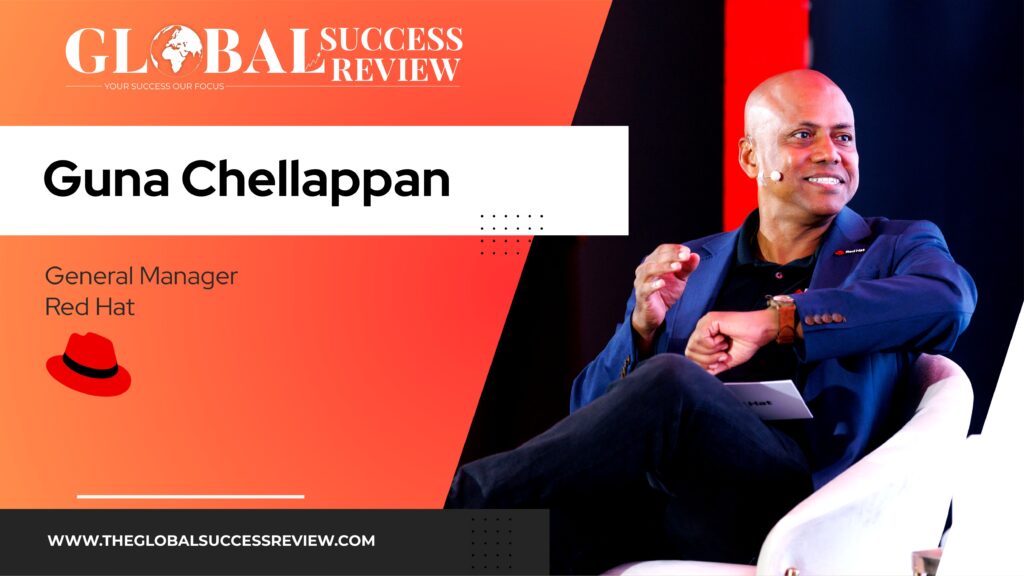
Among the leaders who exemplify this rare combination is Guna Chellappan, General Manager of Red Hat in Singapore.
With more than three decades of experience spanning enterprise technology, ecosystem development, and military service, Guna has built a reputation as a disciplined strategist and people-centered leader. Under his stewardship, Red Hat Singapore has tripled its business since the beginning of Covid in 2020, an achievement made even more remarkable by retaining and developing the same core team throughout this journey.
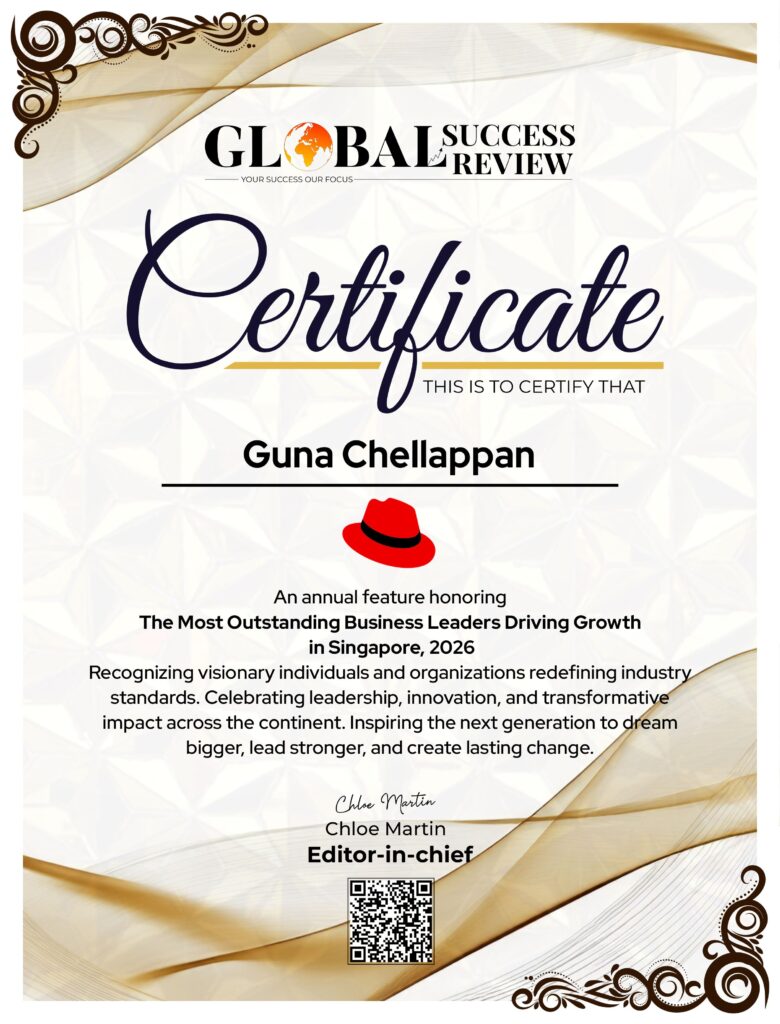
For his exceptional contributions to business growth, technology leadership, and Singapore’s innovation ecosystem, The Global Success Review Magazine proudly recognizes Guna Chellappan as one of The Most Outstanding Business Leaders Driving Growth in Singapore, 2026.
A Leader Shaped by Two Powerful Careers
Some leaders are forged through corporate experience. Others are shaped by service.
Guna Chellappan has had the privilege of both.
Over the past 30 years, he has held leadership roles across some of the world’s most respected technology organizations, including Oracle Corporation, IBM, JDA Software, and Red Hat.
In parallel, he served for 35 years as a National Serviceman in the Singapore Armed Forces Reserves, where he developed the principles of discipline, accountability, and mission-oriented leadership that continue to guide him today.
“The military taught me that leadership is not about rank or hierarchy,” Guna explains. “It is about responsibility, clarity of purpose, and creating trust in environments where people must rely on one another completely.”
This dual-track career gave him a unique perspective: the operational rigor of the military combined with the commercial realities of global enterprise technology.
The Power of Level 5 Leadership
Among the many influences on Guna’s leadership philosophy, one framework resonates deeply: the concept of Level 5 Leadership, introduced by Jim Collins in the bestselling book Good to Great.
Level 5 leaders combine two qualities often seen as opposites:
- Personal humility
- Fierce professional will
This philosophy is evident throughout Guna’s leadership style.
He places the organization’s purpose above personal recognition. He accepts accountability when challenges arise. He credits his teams for success. Most importantly, he builds leaders who can achieve even greater success after him.
For Guna, leadership is not about being indispensable. It is about creating a system and a culture that thrive without you.
Leading Red Hat Through Extraordinary Times
Guna took over as General Manager of Red Hat Singapore during one of the most uncertain periods in recent history.
The COVID-19 pandemic disrupted markets, changed workplace dynamics, and forced leaders to build culture while operating remotely.
Transitioning from a broad Asia-Pacific role to a highly localized market leadership position required a more hands-on approach.
“During COVID, I had to be deeply involved in building the team, even while safe-distancing limited in-person interaction,” he recalls.
Rather than allowing uncertainty to dilute momentum, Guna used the period to strengthen alignment, establish shared values, and build a common purpose.
The result was a high-performing organization capable of delivering sustained growth in a highly competitive market.
A Recognition Rooted in People and Customers
Being named one of Singapore’s most outstanding business leaders is meaningful to Guna, not as a personal accolade, but as validation of a philosophy he has practiced for decades.
“It is an endorsement of a business strategy strongly focused on people and customers.”
This perspective reflects a timeless truth: organizations achieve extraordinary results when they invest deeply in their people and remain relentlessly committed to customer success.
For Guna, commercial performance is not separate from culture. It is a direct consequence of it.
Building High-Performance Teams Through Trust
Many leaders speak about empowerment. Guna operationalizes it.
He believes that people perform at their highest level when they feel trusted, supported, and fully accountable for their work.
His role as a leader is twofold:
- Provide “air cover” when challenges arise.
- Ensure team members receive recognition when success is achieved.
This approach creates psychological safety while reinforcing ownership.
“When people know you will stand with them during difficult moments, they are willing to take bigger responsibilities and deliver beyond expectations.”
That trust transforms a group of capable individuals into a cohesive, high-performing team.
Measuring Success Beyond Revenue
While financial performance is critical, Guna views one metric as especially meaningful:
How well the organization performs when you are no longer at the helm.
This perspective reflects his long-term commitment to succession planning and leadership development.
A truly successful leader creates structures, talent, and culture that continue to thrive independently.
For Guna, this is leadership’s highest form of impact.
The Asia-Pacific Challenge: Complexity as Opportunity
Managing Asia-Pacific markets is among the most demanding assignments in global business.
The region spans diverse languages, cultures, regulatory frameworks, and stages of economic development.
Having led markets across Latin America, the Middle East, and Eastern Europe, Guna considers Asia-Pacific the most complex.
“One size does not fit all.”
Success requires balancing a common strategic framework with market-specific customization.
For example:
- Australia and New Zealand are cloud-first, vendor-led markets.
- Japan and South Korea rely heavily on local partner ecosystems.
- Emerging Southeast Asian markets often require different commercial and technical approaches.
Guna’s ability to adapt strategy while preserving consistency has been central to his success.
The Strategic Importance of Partner Ecosystems
Throughout his career, Guna has seen firsthand that technology companies do not succeed alone.
Partners play a critical role in localization, implementation, engineering, and customer engagement.
His experience managing Oracle’s APAC ecosystem reinforced the value of strong partnerships.
He believes successful ecosystems are built on two pillars:
1. Trust and Consistency
Partners invest when programs, policies, and engagement models remain stable over time.
2. Profitability
Partners scale when they see a clear path to sustainable returns.
“Relationships matter, but partners ultimately invest where they can build profitable, predictable businesses.”
This pragmatic understanding has enabled Guna to cultivate ecosystems that accelerate market growth.
Transformational Growth at Red Hat Singapore
Under Guna’s leadership, Red Hat Singapore has achieved remarkable growth:
- Tripled the business in six years
- Retained the same core team throughout the journey
- Deepened strategic relationships with customers and partners
These outcomes reflect more than strong sales execution.
They demonstrate the power of a consistent leadership philosophy built on trust, discipline, and customer-centricity.
Why Open Source Matters More Than Ever
Red Hat has long championed the transformative potential of open-source technologies.
According to Guna, open source is especially relevant today as organizations confront geopolitical uncertainty, regulatory complexity, and the rise of AI.
Open-source platforms offer:
- Innovation at scale
- Operational flexibility
- Freedom from vendor lock-in
- Transparency and security
- Sovereign control over technology decisions
In a world where digital infrastructure increasingly underpins national competitiveness, these advantages are strategic.
Red Hat’s Leadership in Hybrid Cloud
Red Hat is widely recognized as a leader in hybrid cloud solutions, serving industries such as:
- Financial services
- Telecommunications
- Government and Public sector
- Healthcare
- Critical infrastructure
Its open hybrid cloud strategy enables organizations to build and run applications consistently across on-premises, public cloud, and edge environments.
For enterprises managing mission-critical workloads, this flexibility is essential.
AI, Automation, and the Enterprise of the Future
The emergence of generative AI and agentic AI represents one of the most significant shifts in enterprise technology.
Guna sees automation and AIOps as foundational capabilities that support this transformation.
These technologies enable organizations to build intelligent, scalable, and resilient platforms that can support increasingly complex AI workloads.
However, Guna emphasizes that innovation must be matched by operational readiness.
“Many organizations are investing heavily in AI, but fewer are paying equal attention to resilience and governance.”
This balanced view distinguishes sustainable transformation from short-term experimentation.
The Talent Imperative
Technology transformation is fundamentally a “people” challenge.
Organizations adopting AI-driven automation must attract, develop, and retain talent capable of operating in this new environment.
Guna compares this to managing technical debt.
Just as outdated systems must be modernized, the workforces must also be continuously reskilled.
Companies that invest in talent development will be best positioned to harness AI responsibly and competitively.
Governance and Guardrails
AI presents extraordinary opportunities, but also new risks.
Guna believes enterprises must strengthen governance frameworks as they scale automation.
Critical priorities include:
- Risk management
- Compliance controls
- Security
- Ethical AI guardrails
- Business continuity planning
Without these safeguards, organizations risk undermining trust and resilience.
Singapore’s Opportunity in the AI Era
As one of Asia’s most trusted business hubs, Singapore is uniquely positioned to lead the next wave of AI-driven growth.
Guna points to several competitive advantages:
- Strong legal and regulatory systems
- Global reputation for trust
- World-class infrastructure
- Strategic geographic location
- Deep government support for innovation
By leveraging these strengths and investing in talent , Singapore can become a major exporter of AI-driven innovation to the world.
Leadership Beyond the Corporate World
Guna’s influence extends beyond Red Hat.
He serves as:
- Board Member, Sentosa Development Corporation
- Chief of Staff, 21 SIB, Singapore Armed Forces
- Advisory Committee Member, Nanyang Polytechnic School of IT
- Vice President, SCS Cloud Chapter
- Co-Chair, SGTech AI-Cloud & Data Chapter
He was also recognized as a Fellow of the Singapore Computer Society in 2025 and received the National Commendation Medal (Military) in 2017.
These appointments reflect his commitment to shaping Singapore’s broader technology ecosystem.
Lessons from Military Service
Military leadership teaches lessons that transcend industries.
In environments where stakes are high and resources are constrained, leaders learn to:
- Build trust quickly
- Communicate clearly
- Make decisions under pressure
- Inspire shared purpose
- Develop resilience
Guna credits these experiences with shaping his leadership instincts and reinforcing the importance of serving others.
Humility as a Competitive Advantage
In an era often dominated by personal branding, Guna’s leadership style stands out for its humility.
He focuses on:
- Organizational purpose over personal recognition
- Team success over individual acclaim
- Long-term sustainability over short-term visibility
This humility does not diminish ambition. It channels ambition toward outcomes that endure.
Leading by Example
Guna believes leaders must model the behaviors they expect from others.
Whether navigating uncertainty, building partnerships, or driving transformation, he leads from the front.
This hands-on approach builds credibility and inspires confidence.
People follow leaders who demonstrate commitment through action.
A Philosophy of Service
At its core, Guna’s leadership philosophy is grounded in service.
A leader’s role is to create the conditions in which others can succeed.
That means:
- Removing obstacles
- Providing support
- Recognizing contributions
- Developing future leaders
- Protecting the team during difficult times
When leaders embrace service, performance follows naturally.
Technology as an Enabler of Freedom
One of Guna’s strongest convictions is that technology should expand freedom rather than restrict it.
Open-source innovation aligns with this principle by giving organizations greater control over their technology choices.
This operational freedom becomes increasingly important as businesses navigate changing market conditions and strategic priorities.
The Future of Enterprise Technology
Looking ahead, Guna sees several forces shaping the future:
- Agentic AI
- Quantum computing
- Sovereign platforms
- Open-source innovation
- Workforce transformation
Organizations that succeed will combine innovation with trust, agility, and operational discipline.
Advice to Emerging Leaders
Drawing on lessons from both military and corporate leadership, Guna offers practical guidance:
- Stay humble.
- Put your organization’s purpose first.
- Build trust consistently.
- Invest in your people.
- Prepare successors.
- Adapt strategy to local realities.
- Balance innovation with resilience.
Leadership, he believes, is a responsibility, not a title.
Legacy: Building Teams That Outperform Expectations
When asked which achievement matters most, Guna points not only to revenue growth, but to building a team that has stayed together and achieved extraordinary results over time.
That continuity reflects something deeper than business success.
It reflects trust.
It reflects culture.
It reflects leadership.
A Final Word
Guna Chellappan’s story is a compelling reminder that exceptional leadership is rooted in humility, discipline, and service.
In an era of rapid change, he has demonstrated that sustainable growth comes from investing in people, empowering teams, and staying steadfast in purpose.
By combining military rigor with business insight and a deep belief in open innovation, Guna continues to shape not only Red Hat’s success, but also Singapore’s role in the future of technology.
For organizations seeking to navigate the next wave of transformation, his example offers a powerful blueprint: lead with humility, build with trust, and grow with purpose.