The Adaptability Principle: Building Organisational DNA for a World of
Continuous Change.
In today’s business landscape, uncertainty is no longer an occasional disruption, it has become the operating environment itself. Markets evolve faster than strategic plans, technological advancements reshape industries overnight, and organizations are continuously challenged by economic shifts, geopolitical realities, digital transformation, workforce expectations, and artificial intelligence.
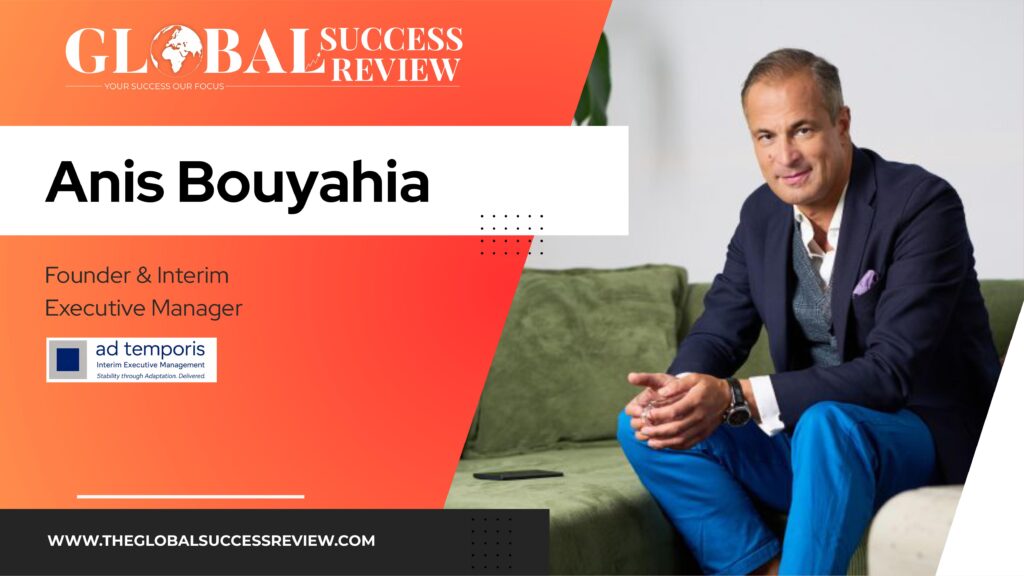
While many organizations continue investing heavily in transformation programs, Anis Bouyahia believes that the real competitive advantage lies elsewhere.
For nearly two decades, the Swiss-based Interim Executive Manager has helped international organizations navigate some of their most complex moments, from restructuring and operational stabilization to post-merger integration, supply chain transformation, and strategic organizational change. Throughout more than 70 executive mandates across 25 international clients in over 15 countries, he has witnessed one consistent truth.
Transformation alone does not create resilience.
Organizations become truly resilient only when they develop the capability to adapt continuously.
This philosophy has become the foundation of Anis Bouyahia’s leadership approach and the defining principle behind ad temporis | Interim Management, the international consulting practice he founded in 2009. Rather than focusing on temporary organizational fixes, his work centers on building structures that remain effective long after an assignment has concluded.
His philosophy is summarized in a simple yet powerful statement:
“Stability through Adaptation.”
This perspective has earned international recognition, including the Europe Interim Management Award 2025, recognition among the Top 30 Companies to Watch in 2026, and growing influence across Europe, the Middle East, and international executive leadership communities.
Yet, despite these accomplishments, Anis Bouyahia measures success differently.
“The objective is never to become indispensable,” he explains. “The objective is to leave behind an organization that is stronger, more adaptable, and better prepared for whatever comes next.”
That belief reflects not only his leadership philosophy but also the evolving role of executive leadership itself.
Beyond Managing Change
For decades, organizational transformation has largely been viewed as a series of projects. Companies launch initiatives, appoint steering committees, invest in consultants, implement new technologies, and define transformation roadmaps with clear beginning and end dates.
However, according to Bouyahia, this project-based understanding of transformation no longer reflects today’s business reality.
Organizations now operate in a world where disruption is continuous. Market expectations evolve faster than organizational structures, technological innovation accelerates decision-making, and competitive advantages have increasingly shorter life cycles.
Under these circumstances, organizations cannot rely solely on periodic transformation initiatives.
They must become adaptable by design.
Bouyahia distinguishes clearly between transformation and adaptation.
Transformation is an initiative.
Adaptation is a permanent organizational capability.
The true purpose of any successful transformation is therefore not merely implementing change but embedding the ability to adapt into the organization’s operational DNA.
This distinction fundamentally changes how executive leaders should think about organizational success.
Rather than asking whether a transformation project has been completed successfully, leaders should ask whether the organization has become more capable of evolving independently after the project concludes.
That capability, according to Bouyahia, determines long-term competitiveness.
The Three Dimensions of Organizational Adaptation
Years of international executive leadership have convinced Bouyahia that sustainable adaptation depends upon three interconnected dimensions.
The first is Leadership.
Leadership extends far beyond setting strategic direction. It shapes organizational behavior through decision-making, accountability, transparency, trust, and the willingness to continuously learn.
Leaders create the conditions in which adaptation either becomes possible or remains impossible.
The second dimension is the Operating Model.
Organizations often focus on organizational charts while overlooking how work actually gets accomplished. Governance structures, decision-making mechanisms, cross-functional collaboration, operational processes, and execution models collectively determine how effectively an organization responds to changing circumstances.
Without an adaptive operating model, even the strongest strategic vision struggles during execution.
The third dimension is the Organization itself.
People, technology, culture, competencies, organizational structures, and capability development must evolve together rather than independently. Adaptability emerges when these elements reinforce one another instead of operating in isolation.
Only when leadership, operating models, and organizational capabilities align can sustainable transformation occur.
This integrated perspective explains why Bouyahia consistently emphasizes systems rather than isolated initiatives.
Technology alone cannot solve organizational problems.
Culture alone cannot create resilience.
Processes alone cannot ensure sustainable growth.
Real adaptation emerges through alignment.
Technology Is Not the Starting Point
Artificial Intelligence has become one of the defining business conversations of this decade. Across industries, organizations are investing heavily in AI technologies, automation, predictive analytics, and digital transformation programs.
Yet Bouyahia believes that many organizations are approaching AI from the wrong direction.
He argues that AI should not primarily be viewed as a technology project.
Instead, organizations become AI-ready only when they possess sufficient organizational adaptability.
Leadership must understand how AI influences decision-making.
Operating models must evolve to integrate intelligent automation.
Employees require new competencies and confidence to collaborate effectively with emerging technologies.
Governance frameworks must ensure responsible implementation.
Without these organizational foundations, AI remains another isolated technology investment rather than a genuine business capability.
Technology may accelerate transformation, but it cannot replace organizational readiness.
In Bouyahia’s experience, organizations often overestimate technology while underestimating the leadership discipline required to integrate innovation into everyday business operations.
This explains why many digital transformation initiatives struggle, not because the technology fails, but because the organization has not yet developed the capability to absorb continuous change.
For Bouyahia, AI readiness is ultimately a leadership challenge before it becomes a technological one.
Quiet Leadership. Stability through Adaptation
Unlike traditional executives who often seek visibility, interim executive leadership operates differently.
Its purpose is not personal recognition.
Its purpose is measurable organizational outcomes.
Throughout international restructuring assignments, operational stabilization programs, mergers, acquisitions, and transformation mandates, Bouyahia has consistently demonstrated that effective leadership frequently happens away from the spotlight.
Thousands of carefully coordinated decisions.
Structured stakeholder communication.
Clear governance.
Risk management.
Operational discipline.
Knowledge transfer.
These are the often invisible elements that determine whether transformation succeeds or fails.
This quiet style of leadership has become one of his defining characteristics.
Rather than creating dependency, he builds capability.
Rather than managing personalities, he strengthens systems.
Rather than delivering temporary improvements, he creates sustainable organizational foundations capable of supporting future growth.
It is a philosophy rooted not in visibility, but in long-term organizational value.