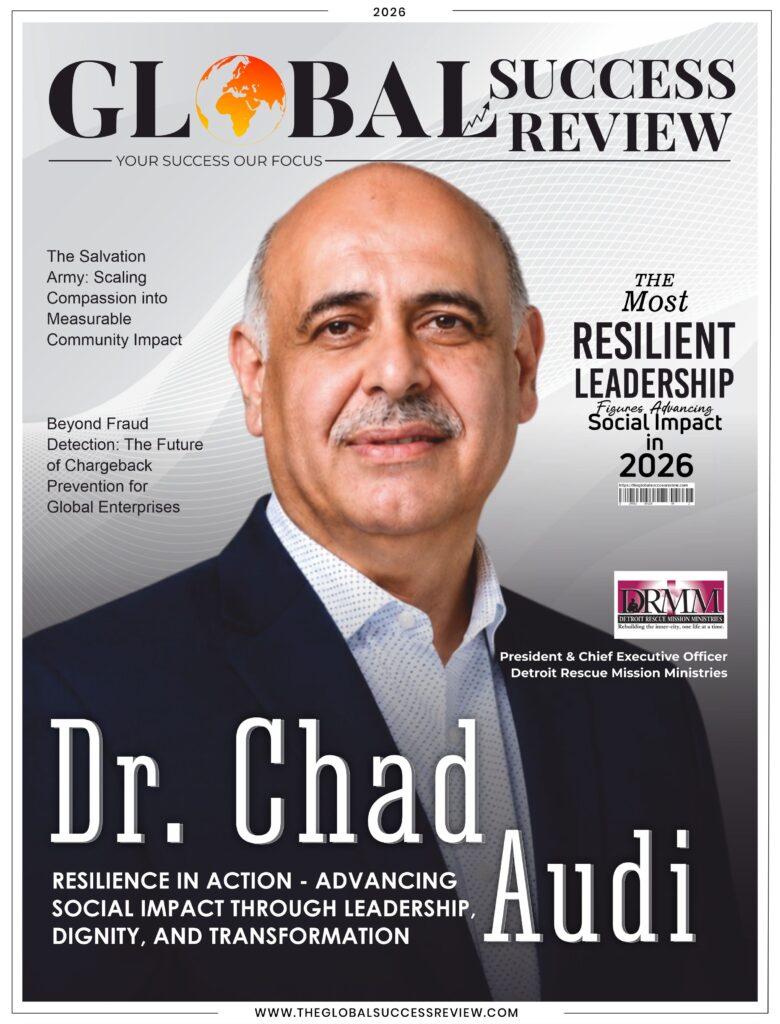
The Most Resilient Leadership Figures Advancing Social Impact in 2026
“See the potential in people, develop it, and leave them stronger than you found them.”
In a world where homelessness, addiction, poverty, mental-health challenges, unemployment, and social vulnerability continue to intersect, meaningful change requires more than compassion alone. It requires resilient leadership, the ability to confront difficult realities, build systems that create opportunity, and continue believing in human potential when circumstances suggest otherwise.
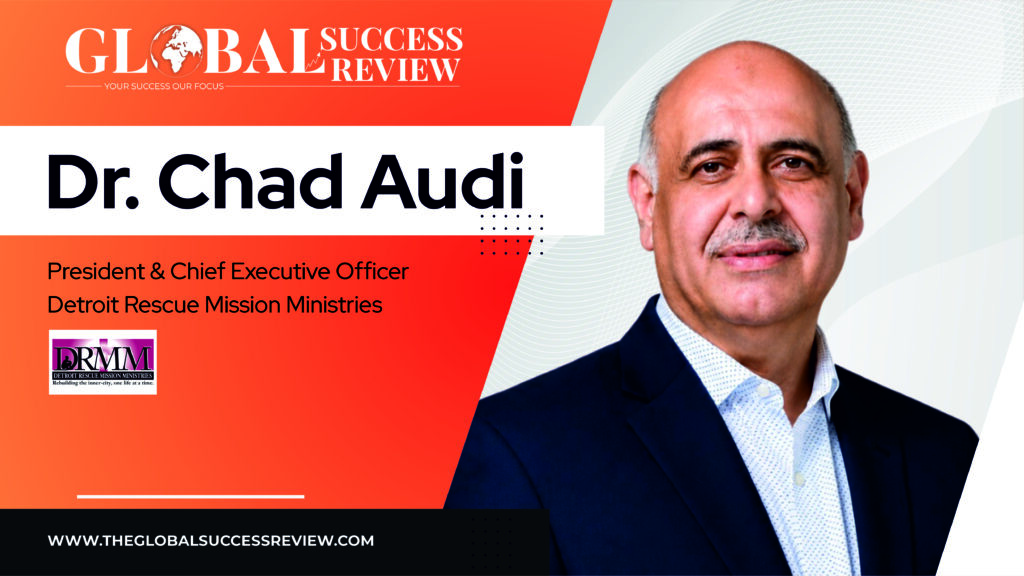
Few leaders embody this philosophy more distinctly than Dr. Chad Audi, President & Chief Executive Officer of Detroit Rescue Mission Ministries (DRMM). For nearly three decades, Dr. Audi has dedicated his professional life to serving individuals and families navigating some of life’s most difficult circumstances. His leadership journey reflects a powerful belief: people should never be defined by the hardest chapter of their lives.
For Dr. Audi, service began as something deeply personal. Growing up amid war taught him how quickly security and stability can disappear and how profoundly people need hope, dignity, and someone willing to stand beside them. Those early experiences shaped a philosophy that has remained central throughout his career: hardship may change circumstances, but it does not diminish human worth.
When he joined Detroit Rescue Mission Ministries, he discovered that the people he encountered- men, women, children, veterans, families, and individuals in recovery, shared a universal need to be seen, respected, and given an opportunity to move forward.
“What began as a profession became a calling,” he reflects.
That calling has helped shape the evolution of DRMM into a broad humanitarian network addressing not only immediate needs, but also the underlying conditions that contribute to long-term instability.
From Emergency Response to Pathways of Transformation
Under Dr. Audi’s leadership, Detroit Rescue Mission Ministries has expanded substantially, growing from three locations to 22 and developing more than 65 programs and services. The organization has also experienced significant financial growth, with annual revenue increasing from approximately $4 million to $25 million, alongside substantial funding secured to support its expanding mission.
Yet Dr. Audi emphasizes that organizational growth is not the objective by itself.
“The vision has always been to meet people where they are while refusing to leave them there.”
That philosophy captures the fundamental difference between temporary relief and transformative social impact. A meal can address hunger today. A shelter can provide safety tonight. But sustainable transformation requires a broader pathway: housing, recovery, mental-health support, employment, education, transportation, relationships, and the confidence to build a different future.
Today, DRMM serves more than 2,400 people and provides at least 4,500 meals each day. Its service portfolio encompasses emergency shelter, addiction treatment and recovery, behavioral health support, veterans’ services, returning-citizen support, family and youth programs, workforce development, housing, food distribution, community outreach, and other community-based initiatives.
For Dr. Audi, however, statistics tell only part of the story.
The deeper measure of success is found in families reunited, children experiencing safety, individuals returning to employment, people moving into permanent housing, and those recovering the belief that their lives still have value and possibility.
Seeing the Whole Person
One of Dr. Audi’s defining leadership principles is the conviction that social challenges cannot be addressed effectively when people are reduced to individual problems.
A person may arrive seeking food or shelter, but the underlying circumstances could include trauma, addiction, mental-health challenges, unemployment, family separation, transportation barriers, legal difficulties, or the loss of identification and financial stability.
Treating only the immediate symptom can leave the individual vulnerable to returning to the same crisis.
DRMM therefore approaches service through interconnected pathways that can include assessment, individualized planning, case management, behavioral-health and recovery support, housing assistance, life-skills development, education, employment preparation, transportation, and community referrals.
This holistic philosophy also recognizes the importance of collaboration. No single nonprofit can solve homelessness or poverty independently. Government agencies, healthcare providers, employers, schools, faith communities, foundations, donors, volunteers, and people with lived experience all have roles to play.
For Dr. Audi, effective partnerships are not about institutional visibility. They are about coordinating resources around the journey of the person being served.
Restoring Neighborhoods, Restoring Possibility
Some of the most defining moments of Dr. Audi’s leadership demonstrate how social impact can extend beyond traditional nonprofit programming.
In 2009, vacant houses surrounding schools represented a serious safety concern for children and families. Rather than viewing the problem as isolated to abandoned properties, DRMM helped mobilize approximately 800 volunteers to board around 100 homes and clean the surrounding neighborhood.
A subsequent effort addressed roughly 120 additional homes, removed five dangerous structures, and restored surrounding streets and lots. DRMM later acquired and rehabilitated 54 structurally sound homes.
What began as a neighborhood safety initiative evolved into a broader strategy involving housing, workforce development, and community renewal.
The experience reinforced a lesson that has remained central to Dr. Audi’s leadership: visible problems often contain hidden opportunities.
Communities frequently possess enormous reserves of compassion and capability. What they need is a credible vision, practical organization, and an invitation to participate.
The organization’s housing impact has continued through initiatives that have helped provide 62 permanent homes, furnish approximately 100 homes, donate 40 vehicles, and complete repairs on 25 community homes.
These efforts demonstrate that social impact can be both humanitarian and structural, helping individuals while strengthening the environments in which they live.
Resilience Rooted in Faith and Stewardship
Leading a large humanitarian organization inevitably brings difficult decisions. Economic downturns, rising costs, public-health emergencies, changing regulations, workforce pressures, aging facilities, and fluctuating funding can create extraordinary operational challenges.
Dr. Audi believes resilience does not mean pretending that hardship does not exist.
Instead, resilience means continuing forward with wisdom, faith, adaptability, and purpose.
His faith serves as a foundation for this perspective. He believes every person is created in the image of God and therefore possesses dignity that circumstances cannot erase.
That conviction profoundly influences his approach to leadership.
He does not view a person experiencing homelessness, addiction, incarceration, fear, or anger simply as a problem to be managed. He sees a human being whose value remains intact and whose potential may not yet have been fully recognized.
At the same time, Dr. Audi believes compassion must coexist with accountability.
“Compassion without accountability can create dependency, while accountability without compassion can crush hope.”
For him, effective humanitarian leadership requires both.
It means offering support while encouraging responsibility, providing opportunities while establishing expectations, and extending compassion without removing a person’s agency.
Measuring What Truly Matters
Modern organizations are increasingly expected to demonstrate measurable outcomes, and Dr. Audi embraces this responsibility.
Meals served, beds provided, and people enrolled in programs are important indicators of organizational activity. But they do not fully answer the question of whether lives are changing.
DRMM therefore considers outcomes such as stable housing, sustained recovery, employment, income growth, treatment completion, improved health, family reunification, educational progress, reduced recidivism, and continued stability after program completion.
In earlier transitional-housing work, an approximately 84 percent success rate three years after discharge reinforced Dr. Audi’s belief in sustained support rather than short-term intervention alone.
Yet he also values qualitative transformation.
Does a person feel safe? Has trust been restored? Can a family manage its finances? Does an individual have healthy relationships and a realistic plan for the next challenge?
For Dr. Audi, meaningful impact combines measurable progress with human transformation.
Success does not require perfection. It means greater capacity, greater choice, and increasing independence.
Leadership That Develops People
Dr. Audi’s leadership philosophy extends beyond the people served by DRMM. He is equally committed to developing employees, volunteers, partners, and future leaders.
His approach can be summarized in one principle: see potential, develop it, and leave people stronger than you found them.
He views leadership as stewardship rather than ownership. A title creates responsibility, but character earns trust.
This perspective has also shaped his approach to organizational talent. Dr. Audi recalls an employee who struggled in an accounting role. Rather than immediately concluding that the individual lacked ability, leadership explored a different environment. After moving into a more people-centered position, previously hidden strengths emerged and the employee’s leadership potential became visible.
The lesson is relevant far beyond the nonprofit sector.
Sometimes an individual is not failing the organization; the organization has simply placed the individual in the wrong seat.
For corporate and business leaders, Dr. Audi’s experience offers a powerful reminder to look beyond performance labels and consider whether people have been given the right environment to succeed.
Innovation With a Human Purpose
Technology and modern organizational practices are also increasingly important to DRMM’s future.
Data systems can strengthen intake, case coordination, compliance, outcome tracking, and continuity of care. Digital communication can improve connections with donors, volunteers, partners, and people seeking assistance. Technology can also support training, telehealth access, workforce preparation, and staff development.
But Dr. Audi maintains an important boundary: technology must remain a tool rather than a substitute for human care.
His guiding question is straightforward:
Does an innovation help a person receive the right support more quickly, safely, and respectfully?
This human-centered approach keeps innovation connected to mission.
The best innovation, he believes, is not necessarily the newest platform. It is the practical improvement that reduces friction, equips staff, expands access, and creates more time for meaningful personal engagement.
A Father, A Family, and the Meaning of Humanitarian Service
Among the experiences that continue to inspire Dr. Audi is the story of a devoted father caring for his daughter after she was shot at age twelve.
The daughter survived a coma but was left with significant disabilities. Her father dedicated himself to her care, demonstrating extraordinary love, sacrifice, and perseverance.
He did not seek pity. He needed an opportunity to provide his daughter with stability and dignity.
DRMM helped secure a home, a vehicle, and employment for him.
The practical resources mattered, but Dr. Audi remembers the father’s determination most of all.
The experience reinforced a central principle of his humanitarian philosophy: service is not about rescuing passive people. Often, those receiving assistance are already demonstrating extraordinary courage.
The role of an organization is to remove barriers, connect resources, and honor that determination.
Building the Next Chapter of Social Impact
Looking toward the next three to five years, Dr. Audi sees an opportunity to deepen DRMM’s impact while expanding pathways toward permanent stability.
Priorities include strengthening housing options, behavioral-health and addiction services, workforce and entrepreneurial training, veterans’ services, support for returning citizens, family-centered shelter, and programs for young adults aging out of foster care.
He also sees prevention becoming increasingly important.
Helping households stabilize before eviction, connecting vulnerable people with care before a crisis becomes chronic, and building stronger community partnerships can prevent emergencies from becoming long-term cycles.
His vision extends beyond organizational expansion. He wants proven approaches to dignity, recovery, employment, and housing to become accessible wherever they are needed.
Expansion, however, must remain responsible and mission-driven.
The objective is not simply to place the DRMM name in more locations. It is to make effective pathways to stability available to more people.
A Legacy Measured in Lives
After nearly three decades of leadership, Dr. Audi’s definition of legacy remains remarkably human.
He does not point first to buildings, budgets, programs, or organizational growth.
Instead, he speaks about people who discovered that their past did not have to determine their future.
He hopes former clients remember that someone saw their worth before they could see it themselves. He hopes communities become safer and more connected because people listened, partnered, and acted. And he hopes future DRMM leaders carry forward a culture of courage, humility, excellence, faith, and service.
His ultimate concept of legacy is multiplication.
A life restored can strengthen a family. A stabilized family can strengthen a neighborhood. A developed leader can influence countless others.
That is the deeper meaning of resilience.
For Dr. Chad Audi, resilience is not simply surviving adversity. It is transforming adversity into opportunity, turning compassion into action, and building systems that allow people to recover their dignity and reclaim their future.
His leadership offers a compelling lesson for organizations everywhere: the greatest measure of success is not how high a leader rises, but how many people become stronger because that leader chose to serve.
And perhaps that is why his guiding philosophy remains so powerful:
See the potential in people. Develop it. And leave them stronger than you found them.