
The Visionary Leaders Shaping the Global Future in 2026
Leadership Beyond Borders, Diplomacy Beyond Politics, and a Vision Rooted in Trust
In an era where geopolitical tensions dominate headlines, technological disruption is reshaping industries, and global uncertainty challenges economies, true leadership demands far more than influence. It demands vision, responsibility, and the courage to unite people around a common purpose.
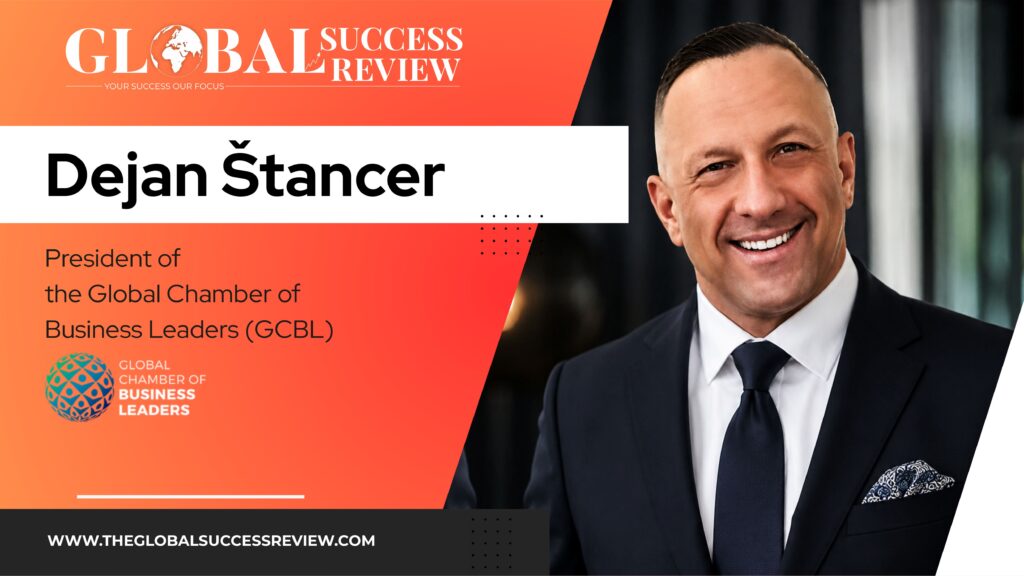
Few leaders embody these qualities as profoundly as Dejan Štancer, President of the Global Chamber of Business Leaders (GCBL), an international organization with Special Consultative Status with the United Nations Economic and Social Council (ECOSOC). As Chairman of Global Trends Magazine, an international business strategist, and a respected advocate for global cooperation, Štancer has dedicated his career to one powerful conviction, that collaboration is humanity’s greatest competitive advantage.
While many leaders focus on building organizations or expanding influence, Štancer has spent more than a decade building something far more enduring: bridges between businesses, governments, innovators, academics, diplomats, and communities across the globe.
His philosophy is refreshingly simple yet remarkably powerful.
Economic prosperity grows through cooperation. Innovation flourishes through open dialogue. Lasting peace is built not merely through political agreements but through trust, shared interests, and meaningful human relationships.
These principles have become the cornerstone of the Global Chamber of Business Leaders, the driving force behind the Global Coalition for Cooperation and Peace, and the editorial vision of Global Trends Magazine, an internationally respected publication exploring the trends shaping tomorrow’s world.
Despite his growing international recognition, Štancer rarely measures success by titles or accolades. Throughout his leadership journey, one belief remains constant: leadership exists to create opportunities for others, not to elevate oneself.
His work serves as a reminder that in a rapidly changing world, humanity’s greatest strength will never be technology alone, it will always be our ability to work together.
From Business Leadership to Global Diplomacy
Every leader’s journey begins with a defining realization.
For Dejan Štancer, that realization came through years of engaging with international institutions, policymakers, entrepreneurs, and diplomatic networks. Behind official meetings and public announcements, he discovered a more complex reality where trust often determined outcomes more than power itself.
Rather than becoming discouraged by global divisions, he became convinced that the world required more people willing to create connections where others saw conflict.
He recognized that while governments negotiate agreements, businesses establish relationships. Entrepreneurs generate opportunities where uncertainty exists, and economic collaboration naturally brings together people from different nations, cultures, religions, and political systems.
To him, commerce has no borders, innovation recognizes no nationality, and prosperity belongs to everyone willing to collaborate.
This realization inspired the creation of the Global Chamber of Business Leaders, not as another international organization, but as a global platform dedicated to strengthening cooperation among leaders committed to creating meaningful impact.
His belief remains unwavering: dialogue always leaves room for tomorrow, while conflict rarely does.
Leadership Defined by Responsibility
In today’s highly connected yet increasingly fragmented world, leadership is often confused with visibility.
Štancer offers a very different perspective.
He believes leadership does not begin with authority or position. Titles may create access, but they cannot create trust. Genuine leadership begins when individuals accept responsibility for improving the lives of others.
Throughout his career, he has consistently emphasized that leadership is not about attracting followers but about developing future leaders.
This philosophy has influenced every initiative he has helped establish.
Whether building international partnerships, strengthening business communities, or promoting responsible diplomacy, his objective has always remained the same: to create environments where collaboration enables everyone to succeed.
In his view, today’s leaders face challenges unlike any previous generation.
Rapid technological advancement, geopolitical uncertainty, declining institutional trust, climate concerns, cybersecurity threats, and artificial intelligence are reshaping the global landscape simultaneously.
These realities require leaders who think beyond quarterly reports, election cycles, or personal ambitions.
They require courage, integrity, patience, and humility.
Most importantly, they require cooperation.
History repeatedly demonstrates that civilizations advance when they collaborate and struggle when they isolate themselves.
For Štancer, cooperation is not a compromise; it is one of leadership’s greatest strengths.
Trust: The World’s Most Valuable Strategic Asset
Throughout every conversation with Dejan Štancer, one concept continually emerges.
Trust.
He believes trust is becoming the most valuable resource of the twenty-first century.
Economies rely on trust.
Financial systems rely on trust.
International diplomacy depends on trust.
Innovation succeeds only when people believe technological progress serves humanity’s best interests.
As trust declines, societies become increasingly polarized, institutions lose credibility, and constructive dialogue becomes more difficult.
For this reason, Štancer argues that responsible leadership begins with ethical decision-making.
Ethics is not merely an academic discussion or corporate slogan.
It is demonstrated through transparency, accountability, fairness, and the willingness to honor commitments even when circumstances change.
According to him, every decision either strengthens confidence or weakens it.
Leaders therefore carry a responsibility far greater than managing organizations; they shape public confidence in the future itself.
History has repeatedly shown that civilizations rarely collapse because they lack intelligence.
They decline when trust disappears.
Building Global Platforms for Dialogue
Recognizing that modern challenges cannot be solved in isolation, Štancer has invested considerable effort into creating international platforms that encourage cooperation across sectors.
The Global Chamber of Business Leaders serves as a meeting point where entrepreneurs, executives, policymakers, diplomats, researchers, innovators, and thought leaders collaborate to address global challenges collectively.
Similarly, the Global Coalition for Cooperation and Peace reflects his belief that peace is not solely a diplomatic objective but an economic necessity.
No entrepreneur dreams of instability.
No investor welcomes conflict.
No family wishes to raise children amid uncertainty.
Economic stability creates opportunity, opportunity strengthens communities, and stronger communities become the foundation of lasting peace.
For Štancer, peace is not simply the absence of war.
Peace represents education.
Innovation.
Economic development.
Security.
Hope.
It creates the conditions under which societies thrive.
Global Trends Magazine: Understanding Tomorrow Before It Arrives
Štancer’s vision extends beyond diplomacy and business leadership into global media.
As Chairman of Global Trends Magazine, he sought to create far more than another publication.
His objective was to provide meaningful context rather than simply deliver information.
In today’s digital age, millions of stories are published every day.
Yet information alone rarely explains why events matter or how they will influence the future.
Global Trends Magazine was established to bridge that gap.
The publication connects economics with geopolitics, innovation with ethics, technology with society, and business with diplomacy.
Its editorial mission encourages thoughtful discussion rather than emotional reaction, helping readers understand not only current developments but also the broader forces shaping the future.
For Štancer, wisdom, not speed, ultimately determines lasting progress.
Artificial Intelligence and the Human Future
Artificial intelligence represents one of the defining transformations of modern civilization.
Štancer approaches this technological revolution with balanced optimism.
He believes AI itself is neither inherently beneficial nor dangerous.
Like every powerful innovation throughout history, its impact depends entirely on how humanity chooses to use it.
Artificial intelligence has the potential to revolutionize healthcare, scientific research, education, productivity, and countless industries.
However, technological progress must always remain guided by ethics and human responsibility.
Technology should expand human potential, not replace human judgment.
The greatest achievement of artificial intelligence will not be measured by how many tasks it automates.
It will be measured by how effectively it enables people to solve meaningful problems and improve lives.
Technology may provide answers.
Human wisdom must continue asking the right questions.
The Business of Peace
One of Štancer’s most distinctive perspectives is his belief that business plays a far greater role in peacebuilding than many people recognize.
Successful business relationships depend upon mutual benefit.
Every commercial partnership creates connections across cultures, borders, and ideologies.
These relationships naturally encourage stability because prosperity becomes a shared objective.
Businesses create employment.
Employment generates opportunity.
Opportunity reduces despair.
Societies filled with opportunity are significantly less vulnerable to conflict.
While governments establish frameworks and institutions shape policy, businesses build practical cooperation through everyday relationships.
This interconnectedness strengthens economies while simultaneously reinforcing peace.
According to Štancer, humanity does not require fewer differences.
It requires more bridges connecting those differences.
Success Measured by Collective Progress
Although Dejan Štancer has established internationally respected organizations and initiatives, he consistently redirects recognition toward the communities that made those achievements possible.
Success, in his eyes, is never individual.
It belongs to every contributor, partner, volunteer, advisor, colleague, and supporter who believes in a shared vision.
He defines success by the positive impact created for others.
If an idea improves lives, strengthens cooperation, inspires future leaders, or creates opportunities for meaningful progress, it has already fulfilled its purpose.
This humility distinguishes his leadership style.
Rather than standing above people, he believes leaders should walk alongside them.
Perhaps that philosophy explains why colleagues consistently describe him as a leader driven by determination, perseverance, and purpose rather than personal ambition.
Even through setbacks, uncertainty, and years of relentless work, his commitment has remained unchanged.
Every challenge has become another opportunity to learn.
Every obstacle another step toward meaningful progress.
A Legacy of Cooperation
When asked how he hopes history will remember him, Dejan Štancer does not mention awards, influence, or institutional achievements.
Instead, he hopes to be remembered as someone who devoted his life to strengthening cooperation rather than division.
Someone who believed peace deserved as much investment as conflict has historically received.
Someone who never stopped believing that dialogue remains stronger than hostility.
His legacy is rooted not in power but in purpose.
Not in prestige but in responsibility.
Not in personal recognition but in collective progress.
As the world enters a new era defined by technological transformation, geopolitical complexity, and unprecedented global interdependence, leaders like Dejan Štancer remind us that the future will not be determined solely by innovation or economic growth.
It will be determined by our willingness to trust, collaborate, and create shared value across borders.
Editorial Closing
Dejan Štancer represents a rare blend of business leadership, diplomatic vision, and unwavering commitment to humanity’s collective future.
His work through the Global Chamber of Business Leaders, the Global Coalition for Cooperation and Peace, and Global Trends Magazine reflects a leadership philosophy built on responsibility, ethical governance, and international cooperation.
In a world often divided by ideology, geography, and uncertainty, he continues to champion a message that is both timeless and urgently relevant:
Leadership is not about accumulating power, it is about creating trust.
The future will not belong to those who build higher walls. It will belong to those who build stronger bridges.
That vision is not simply an aspiration for tomorrow.
It is a responsibility for today’s leaders.
And it is precisely why Dejan Štancer stands among The Visionary Leaders Shaping the Global Future in 2026.
