
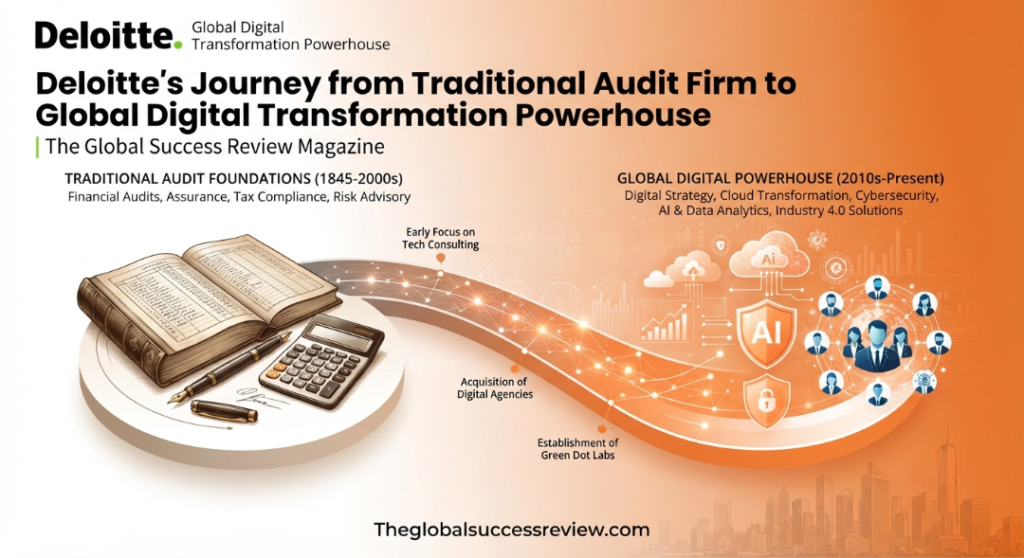
Deloitte’s Journey from Traditional Audit Firm to Global Digital Transformation Powerhouse | The Global Success Review Magazine
From a traditional accounting and auditing practice established in the 19th century to a global professional services organization operating at the intersection of business, technology, data, and artificial intelligence, Deloitte’s evolution is a powerful example of long-term strategic reinvention.
In professional services, reputation can take decades to build, but relevance can disappear quickly if organizations fail to adapt.
Deloitte has navigated more than 180 years of economic, technological, and social change. Founded by William Welch Deloitte in 1845, the organization began with a focus on accounting and auditing and gradually expanded its capabilities as the needs of businesses changed. DDeloitte+1
Today, Deloitte operates across areas including audit and assurance, consulting, financial advisory, tax, risk, technology, cybersecurity, cloud, data, and artificial intelligence.
Its transformation demonstrates a fundamental principle of modern business:
Organizations do not always need to abandon their original strengths to reinvent themselves. They can use those strengths as a foundation for entering new markets and creating new forms of value.
Building the Foundation: The Audit and Assurance Era
Deloitte’s origins are closely connected to the development of modern professional accounting.
William Welch Deloitte established his accountancy practice in London in 1845, at a time when industrialization was creating increasingly complex businesses and new demands for financial accountability. His early work included auditing companies such as the Great Western Railway, helping establish the importance of independent financial oversight. DDeloitte+1
Over the following decades, Deloitte and its legacy firms developed expertise in accounting, audit, tax, assurance, and financial reporting.
This created more than a portfolio of professional services.
It created trust.
Businesses and institutions increasingly relied on professional advisers to help provide confidence in financial information, governance, controls, and compliance.
That trust would eventually become one of Deloitte’s most important strategic assets as it expanded into consulting and technology.
The Information Revolution
Deloitte’s transformation did not begin with cloud computing or artificial intelligence.
It began much earlier, as technology started changing the way businesses managed information.
During the 20th century, computing and data-processing technologies began transforming accounting and auditing. Deloitte’s predecessor organizations were involved in technological innovation, including the early use of automated bookkeeping and computer technology in auditing. DDeloitte
This was an important turning point.
Technology was no longer simply something businesses purchased from technology companies. It was becoming part of how businesses operated, managed information, controlled risk, and made decisions.
Professional services firms therefore had to understand both business and technology.
Deloitte increasingly developed capabilities at this intersection.
Expanding Beyond Traditional Accounting
As corporations became larger, more global, and more technologically sophisticated, their problems became more complex.
Clients were no longer looking only for help with financial statements or tax compliance.
They wanted advice on strategy, operations, mergers and acquisitions, technology, organizational performance, risk, and transformation.
Deloitte responded by expanding beyond its traditional accounting foundation into broader consulting and advisory services.
This represented a fundamental shift in the organization’s value proposition.
Instead of simply helping clients understand what had happened financially, Deloitte increasingly helped organizations determine what they should do next.
The consulting model became an important bridge between Deloitte’s historical professional expertise and the emerging digital economy.
The Consulting Inflection Point
The growth of management consulting fundamentally changed the professional services industry.
Businesses increasingly needed external expertise to redesign operations, implement technology, manage complex transactions, and respond to globalization.
Deloitte’s history reflects this evolution. Its legacy organizations expanded management consulting capabilities during the post-war period, while the organization later created Deloitte Consulting as a distinct business in 1995 to better serve multinational clients. DDeloitte
This was more than a structural change.
It reflected a changing definition of professional expertise.
The modern adviser needed to understand not only accounting and finance, but also technology, strategy, operations, people, and industry-specific challenges.
Globalization as a Growth Engine
The globalization of business created another major opportunity.
Multinational organizations increasingly needed advisers capable of supporting operations across countries and regulatory environments.
Deloitte developed a broad international network, allowing it to bring multidisciplinary capabilities to clients operating across borders.
Global scale became particularly valuable because complex business problems rarely fit neatly into one category.
A multinational organization might simultaneously require assistance with tax, finance, cybersecurity, technology implementation, risk management, workforce transformation, and strategy.
The ability to connect these capabilities became a major part of Deloitte’s competitive proposition.
Technology Becomes Central to Transformation
The arrival of enterprise software and digital technologies created a new chapter in Deloitte’s evolution.
Businesses were no longer asking only how to improve existing processes.
They were asking how technology could fundamentally redesign the organization.
Enterprise resource planning, customer relationship management, analytics, automation, digital platforms, and emerging technologies became central to corporate strategy.
Deloitte expanded its technology consulting capabilities to help organizations navigate these changes.
This transformed the firm’s identity.
Technology evolved from being a supporting capability into a central component of business transformation.
Deloitte Digital, for example, focuses on connecting customer experience, marketing, sales, service, technology, and talent. Deloitte Digital describes itself as a creative consultancy within Deloitte focused on creating growth through connected ideas, technology, and talent. DDeloitte
The result was a new type of professional services organization—one capable of combining traditional business expertise with technology implementation.
The Cloud Transformation
Cloud computing created another major inflection point.
Organizations began moving applications, infrastructure, and data toward cloud environments to improve scalability, flexibility, and speed.
But cloud transformation was not simply an IT project.
It affected finance, operations, cybersecurity, data governance, workforce models, customer experience, and organizational strategy.
Deloitte therefore positioned cloud as part of a broader business transformation agenda.
Its ecosystem approach includes relationships with major technology providers and capabilities spanning cloud infrastructure, security, analytics, artificial intelligence, and enterprise transformation.
The strategic opportunity was significant.
Rather than advising clients only on why they should transform, Deloitte could increasingly participate in how that transformation was designed and implemented.
Data and Analytics: Turning Information into Intelligence
The explosion of digital information created another major opportunity.
Organizations were generating massive volumes of customer, financial, operational, workforce, and supply-chain data.
The challenge shifted from collecting information to extracting value from it.
Analytics became increasingly important in areas such as forecasting, customer intelligence, fraud detection, risk management, operational optimization, and decision-making.
Deloitte developed data and analytics capabilities that connected business consulting with technology and quantitative analysis.
This changed the central question facing business leaders.
It was no longer simply:
“What has happened?”
It became:
“What does the data tell us, what is likely to happen next, and what should we do about it?”
That transition laid important groundwork for the next major stage of Deloitte’s evolution: artificial intelligence.
Cybersecurity and Digital Risk
Digital transformation also created new vulnerabilities.
As businesses moved more operations online and connected increasingly large technology ecosystems, cybersecurity became a strategic concern for executives and boards.
Data breaches, ransomware, privacy issues, technology failures, third-party vulnerabilities, and regulatory requirements created new forms of enterprise risk.
Deloitte’s traditional expertise in risk, controls, governance, compliance, and assurance provided a natural foundation for expanding into cybersecurity and digital risk.
This is an important example of how established capabilities can remain valuable during technological disruption.
Deloitte did not have to abandon its history of risk management.
It could apply that knowledge to a new digital environment.
The AI Chapter
Artificial intelligence represents perhaps the most significant new chapter in Deloitte’s transformation.
Generative AI, machine learning, intelligent automation, and AI-powered analytics are changing how organizations approach productivity, customer experience, decision-making, and business operations.
Deloitte has identified AI and innovation as major strategic priorities, with investments in emerging technologies, AI capabilities, workforce development, and proprietary platforms. DDeloitte
The implications for professional services are substantial.
AI can potentially automate repetitive analytical tasks, accelerate research, assist professionals, improve software development, and create new approaches to business problem-solving.
At the same time, enterprise AI introduces difficult questions around governance, security, privacy, reliability, regulation, and responsible deployment.
This creates a distinctive opportunity for Deloitte.
Its AI proposition can combine:
AI + Strategy + Technology + Data + Risk + Industry Expertise
Rather than viewing AI solely as a technology product, Deloitte can position AI as part of an end-to-end business transformation journey.
Building an AI-Ready Workforce
Technology transformation is ultimately also a people transformation.
AI changes the skills organizations need, the way professionals work, and the nature of many traditional roles.
Deloitte has responded by investing in AI education and workforce development. Its global AI initiatives include the AI Academy and efforts to embed AI capabilities into internal platforms and professional workflows. DDeloitte
This illustrates an increasingly important principle:
Digital transformation cannot succeed through technology alone.
Organizations need people who understand how to use technology, manage its risks, redesign processes, and translate technical capabilities into business outcomes.
For a professional services organization, this becomes particularly important because expertise and talent are central to its business model.
From Professional Adviser to Transformation Partner
Perhaps the most significant change in Deloitte’s evolution is the shift from traditional adviser to transformation partner.
The traditional professional services model often centered on providing expertise.
The modern model increasingly combines expertise with technology, implementation, managed services, data, analytics, and continuous transformation.
A client modernizing its finance function may require:
- Strategy and operating-model design
- Enterprise technology implementation
- Cloud migration
- Data and analytics
- Cybersecurity
- Risk management
- Workforce transformation
- Artificial intelligence
These challenges cannot easily be solved by a single traditional discipline.
Deloitte’s multidisciplinary structure gives it the opportunity to bring multiple capabilities together around a single business problem.
This is increasingly the definition of digital transformation.
Deloitte’s Competitive Position
Deloitte’s competitive identity has therefore changed considerably.
It remains deeply connected to audit, tax, assurance, and financial expertise, while simultaneously competing across consulting, technology, cybersecurity, risk, financial advisory, and digital transformation.
Its strategic proposition can increasingly be summarized as:
Trust + Consulting + Technology + Data + Cloud + Cybersecurity + AI
That combination differentiates Deloitte from organizations that operate in only one part of the business transformation lifecycle.
Its historical credibility provides the foundation.
Its consulting capabilities provide strategic expertise.
Its technology capabilities provide implementation.
Its data and AI capabilities provide intelligence.
Its risk and cybersecurity capabilities provide digital trust.
Together, these capabilities create a broader transformation ecosystem.
The Challenge Ahead
Deloitte’s transformation does not mean that its future is guaranteed.
The professional services industry is intensely competitive.
Traditional professional services firms compete with other global consultancies, technology companies, specialist advisory organizations, and rapidly growing digital firms.
Artificial intelligence may also disrupt the professional services model itself.
Some activities that once required significant amounts of human effort may become increasingly automated.
At the same time, entirely new categories of work may emerge around AI strategy, governance, implementation, cybersecurity, data management, and organizational transformation.
The challenge for Deloitte will therefore be to innovate without compromising the trust, quality, independence, and professional standards associated with its traditional businesses.
The central question is no longer whether Deloitte can adopt new technology.
It is whether Deloitte can continuously convert technological change into measurable value for clients while preserving the trust that built its reputation.
The Strategic Lesson
Deloitte’s transformation offers a powerful lesson for established organizations.
Reinvention does not necessarily mean starting over.
Deloitte’s traditional expertise in accounting, audit, finance, risk, and governance created the trust and client relationships that became the foundation for expansion.
Consulting broadened the relationship.
Technology created implementation capabilities.
Cloud accelerated digital transformation.
Data and analytics introduced new ways of creating insight.
Cybersecurity connected digital transformation with trust and risk.
Artificial intelligence is now opening another frontier.
The journey therefore represents more than the evolution of an accounting firm.
It is a case study in strategic reinvention, global expansion, technology adoption, capability building, ecosystem development, and continuous adaptation.
Deloitte’s history demonstrates that companies can preserve the strengths of their past while continually redefining what those strengths mean in the future.
From accounting ledgers to digital platforms, from traditional audits to cloud transformation, and from business consulting to artificial intelligence, Deloitte’s evolution reflects a broader transformation in the global economy itself.
The next chapter will likely be shaped by AI-powered organizations, autonomous business processes, digital trust, cybersecurity, advanced analytics, and increasingly intelligent enterprise systems.
For Deloitte, the opportunity is to remain at the intersection of these changes—helping organizations not simply adopt new technologies, but reimagine how business itself is conducted.
That may ultimately become Deloitte’s most important transformation of all: moving from being a firm that advises businesses about change to becoming a global partner that helps organizations continuously design, implement, govern, and scale the future of business.
