
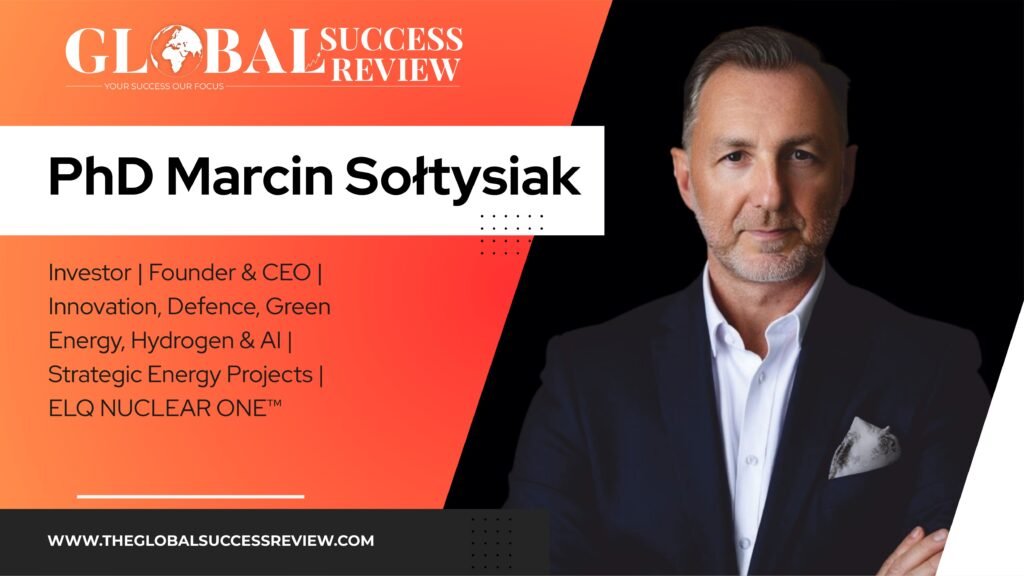
How PhD Marcin Sołtysiak is Redesigning Europe’s Energy Map
PhD Marcin Sołtysiak
Investor | Founder & CEO | Innovation, Defence, Green Energy, Hydrogen & AI | Strategic Energy Projects | ELQ NUCLEAR ONE™
The Most Successful Business Leaders Redefining Excellence in 2026
From Nuclear Disaster to Industrial Rebirth
From nuclear disaster to industrial rebirth – ELQ Nuclear One™ envisions a new energy future for the Chornobyl Exclusion Zone.
A cross-border blueprint connecting Polish engineering, Ukrainian reconstruction, and European capital into one energy sovereignty strategy.
Engineering the Future of Energy, Infrastructure, and European Resilience
In an era defined by geopolitical uncertainty, accelerating energy transition and growing pressure on critical infrastructure, Europe is being challenged to rethink how energy is produced, stored, financed and secured.
For PhD Marcin Sołtysiak, this transformation represents more than an energy-sector opportunity. It is a long-term challenge involving industrial capability, technological sovereignty, investment discipline and the resilience of European economies.
As an investor, founder, entrepreneur and strategic energy leader, Sołtysiak has built his professional journey around connecting these dimensions. His work brings together innovation, infrastructure, renewable energy, hydrogen, energy storage, artificial intelligence, defence and nuclear technologies under a broader vision of European resilience.
At the centre of this vision is a simple principle: the future of energy must be designed through the integration of technology, capital, industrial capability and strategic responsibility.
From Industrial Foundations to an Energy Transformation Platform
The story begins with ELQ, an industrial company founded in 1976.
Under Sołtysiak’s leadership and following a change in ownership in 2012, the organization began evolving beyond its traditional position in electrical equipment manufacturing. Its development increasingly focused on creating an integrated ecosystem capable of responding to the changing requirements of modern energy and infrastructure.
This transformation was shaped around what can be described as a 360° Model, bringing together engineering, investment, manufacturing, infrastructure development and technological innovation.
Rather than viewing individual technologies as isolated solutions, Sołtysiak’s approach considers how different capabilities can operate together.
Renewable generation requires storage. Storage requires intelligent management. Industrial transformation requires reliable infrastructure. Infrastructure requires capital. And long-term energy security requires technological competence that can withstand changing geopolitical and economic conditions.
This interconnected perspective has become a defining characteristic of his leadership.
Where Investment Meets Infrastructure
Sołtysiak’s experience spans both investment and technical development, allowing him to approach energy projects from more than one perspective.
His doctoral work on photovoltaic farm construction projects further strengthened this connection between academic research, engineering and practical implementation.
For him, successful infrastructure is not simply about installing technology. It is about understanding the entire lifecycle of an asset: financing, construction, operation, efficiency, risk, maintenance and long-term value creation.
This perspective becomes increasingly important as energy infrastructure grows more complex.
Europe’s energy transition requires enormous investment, but capital alone cannot deliver transformation. Projects must be technically viable, strategically relevant and capable of producing sustainable economic outcomes.
That is where Sołtysiak’s investor-engineer approach becomes particularly significant.
Building Sovereign Competencies
One of the central themes of Sołtysiak’s strategy is technological and industrial sovereignty.
For Europe, energy independence cannot rely exclusively on importing equipment, technologies or critical components. A resilient energy system requires local manufacturing capabilities, skilled engineering, secure supply chains and the ability to develop and maintain strategic infrastructure.
Within this framework, ELQ has developed capabilities involving electrical infrastructure, transformer stations, battery energy storage systems and other technologies supporting modern energy networks.
Poland represents an important part of this development.
Its industrial base, engineering capabilities and geographical position provide a strong platform from which European energy and infrastructure projects can be developed.
For Sołtysiak, building these competencies is not simply a commercial decision. It is part of a broader effort to strengthen Europe’s capacity to respond to changing energy and geopolitical conditions.
Renewable Energy as the Beginning, Not the Destination
Renewable energy has played an important role in ELQ’s transformation, with activities spanning biomass, photovoltaic energy, wind energy, bioenergy and energy storage.
But Sołtysiak does not view renewable generation as the final destination.
The next stage involves connecting generation with storage, smart grids, hydrogen, artificial intelligence, nuclear technologies and critical infrastructure.
This broader system perspective reflects the reality of modern energy markets. Producing electricity is only one part of the challenge. The ability to store, distribute, manage and secure that electricity is equally important.
Battery Energy Storage Systems are therefore becoming a major component of this strategy.
A 200 MW BESS project in the Kyiv region represents one example of the scale of infrastructure being considered within the wider energy transformation.
Such projects demonstrate how storage can become a strategic asset, particularly in markets where energy resilience and grid stability are critical.
Ukraine: Investing Before the Future Becomes Obvious
Ukraine occupies a particularly important position in Sołtysiak’s vision.
Through ELQ Ukraine, the company has explored opportunities involving renewable energy, energy storage, bioenergy and infrastructure.
The country’s reconstruction represents an enormous challenge, but also an opportunity to create infrastructure that is more resilient, decentralized and technologically advanced than the systems that existed previously.
For Sołtysiak, reconstruction should not simply mean rebuilding what was damaged.
It should mean building better.
A future Ukrainian energy system could combine decentralized renewable generation, storage, digital technologies, modern transmission infrastructure and new industrial capabilities.
Such an approach could strengthen Ukraine’s energy resilience while also creating opportunities for European engineering, investment and technological cooperation.
Chornobyl and the Vision of a New Energy Chapter
Perhaps the most ambitious expression of this vision is ELQ NUCLEAR ONE™.
The initiative explores the potential for a new energy chapter in the Chornobyl Exclusion Zone through the combination of nuclear technologies, renewable energy, storage and industrial development.
In July 2026, ELQ entered into strategic cooperation with the Ukrainian State Agency for Exclusion Zone Management.
The areas of cooperation include solar and wind energy, energy storage, small modular reactor technologies, bioenergy, hydrogen, battery recycling, critical materials, transmission infrastructure and industrial and technology parks.
The objective is not simply to place one technology into one location.
It is to develop a broader framework for how an area historically associated with one of the world’s most significant nuclear disasters could eventually become part of a new European energy and industrial strategy.
At its present stage, the initiative represents a strategic blueprint and framework rather than a guarantee that a specific nuclear facility will be constructed.
That distinction is important.
The significance of ELQ NUCLEAR ONE™ lies in the scale of the vision: transforming a location historically defined by energy catastrophe into a potential laboratory for technological renewal, energy resilience and industrial reconstruction.
The concept of “Chornobyl 2.0” therefore represents not a repetition of the past, but an attempt to imagine a fundamentally different future.
Hydrogen: Turning Industrial Decarbonization Into Reality
Hydrogen represents another important component of Sołtysiak’s energy strategy.
Its potential becomes particularly relevant in industrial sectors where direct electrification may not always provide the most practical solution.
ELQ has been involved in the development of a hydrogen installation in Lower Silesia, integrating renewable energy and storage capabilities.
The broader objective is to connect renewable generation with industrial applications in a way that supports decarbonization while maintaining economic practicality.
For Sołtysiak, the energy transition cannot be based exclusively on slogans or isolated technologies.
It must be supported by projects capable of demonstrating how new technologies can operate within real industrial environments.
BESS, AI and the Digital Energy System
Energy storage is increasingly becoming the bridge between intermittent renewable generation and reliable energy supply.
But storage itself is evolving.
The next generation of energy infrastructure will depend increasingly on digital monitoring, automation, predictive maintenance and artificial intelligence.
Sołtysiak’s vision incorporates AI into this wider energy architecture.
Through technologies such as SCADA systems, predictive maintenance and data-driven management, energy assets can become more responsive and efficient.
Artificial intelligence can help operators understand system behaviour, anticipate potential failures and optimize performance.
The ultimate objective is not technology for its own sake.
It is to create energy infrastructure that is more intelligent, resilient and capable of adapting to changing conditions.
Falanga Invest and the Architecture of Capital
The investment dimension of Sołtysiak’s strategy is reinforced through Falanga Invest SICAV, based in Prague.
The investment platform focuses on areas including renewable energy, BESS, critical infrastructure, data centers, advanced technologies, artificial intelligence, defence and energy security.
This reflects a broader investment philosophy.
The future of infrastructure will increasingly be shaped by the convergence of digitalization, energy security, industrial technology and geopolitical resilience.
Capital must therefore move toward projects that are not only commercially attractive but strategically relevant.
The ambition associated with Falanga Invest extends toward potentially billion-euro-scale investment opportunities.
Such ambitions require a long-term perspective, disciplined risk management and the ability to identify strategic opportunities before they become mainstream.
Sustainability Beyond Greenwashing
For Sołtysiak, sustainability is ultimately connected to economics.
A project cannot be considered sustainable simply because it carries a green label. It must create measurable environmental and economic value.
This principle is reflected in initiatives such as Carbon Free Flights and in the broader integration of renewable energy, storage and industrial technologies.
The approach is deliberately pragmatic.
“Greenwashing is not an option when dealing with institutional capital.”
The statement captures an important element of his philosophy: sustainability must withstand scrutiny from investors, engineers, regulators and the market.
In practical terms, that means developing projects where environmental performance and economic viability reinforce each other rather than compete.
Leadership Through Adaptive Resilience
Sołtysiak’s leadership philosophy is closely connected to resilience.
Markets change. Technologies evolve. Geopolitical conditions shift. Regulations develop. Investment priorities move.
Successful leaders therefore cannot remain rigid.
The strategy may remain consistent, but tactics must adapt.
This principle is especially important when operating across multiple countries and industries.
Energy, defence, infrastructure, technology and finance each operate according to different timelines and risk structures.
Leadership in such an environment requires transparency, trust, discipline and the ability to make informed decisions despite uncertainty.
For Sołtysiak, resilience is therefore not simply the ability to survive disruption.
It is the ability to use disruption as a catalyst for transformation.
Building a More Competitive Europe
Europe’s future competitiveness will depend increasingly on technological autonomy and industrial capability.
The continent needs secure supply chains, advanced manufacturing, strategic infrastructure and access to reliable energy.
Poland and Ukraine can play important roles in this transformation.
Poland brings industrial expertise, engineering capabilities and a strategic position within Europe.
Ukraine, despite the enormous challenges created by war and reconstruction, has the potential to become a major platform for rebuilding energy and industrial infrastructure using modern technologies.
Connecting these capabilities with European capital could create opportunities extending beyond individual projects.
It could contribute to a broader architecture of European energy sovereignty.
This is the strategic space in which Sołtysiak’s work operates.
Engineering the Future
As ELQ approaches its 50th anniversary, its evolution reflects a much broader transformation in the energy sector.
The organization began from an industrial foundation.
Its future is increasingly connected to energy systems, infrastructure, storage, hydrogen, artificial intelligence, nuclear technologies and strategic investment.
For Sołtysiak, this evolution is not about abandoning the company’s heritage.
It is about extending it.
Industrial experience provides the foundation. Engineering provides the capability. Investment provides the scale. Innovation provides the direction.
Together, these elements create a platform for long-term transformation.
The New Definition of Business Excellence
The traditional definition of business success often focuses on revenue, market share and growth.
But in an increasingly complex world, excellence requires more.
It requires the ability to anticipate structural change, understand technological transformation, manage risk and create value across multiple dimensions.
PhD Marcin Sołtysiak represents this broader model of leadership.
He operates simultaneously as an investor, engineer, entrepreneur and strategist.
His work connects energy with economic independence, infrastructure with national resilience, technology with competitiveness and sustainability with long-term value creation.
The ambition behind initiatives such as ELQ NUCLEAR ONE™ demonstrates the scale of this thinking.
The Chornobyl concept is still a blueprint. Its future development will depend on regulatory, technical, financial and geopolitical conditions.
Yet blueprints matter.
They provide direction before construction begins.
They create frameworks through which governments, investors, engineers and technology companies can begin discussing what might be possible.
In that sense, the idea of “Chornobyl 2.0” is larger than a single project.
It represents a vision of transforming the meaning of a place associated with one of the world’s greatest energy disasters into a potential symbol of technological renewal and European cooperation.
For Sołtysiak, the future of energy will not be defined by one technology alone.
It will be engineered through the convergence of renewable energy, storage, hydrogen, AI, nuclear innovation, industrial capability and strategic capital.
And as Europe searches for new ways to strengthen energy security, industrial competitiveness and resilience, leaders capable of connecting these disciplines will become increasingly important.
That is the essence of engineering the future.
And it is precisely why PhD Marcin Sołtysiak stands among The Most Successful Business Leaders Redefining Excellence in 2026.
PhD Marcin Sołtysiak
Investor | Founder & CEO | Innovation, Defence, Green Energy, Hydrogen & AI | Strategic Energy Projects | ELQ NUCLEAR ONE™
The Global Success Review Magazine™
