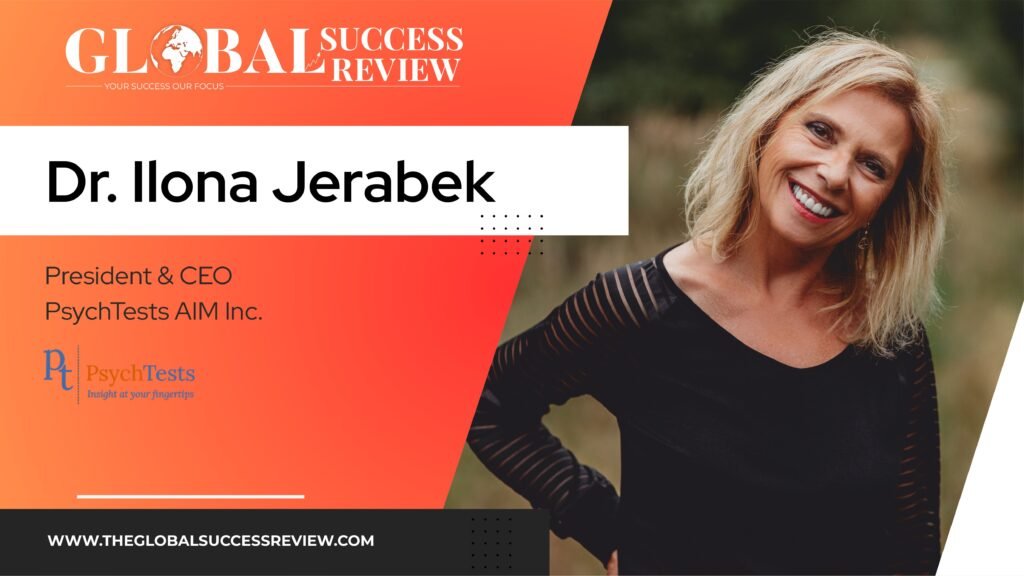
The Most Influential Women Leaders Driving Innovation in Canada, 2026
Psychologist | Psychometrician | Leadership Advisor & Executive Coach | AI & Behavioral Diagnostics Innovator
In an era when artificial intelligence is accelerating the pace of business, leadership is facing a paradox: organizations have access to more information than ever, yet better information does not automatically produce better decisions.
For Dr. Ilona Jerabek, President and CEO of PsychTests AIM Inc., the answer lies somewhere deeper, in the way human beings perceive, interpret, and respond to the world around them.
A psychologist, psychometrician, entrepreneur, executive coach, leadership advisor, researcher, and behavioral technology innovator, Dr. Jerabek has spent more than three decades exploring one fundamental question: Why do intelligent, capable people sometimes fail to do what they already know they should do?
That question has become the intellectual thread connecting her career, from psychological research and psychometric assessment to executive coaching, organizational development, artificial intelligence, and behavioral diagnostics.
Her journey is particularly remarkable because it began long before AI became a boardroom priority. In 1996, Dr. Jerabek co-founded PsychTests, at a time when the commercial internet itself was still emerging. What began as an early online psychological assessment venture developed into a multidisciplinary company working across psychology, psychometrics, technology, research, data, artificial intelligence, and human development.
Today, PsychTests AIM Inc. stands behind a broad portfolio of assessment platforms, behavioral technologies, research initiatives, and applied psychological solutions. Over the years, Dr. Jerabek and her team have developed or collaborated on more than 200 psychological assessments spanning personality, emotional intelligence, leadership, communication, motivation, cognitive abilities, career development, relationships, resilience, decision-making, and workplace performance.
Yet her work has never been about reducing human beings to scores.
It has been about understanding them more accurately.
A Lifelong Curiosity About the Human Mind
Dr. Jerabek’s fascination with human behavior began during childhood.
While reading novels, she was less interested in what happened next than in why characters behaved the way they did. She wondered why two people could experience the same event and walk away with entirely different conclusions.
That curiosity eventually became a professional mission.
Her academic path reflected that growing interest in the science of human behavior. She earned an Honors degree in Applied Psychology with Distinction from Bishop’s University, where she received the Governor General’s Silver Medal for the highest academic standing. She subsequently completed a master’s degree and Ph.D. in Clinical Sciences at Université de Sherbrooke and undertook postdoctoral training in psychiatric genetics at McGill University.
Her early scientific research examined psychological, cardiovascular, and neurochemical mechanisms associated with anxiety and panic disorder. Her work resulted in academic publications and was supported by competitive research scholarships and fellowships.
But the world of academic research was only one part of the journey.
In 1996, Dr. Jerabek helped establish PsychTests and began bringing psychological assessment into the digital environment. At a time when online psychological testing was still in its infancy, the company explored ways of making professionally developed psychological tools accessible beyond traditional clinical and academic settings.
The company evolved with technology, and so did Dr. Jerabek’s vision.
From Measurement to Behavioral Intelligence
Psychometric testing can measure characteristics, but Dr. Jerabek recognized that measurement alone could never fully explain human behavior.
A person is not a personality type.
A score is not an identity.
An assessment result is not a verdict.
Instead, psychological measurement provides evidence, patterns that can help individuals and organizations ask better questions, identify potential blind spots, and make more informed decisions.
This philosophy became central to the development of PsychTests AIM Inc. and its enterprise assessment division, ARCH Profile.
ARCH Profile brings decades of psychometric research into practical organizational applications, supporting areas such as hiring, leadership development, coaching, career development, emotional intelligence, communication, team effectiveness, and talent management.
Its approach is deliberately different from simplistic categorization.
Human behavior is contextual and multidimensional. The same behavior can have different causes. A leader who hesitates may be uncertain, thoughtful, cautious, overwhelmed, or simply processing information. A person who dominates a conversation may be confident or compensating for insecurity.
As Dr. Jerabek puts it, observable behavior is evidence; the meaning assigned to it remains a hypothesis.
That distinction has profound implications for leadership.
Organizations frequently mistake interpretation for fact. Statements such as “she isn’t strategic,” “he lacks executive presence,” or “they aren’t leadership material” can sound objective while actually representing conclusions drawn from limited observations.
The better question is: What specific behavior led us to that conclusion, and what other explanations might exist?
For Dr. Jerabek, better leadership begins with becoming a better observer.
The Silent Override: Understanding What Gets in the Way
One of the most distinctive concepts emerging from Dr. Jerabek’s leadership work is the idea of the Silent Override, the automatic psychological pattern that can interfere with good judgment before an individual is consciously aware that a decision has been shaped.
This helps explain a familiar experience among senior executives.
A meeting ends. The leader walks away and suddenly thinks: Why didn’t I say that? I knew exactly what needed to be said.
Or an organization looks at an exceptionally capable employee and wonders why that person is not realizing their potential despite possessing the necessary skills.
These situations demonstrate an important truth: knowing and doing are not the same thing.
Leadership development frequently focuses on acquiring new skills. But what if the leader already possesses the necessary skills?
The challenge may not be knowledge. It may be the psychological patterns that interfere with applying that knowledge under pressure.
Dr. Jerabek’s approach therefore focuses less on manufacturing a new leadership persona and more on removing the barriers that prevent existing strengths from appearing consistently.
Her work through the Magnetic Leadership Blueprint™ and 360° Leadership MRI™ reflects this philosophy. Leaders begin by understanding how their behavior is actually experienced by others, not simply how they intended it to be experienced.
That gap between intention and impact can reveal some of the most valuable leadership insights.
Leadership Begins With Better Questions
For Dr. Jerabek, leadership is not simply the ability to influence others.
It is the ability to improve the quality of thinking within a group.
The strongest leaders create conditions in which better decisions become possible. They encourage curiosity before certainty. They allow people to challenge ideas without removing accountability. They recognize that agreement is not the same as alignment, and that genuine commitment cannot simply be demanded.
This perspective places conversations at the center of leadership.
Hiring decisions, strategic changes, conflict resolution, organizational culture, innovation, and transformation are all shaped through conversations. Yet conversations often become reactive because individuals enter them carrying different assumptions about what is happening and why.
Intentional leadership requires curiosity.
It requires asking rather than assuming.
It requires listening not only to what is being said, but also paying attention to what remains unspoken.
Dr. Jerabek’s experience coaching leaders across six continents has reinforced her belief that, despite cultural differences, the psychology of leadership is remarkably consistent.
People do not necessarily expect leaders to agree with them.
They expect leaders to understand them.
They want to know that their perspective was heard, considered, and incorporated into thoughtful decision-making.
That is how trust is earned.
AI Will Transform Leadership, But Human Judgment Will Matter More
Artificial intelligence represents the next major chapter in Dr. Jerabek’s work.
PsychTests AIM has been exploring computational approaches to psychological assessment for decades, including pattern recognition, machine learning, fuzzy-logic approaches, adaptive scoring, and mathematical modeling.
Long before generative AI became mainstream, the company was investigating how technology could help identify complex patterns in psychological data.
Today, that work is evolving through AI-enhanced behavioral technology such as Oracien, an AI-based omnibus assessment designed to move psychological assessment beyond static reports toward contextual, natural-language interaction.
But Dr. Jerabek is careful not to position AI as a replacement for human judgment.
She sees a different opportunity.
AI can analyze enormous quantities of information, recognize patterns, summarize data, and generate recommendations. But it cannot independently determine what matters most within every human context.
Culture matters.
Trust matters.
Motivation matters.
Relationships matter.
Ethical considerations matter.
And ultimately, human beings remain accountable for the decisions they make.
As access to information becomes increasingly democratized, Dr. Jerabek believes the defining competitive advantage will shift from who has the most information to who exercises the best judgment.
That creates an important leadership challenge.
AI can generate remarkably convincing answers, even when the assumptions behind those answers are incomplete or incorrect.
The danger is therefore not simply that AI might make mistakes.
The greater danger may be that humans stop questioning the answers.
The leaders of tomorrow will need technological fluency, but they will also need critical thinking, intellectual humility, empathy, ethical judgment, discernment, and the ability to earn trust.
Technology can inform a decision.
It cannot assume responsibility for it.
Building Organizations That Think Better
Dr. Jerabek’s vision extends beyond individual executive development.
Through PsychTests AIM and ARCH Profile, her work addresses organizational questions surrounding talent, leadership, hiring, development, communication, teamwork, and performance.
Assessment, in her view, should strengthen human judgment rather than replace it.
A scientifically grounded assessment can reveal patterns that might otherwise remain invisible. It can help distinguish strengths from overused strengths, potential from readiness, a development opportunity from a genuine mismatch, and temporary challenges from persistent patterns.
But assessment becomes valuable only when its insights can be translated into action.
That means better hiring conversations.
More targeted coaching.
Stronger leadership development.
More effective teams.
Better questions.
Better decisions.
The objective is not to tell organizations who people are.
It is to help them see more clearly.
This philosophy has shaped PsychTests AIM’s evolution for nearly three decades, from early online assessments to sophisticated enterprise platforms and AI-enhanced behavioral diagnostics.
A Leadership Philosophy Built on Curiosity
Despite her extensive academic, entrepreneurial, and professional experience, Dr. Jerabek continues to place curiosity at the center of her leadership philosophy.
Every assessment, executive coaching engagement, organizational project, and speaking opportunity provides another opportunity to learn about human behavior.
For her, intellectual humility is not weakness.
It is a professional responsibility.
The more experience leaders accumulate, the easier it becomes to assume they already understand people and situations. Yet experience can sometimes create the illusion of certainty.
Dr. Jerabek challenges that instinct.
The day a leader believes they have all the answers may be the day they stop asking the questions that could reveal something new.
That principle is particularly relevant in an era defined by rapid technological change.
The future will not necessarily belong to the organizations with the most technology. It will belong to those capable of combining technological intelligence with human wisdom.
Empowering the Next Generation of Women Leaders
As a woman leading an organization at the intersection of psychology, technology, and innovation, Dr. Jerabek also brings a distinctive perspective to women’s leadership.
She emphasizes that many of the psychological challenges she addresses apply to leaders regardless of gender. Yet women can face additional layers of complexity in how leadership behaviors are interpreted and judged.
Strength can be perceived differently when demonstrated by a woman.
Confidence can be interpreted differently.
Ambition can carry different assumptions.
These external expectations can interact with internal psychological patterns, creating additional forms of the Silent Override.
For Dr. Jerabek, empowering women leaders is therefore not simply about encouraging them to become more confident or assertive.
It is about helping them identify the internal and external assumptions that may interfere with their ability to exercise their judgment fully.
The goal is not to make women conform to someone else’s definition of leadership.
It is to remove the interference that prevents them from expressing their own capabilities.
The Future Belongs to Better Questions
Looking toward the future, Dr. Jerabek’s ambitions remain centered on a simple but powerful mission: improving the quality of human judgment.
Through PsychTests AIM, ARCH Profile, behavioral research, executive coaching, speaking, and emerging AI technologies such as Oracien, she is working toward a future where psychological insight becomes more accessible, contextual, practical, and meaningful.
Her vision is not simply to create more sophisticated assessments.
It is to help leaders see themselves, their teams, and their organizations more accurately.
Because better perception creates better conversations.
Better conversations create better decisions.
And better decisions create stronger organizations.
For the next generation of women leaders, her message is equally powerful: leadership does not require becoming someone else.
It requires understanding yourself deeply enough to remove the patterns that prevent your best judgment from emerging when it matters most.
Dr. Ilona Jerabek’s career demonstrates what can happen when curiosity is transformed into a lifelong mission.
From psychological research to online psychometrics, from entrepreneurship to executive coaching, and from artificial intelligence to behavioral diagnostics, her work has consistently pursued one fundamental objective:
to understand human beings more accurately, and use that understanding to help them lead more effectively.

Her greatest contribution may therefore not be a single assessment, technology, methodology, or leadership framework.
It may be the question she continues to encourage leaders to ask:
What assumption about yourself, your team, or your organization have you accepted as fact without ever testing it?
For Dr. Jerabek, meaningful breakthroughs rarely begin with having a better answer.
They begin with having the courage to ask a better question.
And as leadership enters an increasingly intelligent, automated, and rapidly changing era, that may be one of the most important forms of innovation of all.