From Personal Transformation to Purposeful Leadership: How the Founder of Build Toward™ Is Helping Leaders Move from Reaction to Deliberate Action
Media Partner: The Global Success Review Magazine™ for Build Toward™.
The Entrepreneur Shaping a New Era of Decisive Leadership
The Leadership Journey Begins Within
Leadership is often measured through business growth, professional achievements, strategic decisions, and the ability to guide others toward ambitious goals. Yet, beneath every leadership decision lies a more personal challenge: understanding oneself well enough to respond thoughtfully when circumstances become difficult.
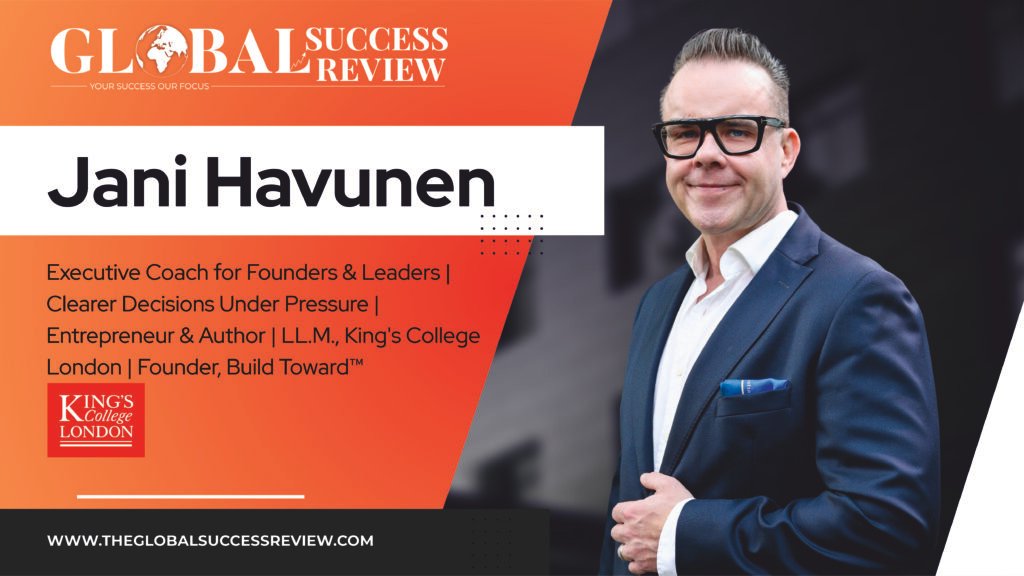
For Jani Havunen, founder of Build Toward™, entrepreneur, executive coach, and author, this principle is grounded in a life shaped by contrasting experiences. His journey has moved through addiction, destructive behaviour, crime, and imprisonment toward education, entrepreneurship, and a deeper exploration of human behaviour and decision-making. Rather than presenting transformation as a single defining moment, Havunen describes it as a gradual process of learning to take greater responsibility for his choices and direction.
Around 2016, he began examining the relationship between his experiences, thinking, and behaviour. He gradually recognised that while the past could help explain the patterns he had developed, it did not have to determine his future.
This distinction became fundamental to his personal and professional philosophy. Understanding why people behave in certain ways matters, but meaningful progress also requires the willingness to change what happens next.
Education became an important part of that transformation. Through sustained effort, Havunen pursued advanced studies, including an LL.M. in International Corporate and Commercial Law at King’s College London, while developing his entrepreneurial experience. These experiences strengthened his analytical thinking and broadened his understanding of responsibility, risk, and the consequences of decisions.
Entrepreneurship added another dimension. Business leadership is never exclusively about the ambitions of one individual. Decisions influence employees, customers, partners, and the people who depend on an organisation’s stability and direction.
For Havunen, these different experiences converge around one central conviction: effective leadership begins with the ability to lead oneself.
When Pressure Changes the Way Leaders Think
Modern leaders operate in environments characterised by constant communication, technological change, economic uncertainty, and competing demands. Founders and executives are expected to make decisions quickly, solve problems continuously, and maintain a clear vision while managing the immediate needs of their organisations.
Yet, greater responsibility does not automatically produce better judgment.
Havunen believes pressure can subtly change how capable leaders interpret situations. The effects are not always obvious because unhelpful responses may initially resemble familiar strengths.
A founder who built a company through determination and personal involvement, for example, may respond to increasing pressure by taking even more control. An executive who values efficiency may begin treating every issue as urgent, leaving little room for strategic reflection. Another leader may avoid a difficult conversation because the discomfort of addressing a problem seems greater than the perceived benefit of confronting it.
These responses can become self-reinforcing. As pressure increases, leaders may rely more heavily on established habits, even when changing circumstances demand a different approach.
“The challenge for leaders is therefore not simply to become more efficient at handling pressure,” Havunen explains in his leadership philosophy. “It is to recognise when their established ways of thinking and operating may no longer serve the situation effectively.”
The distinction is important. Pressure does not necessarily mean a leader lacks competence. It can instead reveal the limitations of habitual responses that once proved useful.
Recognising those patterns creates an opportunity to reconsider assumptions, evaluate priorities, and choose a more appropriate course of action.
Creating Space Between Pressure and Response
Havunen’s approach to decisive leadership is built around the ability to create distance between a situation and the response it triggers.
This does not mean postponing every difficult decision or pursuing certainty before taking action. In business, delays can carry real costs, and some circumstances require immediate intervention. The objective is to recognise what a situation actually demands rather than allowing urgency alone to dictate the response.
A brief moment of reflection can change the questions a leader asks. Is this genuinely urgent, or does it simply feel urgent? What information is missing? Am I responding to the facts, or to an assumption about what those facts mean? What could this decision mean for the organisation beyond the immediate moment?
Such questions help leaders distinguish between reacting to pressure and responding to the underlying challenge.
For Havunen, decisive leadership is not synonymous with speed. It is the ability to exercise sound judgment, act with sufficient clarity, and accept responsibility for the consequences.
Some decisions can be made quickly because the risks are limited and the available information is adequate. Others deserve more careful examination because they may affect people, financial stability, organisational culture, or long-term strategy.
He also emphasises that responsible decisiveness includes the willingness to reconsider a decision when new evidence emerges. Changing direction is not automatically a sign of weakness. It can be evidence that a leader remains attentive to reality rather than becoming attached to an earlier judgment.
In this sense, effective decision-making combines reflection with action. Leaders need enough awareness to choose thoughtfully and enough discipline to follow through.
Run the Filter™: A Practical Framework for Better Decisions
One of Havunen’s central initiatives is Run the Filter™, a decision-making framework built around three stages: Notice, Filter, and Choose. Its purpose is to help individuals connect self-awareness with priorities and deliberate action.
The framework begins with Notice. Before deciding what to do, a person must recognise what is happening. This includes the external situation, the internal response it creates, and the assumptions or recurring behavioural patterns influencing the interpretation of events.
The next stage, Filter, introduces direction. Instead of responding only to what feels urgent, familiar, or emotionally compelling, individuals consider whether a possible action aligns with their values, priorities, and longer-term objectives. The process encourages a distinction between what demands attention in the moment and what genuinely deserves commitment.
Finally, Choose turns awareness into action. Understanding a situation or identifying a behavioural pattern is valuable, but insight alone does not create change. A deliberate choice must lead to a practical response.
Together, the three stages provide a straightforward way to examine the reasoning behind decisions rather than focusing exclusively on the options available.
The framework is designed to be accessible. Leaders do not necessarily need a complicated system to improve their thinking; they need a repeatable process that helps them recognise what is influencing their judgment, reconnect with their direction, and act intentionally.
Applied consistently, this approach can help founders and executives question assumptions, navigate uncertainty, and make decisions that are more closely aligned with their responsibilities and objectives.
Build Toward™: Turning Intention into Consistent Progress
Self-awareness and sound decisions are essential, but they are only part of the equation. Meaningful goals also require consistent execution.
Through Build Toward™, Havunen focuses on helping leaders create structures that support progress. These structures can include clearer priorities, established routines, defined responsibilities, and systems for evaluating results and adjusting direction.
His philosophy recognises that motivation and structure serve different but complementary purposes. Motivation helps people understand why a goal matters and can encourage them to begin. Structure helps translate that intention into behaviour, particularly when enthusiasm fluctuates or competing demands arise.
Havunen’s own development reflects this distinction. Returning to education and building a different future required more than a desire to change. It involved completing assignments, organising time, following through on commitments, developing habits, and adapting when circumstances became difficult.
The same principle applies to entrepreneurship. A compelling vision may provide direction, but it does not automatically determine what happens each day. Progress depends on the decisions, routines, and practical systems that connect long-term ambition with everyday activity.
Build Toward™ brings these ideas together by encouraging people to develop a more deliberate relationship between their objectives and their actions. The aim is not to impose rigid systems or eliminate flexibility. It is to establish a foundation that supports consistency while allowing room to learn and adapt.
For leaders balancing strategy, people, and operational responsibilities, this connection between intention and execution can be particularly valuable.
The Power of Responsibility Without Blame
Havunen’s personal history has also shaped how he understands resilience and accountability.
He distinguishes between understanding the circumstances that influence behaviour and using those circumstances to justify actions. Experiences, relationships, and past difficulties can affect how people interpret situations and respond to challenges. Exploring these influences can help individuals recognise patterns that might otherwise remain unnoticed.
However, awareness is only the beginning.
For Havunen, taking responsibility means acknowledging the role one’s decisions play in shaping outcomes while remaining willing to learn from mistakes. It does not require ignoring the past or denying the challenges a person has faced. Rather, it involves using that understanding to make more constructive choices in the future.
His understanding of resilience has evolved in a similar way. Simply enduring difficult circumstances is not always the same as progressing beyond them. Some coping strategies may help people navigate one period of life but become counterproductive later. Growth can therefore involve recognising when familiar responses need to change.
In business, this perspective has practical implications. When a decision produces an unexpected result, leaders can focus exclusively on assigning blame, or they can examine what happened, identify contributing factors, and determine what needs to change.
The latter approach does not eliminate accountability. It gives accountability a constructive purpose.
Havunen believes leaders must also recognise that their decisions affect people beyond themselves. Employees, customers, and partners may depend on the quality of their judgment. This makes careful consideration, openness to different perspectives, and a willingness to correct mistakes essential elements of responsible leadership.
Where Legal Reasoning Meets Human Behaviour
Havunen’s legal education and commercial experience provide another foundation for his approach.
Legal reasoning involves identifying relevant facts, distinguishing evidence from assumptions, considering alternative interpretations, and evaluating potential consequences. These disciplines can be useful far beyond the legal profession, particularly when leaders face complex decisions with competing priorities and uncertain outcomes.
His studies in International Corporate and Commercial Law at King’s College London broadened his understanding of the relationship between business activity, contractual responsibilities, regulation, and risk. His entrepreneurial experience reinforced the practical importance of applying that knowledge in situations where complete certainty is rarely possible.
At the same time, Havunen’s interest in psychology and human behaviour encourages him to look beyond the surface of a problem. A challenge that appears operational may also involve assumptions, motivations, established habits, or interpersonal dynamics.
Combining these perspectives helps him approach leadership challenges from more than one angle. Analytical reasoning can clarify the facts and implications of a decision, while an understanding of human behaviour can help illuminate why individuals respond to circumstances in particular ways.
His approach to executive coaching reflects this balance. Constructive challenge, he believes, requires honesty and respect. Simply agreeing with a client may not help them recognise an unhelpful pattern, but unnecessary confrontation is not a substitute for meaningful insight.
The objective is not to make decisions on behalf of founders and executives. It is to help them examine their thinking, question assumptions where appropriate, and strengthen their own capacity to make informed choices.
The Human Dimension of Leadership in an AI-Driven World
As artificial intelligence transforms business operations, leaders have access to increasingly powerful tools for analysing information, identifying patterns, and generating alternatives. These capabilities can improve efficiency and support better-informed decisions.
Yet Havunen believes technological progress makes human judgment even more important.
Access to more information does not automatically determine which objectives an organisation should pursue, how competing interests should be balanced, or which consequences it should be prepared to accept. Those questions require values, context, and accountability.
Leadership also involves understanding people, resolving disagreements, building trust, and helping teams navigate uncertainty. These responsibilities demand self-awareness and interpersonal understanding, particularly when decisions affect organisational culture and working relationships.
There is an important tension here: as technology enables faster execution, leaders must become more deliberate about the direction in which they are moving.
Efficiency is valuable, but it cannot independently establish whether an objective is worthwhile or whether the means of achieving it are responsible. Greater technological capability makes it increasingly important to examine assumptions, recognise limitations, and consider the wider effects of decisions.
For Havunen, self-leadership remains central to this challenge. Leaders who understand their own behavioural patterns and remain willing to question their judgment are better positioned to use technology thoughtfully rather than simply allowing greater speed to dictate their actions.
A Future Built on Deliberate Action
Looking ahead, Havunen intends to continue developing Build Toward™ as a platform focused on self-leadership, decision-making, and consistent execution. He also aims to expand the reach of Run the Filter™ through coaching, education, writing, and speaking.
His work is particularly relevant to founders and high-performing professionals who possess significant capability and ambition but recognise that greater effectiveness may require changes in how they make decisions, manage competing priorities, and lead themselves and others.
Writing remains an important part of this mission. His book, Shit Life to Self-Made: A Real Talk Roadmap for the Lost and Ambitious, draws on personal experience and psychological reflection to explore the possibility of building a different future. It forms part of a wider effort to encourage people to understand their patterns and take a more active role in shaping their lives.
At the heart of this work is a principle that extends beyond entrepreneurship or formal leadership positions: the pressure of the present moment should not automatically determine the direction of the future.
No individual can control every circumstance or predict every outcome. What people can develop, however, is a greater ability to understand themselves, evaluate their choices, and act in accordance with their values and long-term priorities.
For Havunen, leadership legacy is measured not only by personal achievements or business results, but also by the opportunities created for others, the fairness with which people are treated, and the extent to which others are encouraged to develop their capabilities.
His journey does not suggest that transformation is simple or that every person follows the same path. Instead, it illustrates how progress can emerge through sustained learning, personal responsibility, and deliberate action.
Through Build Toward™ and Run the Filter™, Havunen continues to advance a view of leadership that places thoughtful judgment before reflexive reaction and consistent execution behind meaningful ambition.
In a world that increasingly rewards speed, his message is a timely one: better leadership begins when people pause long enough to understand what is shaping their decisions—and then choose what to do next.
The Global Success Review Magazine™ celebrates leaders whose journeys offer meaningful perspectives on ambition, transformation, and the responsibilities that accompany influence. Jani Havunen’s work brings these themes together through a philosophy grounded in self-awareness, accountable decision-making, and the determination to build toward a more deliberate future.