Redefining Leadership Through Humanity, Communication, and Courage
In an era where organizations are investing billions into digital transformation, artificial intelligence, agile delivery, and innovation frameworks, one truth continues to surface across industries: technology may accelerate change, but people determine whether transformation succeeds.
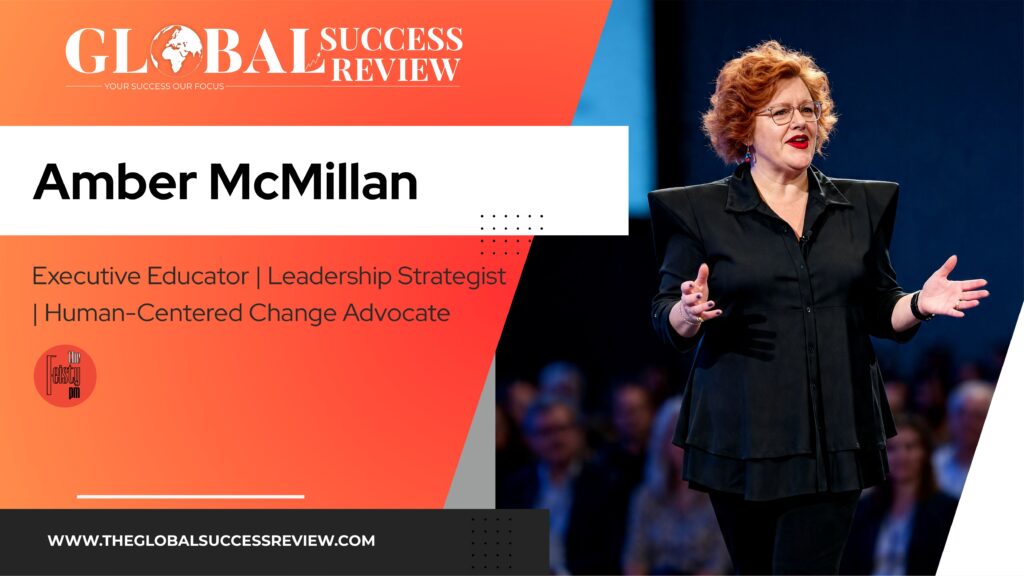
At the center of this conversation stands Amber McMillan, a leadership educator and human-centered change advocate whose work is reshaping how organizations think about self-awareness, trust, emotional intelligence, and organizational performance.
Recognized in The Global Success Review Magazine as one of The Most Visionary Business Leaders Transforming Canada 2026, Amber is not simply teaching project management or leadership theory. She is challenging the deeply rooted assumptions that continue to limit modern organizations. Through executive education, mentorship, coaching, and transformative dialogue, she has become a powerful voice advocating for leadership that prioritizes self-awareness alongside performance.
Her work spans healthcare, education, government, and organizational leadership environments where communication breakdowns, change fatigue, and disengagement often carry real operational consequences.
Her message is both disruptive and refreshingly practical:
“Leadership isn’t about having the answers, it’s about having the awareness to ask better questions, the courage to listen to the answers, and the discipline to act on what you hear.”
That philosophy has become the foundation of her growing influence across leadership development, organizational transformation, stakeholder engagement, and change management.
Yet Amber’s story did not begin in a corporate boardroom or executive office. It began somewhere far more human.
Leadership Lessons Born in the Kitchen
Amber McMillan’s path into leadership was unconventional, which is perhaps why her perspective resonates so deeply with professionals navigating real-world complexity today.
Before becoming an executive educator and leadership strategist, Amber worked as a chef and business owner. In fast-paced culinary environments, she experienced firsthand the intensity of listening under pressure. Kitchens are environments where emotions, expectations, timing, collaboration, and accountability collide in real time. There is little room for misunderstanding, ego, or disengagement.
Those experiences shaped her understanding of leadership long before she formally entered the worlds of project management and executive education.
“My journey didn’t start in a boardroom, it started in a kitchen,” Amber explains. “As a chef and business owner, I learned quickly that success has very little to do with process and everything to do with people.”
That realization became transformational.
While many organizations focused heavily on systems, methodologies, governance structures, and delivery frameworks, Amber noticed a persistent blind spot: the human experience of change itself.
Organizations were implementing tools without understanding people.
They were pursuing efficiency without building trust.
They were demanding innovation while unintentionally creating cultures where employees felt psychologically unsafe to speak honestly.
Amber recognized that most project failures were not caused by technology or technical capability. Instead, they emerged from trust breakdowns, emotional resistance, lack of self-awareness, and avoidance of difficult conversations.
“Most project failures aren’t technical,” she says. “They’re the result of leaders avoiding the conversations they don’t want to have.”
That insight would become the driving force behind her career.
The Rise of “The Feisty PM”
Over time, Amber developed a leadership voice that was both direct and deeply human. Her growing audience became familiar with her distinctive perspective under the name “The Feisty PM.”
The title itself often sparks curiosity.
For Amber, however, “feisty” is not about aggression or volume. It represents courage, authenticity, curiosity, and the refusal to settle for superficial leadership.
“Feisty isn’t about being loud,” she explains. “It’s about being honest, curious, and unwilling to settle for surface-level leadership.”
Her philosophy challenges many conventional leadership narratives.
While organizations frequently prioritize metrics, productivity, and execution frameworks, Amber consistently redirects attention toward self-awareness, relational intelligence, listening, and relational trust.
Her leadership philosophy is grounded in several core beliefs:
- Relational intelligence is no longer optional.
- Silence can be strategic
- No framework will ever replace genuine human work
- Self-awareness is foundational to leadership effectiveness
These principles may sound simple, yet their implementation requires profound personal accountability.
Amber believes that leadership is not a performance people put on once they achieve authority. Instead, leadership is embodied through consistent behaviors, awareness, and intentional listening.
“What sets me apart is that I don’t separate performance from people,” she says. “Leadership is relational before it’s operational.”
“I challenge leaders to look at themselves first, because self-awareness is the foundation of everything else.”
This perspective has resonated strongly with professionals navigating increasingly complex workplaces where burnout, disengagement, miscommunication, and change fatigue have become widespread challenges.
Why Human-Centered Leadership Matters More Than Ever
Across industries, organizations are facing extraordinary transformation pressures.
Digital disruption continues accelerating. Artificial intelligence is reshaping workflows. Remote and hybrid work models are redefining collaboration. Economic uncertainty is increasing stress across teams. Meanwhile, employees are demanding more meaningful, psychologically safe workplace cultures.
Amber believes these pressures are exposing a leadership gap that many organizations can no longer ignore.
“AI and digital transformation are accelerating change,” she explains, “but they’re also exposing leadership gaps. The challenge isn’t the technology. It’s how people adapt to it.”
Her warning is strikingly relevant in today’s environment:
“We are automating tasks faster than we are developing humans.”
This observation captures a growing tension within modern organizations. While businesses invest heavily in technological capability, leadership development often remains underprioritized or disconnected from emotional reality.
Amber argues that technical expertise alone is no longer enough.
The future belongs to leaders who can:
- Build trust under pressure
- Communicate clearly during uncertainty
- Navigate resistance with empathy
- Foster psychological safety
- Create environments where people feel heard and valued
- Lead with adaptability and relational intelligence
In other words, leadership itself is becoming more human, not less.
Communication: The Real Competitive Advantage
One of Amber McMillan’s strongest areas of focus is relational intelligence.
For her, trust is not simply about delivering information. It is about creating understanding, trust, emotional clarity, and psychological connection.
Her passion for listening emerged early in life.
“Being put on stage at a young age taught me how to communicate before I understood what self-awareness really meant,” she reflects.
Later, working in high-pressure operational environments showed her just how quickly organizations unravel when trust fails.
Many leaders assume they communicate effectively because they speak clearly or provide detailed instructions. Amber believes the issue runs much deeper.
“Leaders often believe they’re communicating clearly,” she says, “but they’re not listening. That’s where breakdown happens.”
According to Amber, three major barriers consistently undermine organizational listening:
- Ego
- Assumptions
- Lack of self-awareness
These barriers create environments where misunderstandings compound, trust deteriorates, and collaboration suffers.
Amber teaches leaders to move beyond performative listening and develop genuine relational awareness. This includes learning how to listen without defensiveness, engage with discomfort honestly, and create dialogue rather than simply issuing direction.
“Trust isn’t built through strategy decks,” she explains. “It’s built through consistency and presence.”
This practical, emotionally intelligent approach has helped organizations strengthen engagement, improve collaboration, and navigate transformation with greater resilience.
Reframing Stakeholder Engagement
One particularly distinctive aspect of Amber’s philosophy is her intentional use of the term “interest holder” rather than “stakeholder.”
To some, this may appear like a subtle semantic shift. To Amber, however, language fundamentally shapes organizational thinking and behavior.
“I intentionally use the term interest holder instead of stakeholder,” she says. “Language shapes culture. The way we describe people influences how we lead them.”
This reflects a broader principle that runs throughout her work: people are not obstacles to strategy; they are central to it.
Many organizations treat stakeholder engagement as a procedural requirement rather than a relational responsibility. Amber challenges leaders to rethink engagement through the lens of empathy, awareness, and trust.
Most organizations already possess the necessary tools and frameworks. What they often lack is relational awareness.
“I help leaders understand how their behaviour, assumptions, and relational intelligence style directly impact engagement,” she explains.
This shift from process-focused management to relationship-centered leadership has become increasingly important in today’s interconnected, emotionally complex workplaces.
Psychological Safety: The Foundation of Innovation
Amber McMillan is also a passionate advocate for psychological safety and inclusive leadership.
In many workplaces, employees remain hesitant to share concerns, challenge ideas, ask questions, or admit mistakes because they fear embarrassment, exclusion, or retaliation.
Amber believes this fear directly undermines organizational performance.
“You can’t demand innovation in a culture where people are afraid to speak,” she says.
For her, psychological safety is not a soft skill or optional workplace trend. It is the foundation upon which collaboration, creativity, trust, and innovation are built.
She approaches diversity, equity, and inclusion not as corporate branding exercises, but as practical leadership responsibilities.
“I treat inclusion as an action, not an initiative,” Amber explains. “That means actively listening, challenging bias, and creating environments where people can speak without fear.”
This philosophy has transformed teams struggling with conflict, disengagement, and low trust.
Amber recalls working with organizations where relational intelligence breakdowns and interpersonal tension had severely impacted collaboration. Rather than introducing another technical system or process model, she focused on behavior, self-awareness, relational intelligence patterns, and emotional safety.
The results were transformative.
Teams that once struggled with distrust and minimal engagement became aligned, collaborative, and high-performing, not because of technology, but because people began showing up differently.
Leadership Starts With Self-Awareness
One of Amber’s most powerful messages is that leadership begins internally.
In a business culture often obsessed with external strategies, certifications, and methodologies, Amber consistently brings the focus back to self-awareness.
For her, leadership effectiveness is deeply connected to a leader’s willingness to understand themselves honestly.
This includes examining:
- Emotional triggers
- Communication habits
- Defensive behaviors
- Assumptions
- Biases
- Responses to pressure
- Relationship patterns
Without this awareness, even technically competent leaders struggle to build trust or inspire meaningful engagement.
Amber’s educational methods reflect this philosophy.
Rather than relying heavily on passive instruction, she creates learning environments built around:
- Reflection-based learning
- Real-world scenarios
- Facilitated dialogue
- Honest conversation
- Immediate practical application
“People engage, challenge, and apply concepts immediately,” she explains. “That’s where transformation happens.”
Her work encourages leaders to stop viewing growth as external performance management and start seeing leadership as an ongoing practice of personal awareness and relational accountability.
Resistance Is Not the Enemy
Another defining aspect of Amber McMillan’s leadership philosophy is her nuanced understanding of resistance.
In many organizations, resistance is viewed negatively, something to eliminate, overcome, or suppress.
Amber sees it differently.
“The biggest challenge has always been navigating environments where performance is valued over people,” she explains. “Most resistance comes from fear, fear of change, fear of being exposed, fear of losing control.”
This perspective fundamentally changes how leaders approach transformation.
Instead of fighting resistance aggressively, Amber teaches leaders to explore the emotional realities underneath it.
“Resistance is rarely the problem, misunderstood emotion is.”
This insight has proven especially important during periods of organizational change where employees often experience uncertainty, anxiety, identity disruption, or fear of failure.
Leaders who dismiss these emotions unintentionally deepen disengagement. Leaders who acknowledge and navigate them with empathy create trust and resilience.
Amber’s work helps organizations shift from reactive management to emotionally intelligent leadership.
The Human Side of Transformation
Transformation initiatives often fail because organizations underestimate the emotional complexity of change.
Amber believes successful transformation depends less on perfect planning and more on relational adaptability.
People do not resist change simply because they dislike new systems. They resist when they:
- Feel unheard
- Lack clarity
- Fear loss
- Distrust leadership
- Experience psychological unsafety
- Feel emotionally disconnected from the vision
This is why Amber’s approach focuses heavily on trust, emotional intelligence, and leadership presence.
Her work consistently emphasizes one central truth:
People are the work.
This philosophy influences every aspect of her leadership development programs and educational initiatives.
Defining Visionary Leadership in 2026
As organizations continue evolving, Amber believes the definition of visionary leadership itself is changing.
Historically, visionary leaders were often described as charismatic innovators with ambitious ideas and strategic foresight.
While those qualities still matter, Amber argues that truly visionary leaders today must also possess emotional grounding.
“Visionary leaders are grounded,” she explains. “They don’t just think big; they understand people. They create clarity, build trust, and lead with both confidence and humility.”
This combination of confidence and humility is increasingly rare in environments driven by speed, visibility, and performance pressure.
Amber believes the next generation of transformative leaders will distinguish themselves not through authority alone, but through awareness, relational intelligence, and emotional courage.
Mentorship and Leadership at Scale
As Amber’s influence continues growing, mentorship has become an increasingly important part of her work.
She is passionate about helping emerging leaders understand leadership differently from the beginning.
“Leadership starts with self-awareness,” she says. “If people understand that early, everything else becomes more effective.”
Her mentorship work focuses on helping professionals:
- Build emotional intelligence
- Develop communication awareness
- Navigate complexity
- Lead through uncertainty
- Strengthen relational trust
- Embrace authentic leadership
Amber also believes leadership education must become more accessible and practical.
Too often, leadership development remains overly theoretical or disconnected from lived workplace realities. Her goal is to scale human-centered leadership through education, community, coaching, and content that leaders can apply immediately.
“The goal is to make human-centred leadership practical and accessible, not just conceptual,” she explains.
Why Amber McMillan’s Message Resonates Today
Amber’s growing influence reflects a broader shift occurring across industries worldwide.
Employees are increasingly rejecting transactional leadership cultures.
Organizations are recognizing that burnout, disengagement, and listening failures carry enormous operational and financial consequences.
Leaders are discovering that relational intelligence directly impacts:
- Employee retention
- Innovation
- Collaboration
- Trust
- Productivity
- Adaptability
- Organizational resilience
Amber’s work resonates because it addresses these realities honestly and practically.
She does not offer simplistic motivational slogans or abstract leadership theories detached from operational reality. Instead, she speaks directly to the emotional and relational dynamics leaders encounter every day.
Her message is clear:
- Leadership is relational
- Trust is measurable
- Communication is strategic
- Psychological safety drives performance
- Humanity and performance are interconnected
This practical human-centered philosophy is increasingly becoming essential rather than optional.
Building a Legacy of Human-Centered Leadership
When asked about the legacy she hopes to leave behind, Amber’s answer reflects the same values that have guided her journey from the beginning.
“I want to leave behind leaders who think differently about people,” she says. “Leaders who understand that performance and listening are not competing priorities; they are deeply connected.”
That vision extends beyond organizational success.
Amber is helping redefine leadership itself for a new generation of professionals navigating uncertainty, complexity, and rapid change.
Her influence is not measured solely by titles, certifications, or executive recognition. It is measured by:
- Leaders who communicate differently
- Teams that collaborate more honestly
- Organizations that prioritize psychological safety
- Professionals who lead with greater awareness and empathy
For Amber, the most meaningful accomplishment has never been status or visibility.
“The people I’ve impacted,” she says. “Not the titles, not the programs, but the individuals who now lead differently because they understand themselves better.”
That perspective captures why Amber McMillan stands out among today’s most visionary business leaders.
She is not simply teaching leadership frameworks.
She is helping organizations rediscover the self-awareness that makes leadership meaningful in the first place.
A Leadership Philosophy for the Future
As the future of work continues evolving, Amber McMillan’s philosophy offers a timely and powerful reminder:
Technology will continue advancing.
Processes will continue changing.
Artificial intelligence will continue transforming industries.
But organizations will always depend on human beings to communicate, trust, collaborate, adapt, and lead.
The leaders who succeed in the years ahead will not simply be those with the strongest technical expertise.
They will be the leaders who:
- Listen deeply
- Communicate honestly
- Lead courageously
- Foster psychological safety
- Build trust consistently
- Understand themselves first
Amber McMillan’s work represents this new era of leadership, one where trust is not seen as a weakness, but as the true driver of sustainable performance and transformation.
And in a world increasingly shaped by complexity and change, that message may be more visionary than ever before.
Technology will continue evolving.
AI will continue reshaping industries.
Processes will continue accelerating.
But organizations will always depend on people, people who need trust, clarity, connection, and leadership that feels human.
Amber McMillan’s work reflects a growing realization across modern business: leadership is not just about performance. It is about people.
And in a world increasingly driven by metrics, automation, and speed, her message may be more important than ever:
“Worth is not a KPI.”
Connect With Amber McMillan
Executive Educator | Leadership Strategist | Human-Centered Change Advocate
Website: www.ambermcmillan.com