Redefining Human Capital Leadership in a Mission-Driven World
In an era where organizations are navigating unprecedented transformation driven by technology, global workforce shifts, and evolving human expectations, leadership in Human Resources has never been more critical. At the forefront of this evolution stands Brady Pyle, a visionary HR leader whose career spans more than three decades of shaping culture, developing leaders, and aligning people strategies with mission-critical outcomes.
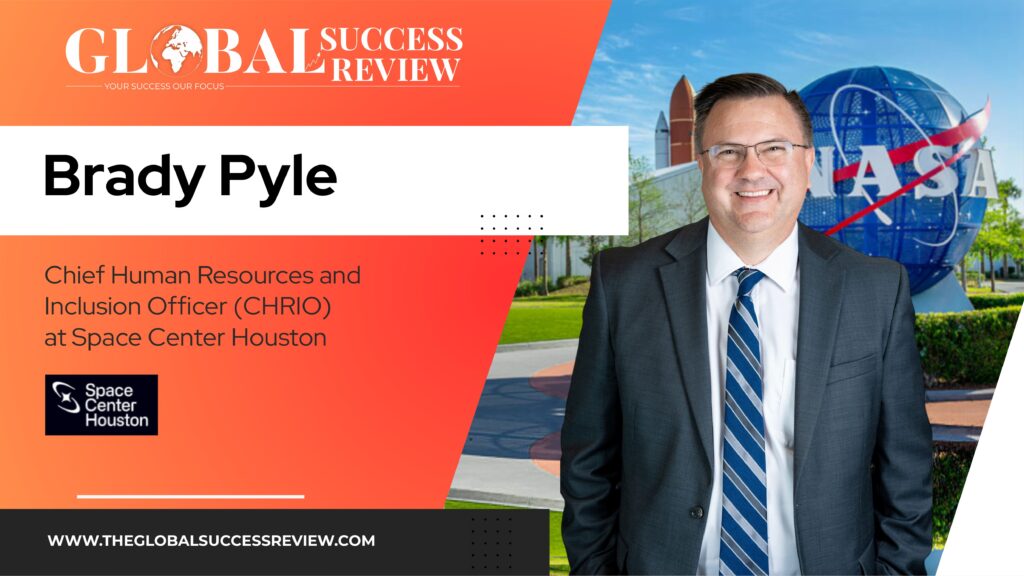
As the Chief Human Resources and Inclusion Officer (CHRIO) at Space Center Houston, Brady brings a rare combination of operational excellence, strategic foresight, and deeply human leadership. His journey, from a young student inspired by public service to a transformative HR executive within NASA and beyond, reflects a lifelong commitment to one core mission: improving leadership wherever he goes.
A Calling Rooted in Purpose and Public Service
Brady Pyle’s leadership journey began not in a boardroom, but in a moment of clarity during his formative years. As a ninth-grade student, he felt a distinct calling toward government service, inspired by the legacy of his father and grandfather, who served as helicopter mechanics at the Corpus Christi Army Depot.
Determined to carve his own path within that tradition, Brady pursued higher education at Texas A&M University, leveraging cooperative education opportunities to explore various professional fields. His early experiences, from accounting roles to federal internships- provided valuable lessons, particularly the importance of discovering not only what aligns with one’s strengths, but also what does not.
It was during his time with the Department of Health and Human Services that Brady discovered his affinity for human resources, not as a policy-driven function, but as an operational and people-centered discipline. That realization would define the trajectory of his career.
From Foundations to Flight: A Career Built at NASA
Brady’s professional ascent took a defining turn when he joined NASA’s Johnson Space Center as a Graduate Co-op. What began as an opportunity quickly evolved into a 30-year career that would position him at the heart of one of the world’s most complex and high-performing organizations.
Over the years, he served in a variety of roles, each contributing to his comprehensive understanding of human capital strategy. From HR Business Partner roles to leadership development, workforce planning, and executive HR leadership, Brady’s career at NASA became a living laboratory for leadership innovation.
One of the defining aspects of his tenure was his ability to operate at the intersection of technical excellence and human dynamics. Working alongside scientists, engineers, and astronauts required not only data-driven decision-making but also the ability to influence highly analytical minds with credibility and clarity.
Brady quickly learned that in such environments, trust is earned through preparation, insight, and the ability to translate complex human challenges into structured, evidence-based solutions.
Leadership Philosophy: Leading from the Inside Out
At the core of Brady Pyle’s leadership approach is a philosophy grounded in self-awareness and intentionality: leadership begins within.
He believes that effective leaders must first understand their own values, motivations, and behaviors before they can meaningfully lead others. For Brady, those values were instilled early: integrity, excellence, and continuous improvement, principles that continue to guide his decisions and interactions.
His approach extends beyond traditional leadership frameworks. While many leaders adhere to the Golden Rule, treating others as they wish to be treated, Brady advocates for the Platinum Rule: treating others as they want to be treated. This shift reflects a deeper commitment to empathy, individuality, and inclusive leadership.
Equally important is his belief in “humble inquiry”, asking thoughtful questions rather than prescribing immediate solutions. This philosophy not only fosters trust but also empowers teams to think critically and contribute meaningfully. You can learn more about Brady’s philosophy and stories behind it in the book he published last year, Out of This World Leadership.
Transforming HR into a Strategic Powerhouse
Throughout his career, Brady has consistently elevated the role of Human Resources from administrative function to a strategic driver. One of his most impactful contributions at NASA was leading a large-scale transformation of the HR service delivery model.
Faced with the challenge of reducing costs by $7 million over five years, Brady spearheaded a shift from a decentralized HR structure to a functionally managed model. While achieving the financial targets was significant, his true legacy lies in establishing a consistent HR Business Partner model across all NASA centers.
This initiative ensured that HR professionals were not just service providers, but trusted advisors embedded within the business, aligning people strategies directly with mission outcomes.
His leadership during this transformation exemplified his ability to balance operational efficiency with long-term cultural impact.
The Power Trio: Workforce, Culture, and Care
In his current role at Space Center Houston, Brady defines the responsibilities of modern HR leadership through what he calls the “power trio”:
- Ensuring workforce capability for the future
- Stewarding organizational culture
- Taking care of people
This framework reflects a holistic approach to leadership, one that recognizes that organizational success is inseparable from the well-being, engagement, and development of its people.
Under his guidance, Space Center Houston has implemented forward-thinking initiatives in workforce planning, leadership development, and employee benefits, earning recognition as a top benefits provider in its sector.
Building Culture the NASA Way
Brady’s thought leadership extends beyond organizational impact into the broader HR community through his writing and speaking engagements. His work focuses on translating the principles of high-performance cultures, like those at NASA, into actionable strategies for organizations across industries.
His latest book Building Culture the NASA Way introduces a practical framework for culture building:
- Navigate organizational history
- Assess and adapt to current realities
- Strengthen leadership and systems
- Activate inclusion and innovation
These principles are not theoretical constructs but lessons forged in environments where the stakes are extraordinarily high. They emphasize that culture is not a byproduct of strategy; it is the foundation that enables it.
Inclusion as a Performance Driver
One of the defining elements of Brady’s leadership is his commitment to inclusion, not as a compliance requirement, but as a strategic imperative.
At Space Center Houston, inclusion is positioned as both a performance amplifier and a risk-reduction strategy. By fostering diverse perspectives and psychological safety, the organization enhances innovation, decision-making, and overall effectiveness.
Brady emphasizes that culture is shaped by leadership behavior, particularly in moments of difficulty. Through structured listening, engagement surveys, and targeted initiatives, his team ensures that inclusion is embedded into every aspect of the organization.
Coaching: The Heart of Leadership Development
For Brady, leadership development is inseparable from coaching. He believes that great leaders do not wait for problems to arise, they proactively invest in building capability, confidence, and commitment within their teams.
His coaching philosophy is rooted in listening, inquiry, and partnership. Rather than directing solutions, leaders are encouraged to co-create them with their teams, fostering ownership and innovation.
This approach not only strengthens individual performance but also cultivates a culture of trust and continuous learning.
Lessons from Crisis: Putting People First
One of the most profound chapters in Brady’s career came during the COVID-19 pandemic. As organizations worldwide grappled with uncertainty, NASA faced unique challenges in transitioning to a largely remote workforce.
The shift revealed the risks of overwork and isolation, particularly in a mission-driven environment where employees are deeply committed to their roles. Recognizing this, NASA leadership made a pivotal decision to prioritize people over mission timelines, marking a shift from “Mission First, People Always” to “People First, Mission Always.”
Brady and his HR team played a central role in supporting this transition, providing leaders with tools to navigate remote work, manage stress, and maintain engagement. These efforts not only sustained performance but also improved leadership and engagement scores across the organization.
The Future of HR: Bridging Technology and Humanity
Looking ahead, Brady envisions a future where HR serves as a critical bridge between technology and human potential. As artificial intelligence and automation reshape the workplace, HR leaders must evolve into translators, connecting business strategy, technological innovation, and people development.
He emphasizes that while technology will enhance efficiency and data-driven decision-making, the human element remains irreplaceable. Emotional intelligence, continuous learning, and a commitment to people-first leadership will define success in this new era.
Personal Leadership: A Whole-Person Approach
Beyond his professional achievements, Brady’s leadership is deeply personal. A defining moment in his life came through a conversation that reshaped his perspective on work-life balance, reminding him of the importance of nurturing relationships alongside career ambitions.
This experience reinforced his belief in a whole-person approach to leadership, recognizing that individuals perform best when they are supported not only professionally but also personally.
His commitment to mentorship further reflects this philosophy. By encouraging leaders to identify their own “Mount Rushmore” of mentors, he underscores the importance of learning from others and building meaningful connections.
Recognition and Legacy
Brady Pyle’s contributions have been widely recognized through numerous awards and honors, including leadership medals, innovation awards, and accolades for culture and inclusion.
However, his greatest achievement lies not in recognition, but in the leaders he has developed and the cultures he has shaped. Throughout his career, he has consistently focused on building successors, ensuring that each role he leaves is strengthened for the future.
A Vision for the Future
As one of “The Most Visionary HR Leaders Shaping the Future of Leadership in 2026,” Brady Pyle embodies the evolution of modern leadership. His work demonstrates that true influence is not measured by authority, but by the ability to inspire, develop, and empower others.
His vision for the future is clear: organizations must prioritize people, foster inclusive cultures, and embrace continuous learning to navigate an ever-changing world.
In his own words, the HR leaders of today are the CEOs of tomorrow.
Final Reflections
Brady Pyle’s journey is a testament to the transformative power of leadership grounded in purpose, humility, and resilience. From the corridors of NASA to the dynamic environment of Space Center Houston, he has consistently demonstrated that leadership is not about having all the answers; it is about asking the right questions, building strong relationships, and creating environments where people can thrive.
As organizations worldwide look toward the future, leaders like Brady offer a powerful reminder: when we invest in people, we unlock the potential to achieve extraordinary outcomes.
The Global Success Review Magazine proudly recognizes Brady Pyle as a visionary leader whose impact continues to shape the future of leadership, culture, and human capital excellence.