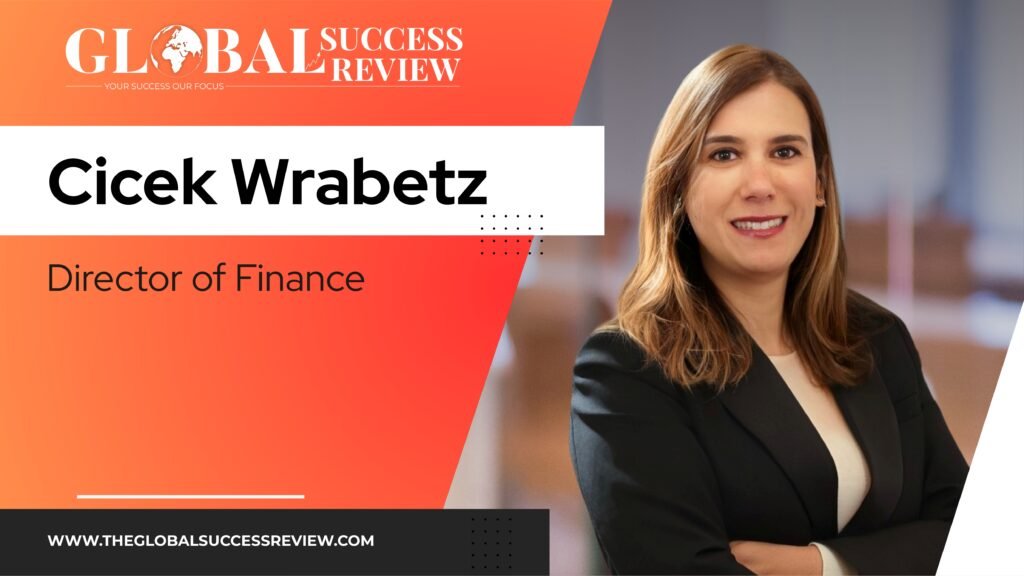
The Most Outstanding Women in Financial Leadership 2026
Cicek Wrabetz
Director of Finance
In an era when financial leadership is evolving far beyond reporting numbers and managing budgets, Cicek Wrabetz represents a generation of finance leaders who understand that the true value of finance lies in connecting data, strategy, people, and business outcomes. As a Director of Finance in the pharmaceutical industry, her career has been shaped by international experience, analytical thinking, strategic planning, business partnership, and a deep commitment to developing people.
For Wrabetz, finance has never been simply about numbers. It is about understanding the story behind those numbers, asking the right questions, challenging assumptions, and helping leaders make better decisions. Her perspective has been strengthened by working across countries, cultures, markets, and business environments, experiences that have taught her to look beyond financial performance and understand the broader forces influencing an organization.
Her leadership philosophy is grounded in three principles: trust, empowerment, and accountability. She believes leaders do not need to have every answer. Instead, they need to create clarity, bring the right people together, ask challenging questions, and give their teams the confidence and opportunity to make informed decisions.
This combination of financial discipline and human-centered leadership has become a defining feature of Wrabetz’s career and the reason she stands out among The Most Outstanding Women in Financial Leadership 2026.
Beyond the Numbers: Finding the Story Behind Finance
Wrabetz’s attraction to finance began with the discipline’s analytical nature. The opportunity to examine facts, understand business performance, and connect financial information to real-world business impact provided the foundation for her career.
Yet, over time, her understanding of finance became much broader.
She came to see financial leadership not as a function that simply produces reports, but as a discipline that helps organizations understand where they are, where they could go, and what decisions are necessary to reach their goals.
For her, the most valuable financial insight emerges when numbers are connected to the realities of the business.
That means understanding commercial priorities, operational challenges, market dynamics, healthcare systems, customers, regulations, and organizational behavior. It also means providing leaders with different perspectives and recommendations rather than simply presenting financial information.
Her international career further strengthened this approach. Working across different countries and markets exposed her to different ways of thinking and operating. The same business situation could be interpreted differently by people from different cultures and market environments, and, importantly, several of those perspectives could be valid.
Rather than seeing those differences as obstacles, Wrabetz learned to approach them with curiosity.
That curiosity has become an important component of her leadership style.
An International Perspective on Leadership
One of the defining characteristics of Wrabetz’s professional journey has been her experience working internationally.
Moving between countries was never simply a professional transition from one position to another. Each move required her to understand a new business environment, adapt to a different culture, communicate in new contexts, and overcome personal challenges associated with living and working in unfamiliar surroundings.
Those experiences proved formative.
They taught her adaptability and strengthened her appreciation for diverse perspectives. They also demonstrated that successful leadership cannot rely on a single formula.
“What works in one market cannot necessarily be applied to another,” is a principle reflected throughout her leadership philosophy.
Markets differ. Healthcare systems differ. Customers behave differently. Regulations vary. Economic conditions change. Organizational cultures have their own characteristics.
Consequently, Wrabetz believes leaders must listen before acting.
Her approach is to understand what matters to local teams and stakeholders, learn from their experiences, and then apply that knowledge to decision-making. This international perspective has helped her become comfortable navigating complexity and making decisions even when information is incomplete.
It has also influenced the way she leads teams: by encouraging people to bring their own perspectives to the table.
For Wrabetz, leadership is fundamentally about connecting people, perspectives, business priorities, and opportunities.
Finance as a Strategic Business Partner
The finance function has undergone a significant transformation. Once primarily associated with reporting, budgeting, and compliance, finance is increasingly expected to contribute directly to growth, investment decisions, business transformation, and organizational strategy.
Wrabetz embraces this evolution.
Modern finance leaders, in her view, must identify growth opportunities, evaluate investments, optimize resource allocation, challenge commercial decisions, and translate complex data into actionable insights.
This transformation also requires finance professionals to work beyond their traditional boundaries.
Commercial teams, supply chain, human resources, operations, IT, medical functions, and market access all contribute different perspectives to an organization. Finance has the opportunity to bring these perspectives together and create a common language around performance, investment, risk, and value creation.
This is particularly important in the pharmaceutical industry, where organizations operate within complex regulatory environments while simultaneously facing market pressures, investment decisions, innovation requirements, and the responsibility of supporting better outcomes for patients.
For Wrabetz, finance can contribute meaningfully to this environment by ensuring that financial discipline and innovation reinforce rather than contradict one another.
“Financial discipline” does not mean restricting innovation. Instead, she views it as the foundation for understanding where an organization creates value and where resources should be allocated.
Once that visibility exists, organizations can make informed investments for the future.
Strategic Planning and the Power of Perspective
Among the many areas of finance in which Wrabetz has developed expertise, strategic and long-term planning have had a particularly significant influence on her leadership journey.
Strategic planning requires more than understanding financial figures. It demands collaboration across functions and the ability to engage with people whose responsibilities may initially appear distant from finance.
These interactions can produce perspectives that challenge established assumptions and create opportunities for better decisions.
Long-term planning also provides finance leaders with an opportunity to participate in major investment decisions and contribute to the broader strategic direction of an organization.
For Wrabetz, every chapter of a career matters.
Her experience across FP&A, financial reporting, internal controls, financial modeling, and strategic planning has demonstrated that professional development is cumulative. Even experiences that initially appear less relevant can eventually become valuable when viewed in a broader leadership context.
This belief encourages professionals to collect experiences, learn continuously, and remain open to opportunities outside their comfort zones.
Leading Through Uncertainty
Uncertainty has been one of the most significant challenges throughout Wrabetz’s career.
In business, leaders rarely have perfect information. Market conditions change, regulations evolve, economic circumstances shift, and unexpected developments can alter strategic assumptions.
Wrabetz has learned that leaders cannot always control the environment around them. They can, however, control how they respond.
Her approach is therefore to focus on what can be influenced, identify what is within her control, and move forward with clarity.
Over time, uncertainty can become a source of resilience.
It teaches leaders to communicate more transparently, have difficult conversations, make challenging decisions, and develop confidence even when outcomes are not guaranteed.
This philosophy is closely connected to her approach to strategic financial planning.
Agility, she believes, depends heavily on the quality and timeliness of information. Leadership teams require a reliable single source of truth to make confident decisions, particularly during periods of volatility.
Thorough planning and flexible execution therefore go hand in hand.
Rather than relying on a single forecast, finance leaders must consider multiple scenarios, evaluate risks and opportunities, and remain prepared to reallocate resources as circumstances change.
The objective is not to predict every possible development.
It is to build an organization capable of responding intelligently when conditions change.
The Digital Future of Finance
Technology is rapidly redefining the finance profession, and Wrabetz sees digital transformation as one of the most important opportunities for the function.
Automation can reduce the amount of time finance professionals spend on repetitive processes, allowing them to focus more heavily on analysis, insight, and decision-making.
Artificial intelligence, advanced analytics, predictive capabilities, scenario modeling, and other digital tools are creating new possibilities for understanding business performance.
Wrabetz believes finance organizations should increasingly use these capabilities to examine businesses from multiple angles, identify emerging risks, understand investment requirements, and uncover opportunities for growth.
The transformation of FP&A is especially important.
She sees significant potential in moving FP&A beyond being viewed simply as a process that needs to be completed. Instead, it can become a genuine growth catalyst by helping organizations understand how the future may develop and where action is required today.
The future finance organization, therefore, will not be defined simply by how quickly it produces reports.
It will be defined by how effectively it turns information into decisions.
Technology will enable this transformation, but technology alone will not create value. Wrabetz believes the strongest organizations will combine technological capabilities with strong business partnering.
The winning formula will be technology plus human judgment, data plus business understanding, and automation plus strategic thinking.
Innovation With Governance and Integrity
The pharmaceutical sector presents a particularly complex environment for financial leadership. Innovation is essential, but organizations must also maintain rigorous governance, compliance, risk management, and financial discipline.
Wrabetz sees these priorities as complementary.
Finance can support innovation through investment-case evaluation, forecasting, scenario development, risk analysis, opportunity assessment, profitability analysis, customer and channel analysis, and KPI reporting.
At the same time, automated processes and technology must include robust controls capable of supporting the governance requirements of highly regulated businesses.
For Wrabetz, integrity remains fundamental.
Finance may sometimes be the function that says “no,” but effective financial leadership also requires understanding how to say “yes” responsibly.
That distinction captures her philosophy particularly well.
The purpose of finance is not to prevent growth. It is to help organizations pursue sustainable growth intelligently.
Trust as the Foundation of Leadership
For Wrabetz, credibility cannot be created through titles alone.
Trust comes from transparency, reliability, business understanding, and consistent action.
If a leader makes a commitment, that commitment must be supported by delivery.
This principle is particularly important in cross-functional and international environments, where finance leaders must earn the confidence of executive leadership, commercial teams, operational colleagues, and other stakeholders.
Wrabetz strives to ensure that colleagues see finance as a trusted business partner rather than simply a control function.
That requires finance professionals to understand the areas they support.
Medical, commercial, market access, operational, and other functions all have different priorities and challenges. Finance leaders who understand those realities can contribute more effectively to decision-making.
Trust, therefore, is built through proximity to the business.
It is built by listening.
It is built by understanding.
And ultimately, it is built by ensuring that actions consistently support words.
Developing People and Building High-Performing Teams
While strategic finance and business transformation are central to Wrabetz’s professional responsibilities, people development is one of the accomplishments she values most deeply.
For her, leadership success is not measured solely by personal achievements.
It is also measured by the people who grow around the leader.
High-performing teams require trust, empowerment, accountability, clear priorities, and continuous development. Leaders must create an environment in which people understand the organization’s broader purpose and see how their own contributions connect to that purpose.
When employees understand the strategy and the reasoning behind important decisions, collaboration becomes easier.
Open communication creates space for different perspectives. Shared objectives create alignment. Respect creates stronger relationships.
Wrabetz also believes development must extend beyond technical expertise.
Future leaders need business acumen, strategic thinking, communication skills, and leadership capabilities alongside their professional knowledge.
This balanced approach allows organizations to create teams that are not only capable of delivering strong performance today but also prepared to handle tomorrow’s challenges.
Advancing Women in Financial Leadership
Wrabetz’s recognition as one of The Most Outstanding Women in Financial Leadership 2026 carries significance beyond personal achievement.
Her more than two decades of professional experience have included moments that required her to believe in herself, step outside her comfort zone, and embrace unfamiliar challenges.
She sees those moments not as barriers but as opportunities for growth.
Gender diversity has evolved considerably throughout her career. In the pharmaceutical industry, women are increasingly visible in senior leadership positions across functions.
Yet, Wrabetz believes the next stage of progress must go beyond representation.
The goal should not simply be to increase the number of women within leadership structures. Women must also have genuine opportunities to influence strategy, transformation, complex business decisions, and organizational outcomes.
Her advice to aspiring women finance professionals is clear: build broad business knowledge, strengthen networks, embrace transformation, explore unfamiliar areas, and remain authentic.
Professional ambition and authenticity do not have to compete with each other.
A leader can be professionally strong while remaining true to her own leadership style.
Building Resilience for the Long Term
Leadership effectiveness is not created during a single moment of pressure.
Wrabetz believes resilience must be developed consistently over time.
Strong values, meaningful relationships, curiosity, and regular self-reflection are among the habits that help sustain her effectiveness.
She compares leadership to sports, where consistency and adaptability must be developed over time.
Success and uncertainty are both parts of a long journey.
The ability to remain grounded while adapting to changing circumstances allows leaders to sustain performance without losing perspective.
This long-term mindset is central to Wrabetz’s understanding of leadership.
A Vision for the Next Generation
Looking toward the next five years, Wrabetz identifies three central priorities: building a finance organization prepared for future transformation, strengthening finance’s role as a strategic business partner, and developing the next generation of leaders.
Her vision extends beyond financial performance.
She wants finance organizations to become digitally enabled, strategically influential, deeply trusted, and committed to developing people.
Within healthcare and pharmaceuticals, this vision carries an even broader purpose.
Finance has a unique ability to connect strategy, performance, risk management, capital allocation, and execution. When these elements work together effectively, organizations can remain financially sustainable while continuing to invest in innovation and ultimately contribute to better outcomes for patients.
For Wrabetz, legacy is therefore not about a title or a single achievement.
It is about lasting impact.
She hopes to leave behind a finance organization recognized as a trusted strategic partner, combining strong governance with innovation, commercial insight, and value creation.
Just as importantly, she hopes to be remembered for developing people and creating opportunities for others to grow.
Her definition of leadership is perhaps best captured in this belief: the most sustainable measure of leadership is not what one accomplishes personally, but how many future leaders one helps create.
Leadership With Purpose
Cicek Wrabetz’s journey demonstrates how the modern finance leader can become far more than a guardian of financial performance.
She represents a model of leadership in which analytical rigor is combined with curiosity, financial discipline with innovation, governance with growth, and strategic thinking with genuine investment in people.
Her international experience has taught her to listen to different perspectives. Her finance career has taught her to turn data into insight. Her leadership experience has taught her the importance of trust, accountability, and empowerment. And her perspective on the future has given her a clear commitment to digital transformation, strategic business partnership, and developing future leaders.
In a rapidly changing pharmaceutical and global business environment, those qualities are increasingly essential.
The finance leaders of tomorrow will need to understand technology without losing human judgment, pursue growth without compromising integrity, and make decisions with both business sustainability and broader impact in mind.
Cicek Wrabetz is already building toward that future.
Her story is ultimately one of finance with purpose: using insight to guide strategy, discipline to enable sustainable growth, technology to improve decision-making, and leadership to create opportunities for others.

That is what makes her a compelling representative of The Most Outstanding Women in Financial Leadership 2026 and a leader whose influence extends beyond the numbers to the people, organizations, and outcomes those numbers ultimately serve.