Redefining Human Decision-Making Through Behavioral Science
How One of the World’s Most Influential Behavioral Economists Is Transforming the Way Humanity Understands Choice, Trust, and Irrationality
Some of the world’s greatest breakthroughs begin not in laboratories or boardrooms, but in moments of profound personal adversity. For Professor Dan Ariely, one of the world’s foremost authorities on behavioral economics, the journey toward reshaping modern decision science began with a life-altering tragedy that ultimately became a lifelong pursuit of understanding human behavior.
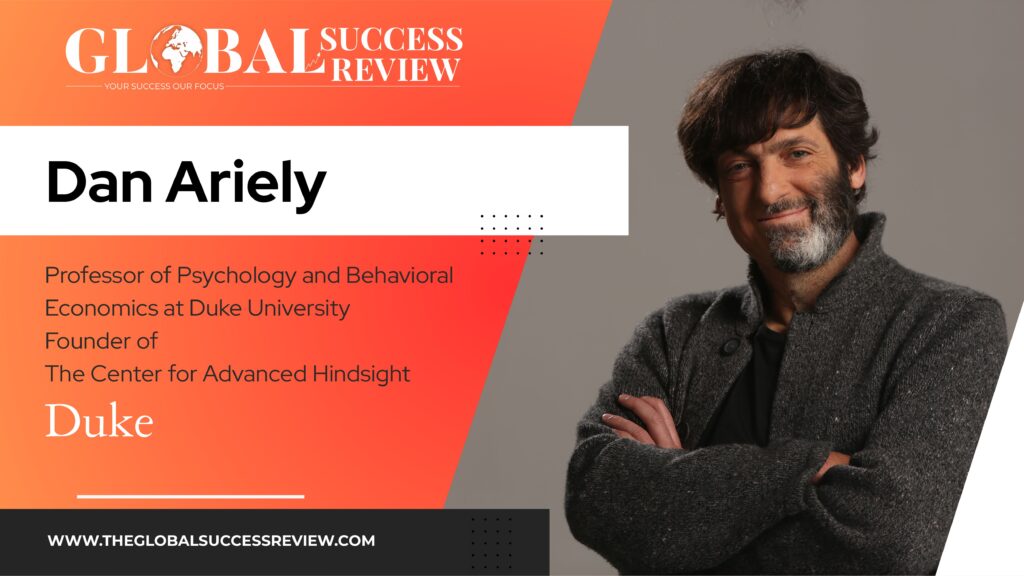
Today, as Professor of Psychology and Behavioral Economics at Duke University and Founder of The Center for Advanced Hindsight, Ariely has transformed the way governments, corporations, healthcare institutions, policymakers, and millions of individuals understand the hidden forces behind everyday decisions. His pioneering research has demonstrated that human beings are not perfectly rational decision-makers, as traditional economic theory once assumed, but rather predictably irrational, a concept that has fundamentally changed economics, psychology, business strategy, public policy, and organizational leadership around the world.
In recognition of his extraordinary influence, The Global Success Review Magazine™ proudly honors Dan Ariely as one of “The Most Influential Thought Leaders Shaping Behavioral Economics in 2026.” This recognition celebrates not only his remarkable academic achievements but also his unwavering commitment to transforming scientific discoveries into practical solutions that improve people’s lives.
What distinguishes Ariely’s work is not simply his ability to explain why people make irrational choices, but his dedication to designing systems that help individuals make better ones. His research extends beyond understanding behaviour; it is about improving it through thoughtful, evidence-based design.
A Journey Born from Adversity
At the age of eighteen, Dan Ariely experienced an event that would forever alter the course of his life. A devastating accident left him with severe burns across much of his body, resulting in nearly three years of hospitalization and rehabilitation.
During this difficult period, he witnessed something that would spark an intellectual curiosity lasting decades. Every day, nurses removed his bandages in one swift motion, believing that minimizing the duration of pain was the kindest approach. Yet Ariely’s lived experience suggested otherwise. The procedure was intensely painful, and he questioned whether conventional medical wisdom truly reflected patients’ realities.
Rather than accepting established practices, Ariely began asking questions.
Could experienced professionals, despite their compassion and expertise, be mistaken about something as fundamental as pain? If intuition could fail in such an important area, where else might human judgment be systematically flawed?
These questions became the foundation of a career devoted to understanding the remarkable gap between how people believe they make decisions and how they actually behave.
Instead of allowing personal tragedy to define his future, Ariely transformed it into a powerful source of intellectual purpose. What began as the observations of a patient evolved into a global movement that has challenged long-standing assumptions about human rationality.
His story illustrates an enduring truth: curiosity often emerges from discomfort, and meaningful innovation frequently begins with questioning accepted beliefs.
Understanding Predictable Irrationality
Classical economics traditionally portrays individuals as logical, self-interested decision-makers who consistently maximize value through rational choices. Ariely’s research challenged this assumption with compelling empirical evidence.
His central philosophy is elegantly simple yet profoundly transformative:
People are irrational, but their irrationality follows predictable patterns.
This insight fundamentally reshaped behavioral economics. Rather than viewing mistakes as random accidents, Ariely demonstrated that people consistently fall into recognizable psychological patterns. Individuals procrastinate despite good intentions, overvalue free offers regardless of actual savings, respond disproportionately to discounts, postpone important financial decisions, and occasionally compromise their own ethical standards while still maintaining a positive self-image.
Far from viewing these behaviors as weaknesses, Ariely sees them as opportunities for understanding.
If human errors occur systematically, they can be studied scientifically. If they can be studied, they can be anticipated. And if they can be anticipated, better environments, institutions, and systems can be designed to help people make wiser decisions.
This optimistic perspective has become one of the defining characteristics of Ariely’s work. Rather than criticizing human imperfection, he embraces it as an essential part of our shared humanity.
Perhaps most importantly, Ariely consistently includes himself among those subject to cognitive biases. He rejects the notion of the detached scientist observing irrational subjects from a distance. Instead, he openly acknowledges that researchers are equally susceptible to the same behavioral tendencies they study.
This humility has made his work both scientifically credible and widely relatable. Readers, executives, policymakers, and students alike recognize themselves within his research because Ariely never presents behavioral economics as a study of “other people.” Instead, it becomes an exploration of all of us.
Making Complex Science Remarkably Human
One of Dan Ariely’s greatest strengths lies not only in discovering important behavioral insights but in communicating them with extraordinary clarity.
Behavioral economics encompasses complex psychological theories, statistical research, and sophisticated experimental methodologies. Yet Ariely has consistently succeeded in translating these concepts into stories that resonate with audiences far beyond academia.
His philosophy of communication begins with a simple principle: start with experiences rather than definitions.
Instead of introducing technical terminology, Ariely invites people into familiar situations: a forgotten gym membership, the temptation of “free” shipping, an impulsive purchase during a sale, or a seemingly harmless ethical compromise. These relatable moments create immediate emotional connections before scientific explanations are introduced.
By replacing jargon with everyday language, he demonstrates profound respect for his audience. His objective is never to simplify ideas by removing their complexity, but rather to reveal that complexity through clarity.
Humor also plays a central role in his teaching style. Ariely frequently uses self-deprecating stories to remind audiences that irrationality is universal rather than exceptional. This approachable style encourages reflection without judgment, allowing individuals to examine their own decision-making more openly.
Perhaps his most powerful question is also his simplest:
“What does this mean for you?”
For Ariely, knowledge without application has limited value. Every research finding should ultimately help individuals improve their health, finances, relationships, professional performance, or overall well-being.
This relentless focus on practical impact has helped behavioral economics move beyond university classrooms into boardrooms, government agencies, hospitals, technology companies, and public institutions across the globe.
Purpose Beyond Recognition
Being recognized among the world’s most influential thought leaders represents far more than a personal achievement for Ariely.
He views such recognition as evidence that behavioral economics itself has matured into a globally significant discipline.
When Ariely began his career, behavioral economics occupied a relatively small niche within academia. Today, its principles influence product design, financial planning, healthcare delivery, education, organizational culture, digital experiences, public policy, and corporate governance.
For Ariely, this evolution represents the true reward.
Rather than treating awards as destinations, he considers them invitations to continue contributing meaningful work. Scientific progress, he believes, is never the accomplishment of one individual but the result of collaboration among researchers, students, institutions, and countless participants whose willingness to question assumptions advances collective understanding.
That philosophy continues to define his remarkable career.
Whether conducting groundbreaking experiments, mentoring future scholars, advising global organizations, or helping individuals make better decisions, Dan Ariely remains guided by one enduring mission: to build a world designed not for perfectly rational people who do not exist, but for real human beings, with all their imperfections, aspirations, contradictions, and extraordinary potential.