Chief UI/UX Architect & Founder
Featured in The Global Success Review Magazine™
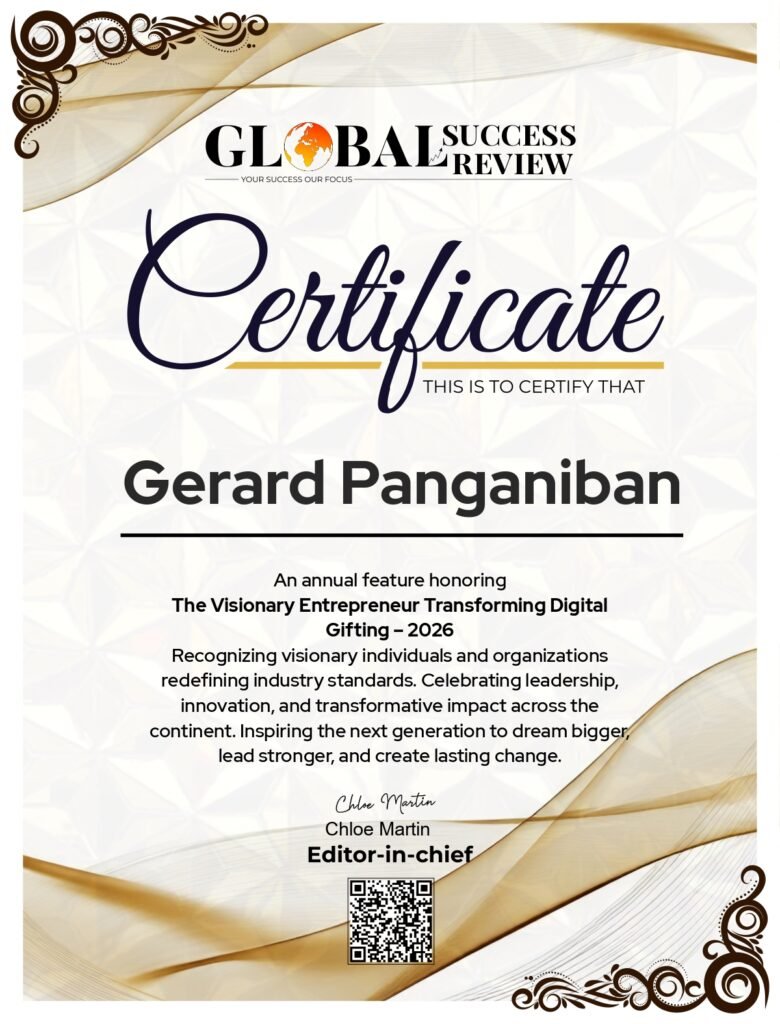
The Visionary Entrepreneur Transforming Digital Gifting – 2026
A meaningful gift can strengthen a relationship, recognize an achievement, express gratitude, or simply remind someone that they matter. Yet, despite the emotional importance of gifting, the process of choosing and delivering the right gift can often become complicated. People forget important dates, struggle to understand what someone truly wants, and sometimes resort to last-minute purchases that lack the thoughtfulness they intended.
For Gerard Panganiban, Chief UI/UX Architect, entrepreneur, and three-time founder, that familiar frustration became the starting point for a much bigger idea.
His entrepreneurial journey has been shaped by years of observing businesses grow patiently from the ground up, combined with practical experience in web development, graphic design, technology, eCommerce, healthcare, and other ventures. What began with freelance work and a simple entrepreneurial ambition eventually led to the creation of G-Designs, which grew into Graphyte Technologies LLC in 2019.
Today, Panganiban is applying that experience to Giftinity, a gifting-as-a-service platform designed to make gifting simpler, more personalized, accessible, and less stressful for individuals and organizations.
His philosophy is straightforward but deeply rooted in patience: meaningful businesses, like meaningful relationships, take time to develop.
“I see building a business like farming, where you plant seeds and only see the harvest years later.”
That perspective has become central to Panganiban’s approach to entrepreneurship. Rather than pursuing quick wins, he emphasizes continuous iteration, customer feedback, simplicity, and long-term product-market fit.
For him, entrepreneurship is not about having every answer at the beginning. It is about having the patience to keep learning until the right answer emerges.
From a Personal Frustration to a Business Opportunity
The story behind Giftinity is remarkably personal.
Like many people, Panganiban has experienced the uncomfortable feeling of realizing that an important occasion has arrived without having a gift prepared. Whether it was for his wife, his mother, or another important person in his life, forgetting an occasion could result in a last-minute search for something that might resemble a gift.
Sometimes, that meant making a quick stop at a gas station or convenience store.
Those experiences revealed a broader problem.
Gifting was supposed to be thoughtful, but the process of finding the right gift could be stressful, time-consuming, and disconnected from the recipient’s actual preferences.
That realization became the foundation for Giftinity.
The original concept began as a graduate-school project: a simple reminder application designed to help people remember birthdays and other important life events. The goal was straightforward: to prevent people from forgetting the moments that matter.
But the concept did not remain static.
It evolved through an eCommerce phase, followed by an AI-based recommendation phase, before becoming the gifting-as-a-service platform it is today.
The technology changed. The business model evolved. The product continued to be refined.
But the central mission remained consistent:
Make gifting simple, thoughtful, and stress-free.
That evolution illustrates one of Panganiban’s strongest entrepreneurial beliefs: the first idea does not necessarily have to be the final idea.
The willingness to pivot, experiment, and learn from the market can be more valuable than attempting to protect an original concept at all costs.
Building with Patience, Iteration and Resilience
Panganiban’s entrepreneurial philosophy has been shaped by a lesson that many founders learn only after years of experience: success frequently takes longer than expected.
He points to Amazon’s long path toward profitability as an example of the patience required to build something substantial. For Panganiban, the lesson is not simply about Amazon. It is about understanding that businesses often require years of experimentation before their full potential becomes visible.
That mindset has been particularly important throughout the Giftinity journey.
The company experienced difficult periods, including the departure of several founding team members when results did not arrive as quickly as they had hoped.
Such moments can test a founder’s confidence in a business model and its future direction.
For Panganiban, however, those experiences became lessons in resilience.
They reinforced the idea that entrepreneurship has no guaranteed timeline and that founders must sometimes continue building without a clearly visible finish line.
Rather than interpreting setbacks as reasons to stop, he treats them as part of the iterative process.
His approach reflects a broader startup philosophy: failure can become data when it is used to improve the next decision.
That philosophy also influences the culture he seeks to create within his teams.
Inspired by the experimentation culture associated with Silicon Valley startups, Panganiban encourages trial and error. Instead of creating an environment where people are afraid to experiment, he believes teams should be able to test ideas, learn from outcomes, and continuously improve products and systems.
For a technology company operating in a rapidly changing market, that mindset can be essential.
Reimagining Gifting as a Service
At its core, Giftinity is designed to address a simple but widespread challenge: people want to give meaningful gifts, but they do not always know what the recipient actually wants.
This becomes even more complicated in professional environments.
Businesses regularly send gifts to employees, clients, vendors, partners, and colleagues. Yet conventional corporate gifting can sometimes result in products that recipients do not want or use.
Panganiban has personally observed situations in which gifts were ignored, discarded, or re-gifted.
For him, this represents more than wasted money. It represents a missed opportunity to create a meaningful connection.
Giftinity approaches the problem differently by placing the recipient at the center of the experience.
Rather than relying entirely on the giver to guess what someone might appreciate, Giftinity allows recipients to choose from gifts they actually want.
The giver can still participate in the experience and express the thought behind the gesture, while technology helps remove some of the uncertainty.
The result is intended to shift gifting from guesswork toward preference-driven personalization.
Giftinity’s model is also designed to address another challenge: accessibility.
Many businesses rely on enterprise platforms such as CRM, HR, customer-support, or workforce-management systems. While these tools can be powerful, they can also be excessive or inaccessible for small businesses and individuals who simply want an organized way to send thoughtful gifts.
Giftinity does not require users to deploy complicated enterprise infrastructure.
The platform is designed to work through a browser or mobile device without requiring systems such as Salesforce, HubSpot, Zendesk, ADP, or Okta.
That simplicity is especially important to Panganiban because of his experience working with small and medium-sized businesses.
His vision is not to create another complicated enterprise system.
It is to make an enterprise-like gifting capability accessible to people who may never need or afford an enterprise technology stack.
Where Artificial Intelligence Meets Human Emotion
Artificial intelligence is rapidly changing digital commerce, but Panganiban believes technology should not eliminate the human element.
Instead, it should remove unnecessary friction.
This principle is central to Giftinity’s AI Gift Concierge, which is designed to help users discover appropriate gift options without forcing them to navigate endless product pages.
Panganiban compares the ideal AI experience to a knowledgeable hotel concierge.
A good concierge does not overwhelm a guest with hundreds of possibilities. Instead, the concierge listens, understands the need, narrows the choices, and helps the guest arrive at an appropriate decision.
Panganiban believes AI-powered gifting should work in much the same way.
The technology should reduce decisions rather than create more of them.
Most importantly, AI must earn the user’s trust.
If the system feels as though it is simply guessing, the experience quickly loses credibility.
This is where his background as a UI/UX architect becomes particularly relevant.
For Panganiban, good technology should feel effortless.
The interface, recommendations, reminders, and logistics should work quietly in the background, allowing the human experience to remain at the center.
In his view, technology should handle the friction.
The people should handle the meaning.
Designing Around the User
Panganiban’s UI/UX background gives him a distinct perspective on product development.
For him, usability is not merely about attractive interfaces. It is about reducing cognitive effort and helping people accomplish their goals naturally.
An AI-powered gifting experience, therefore, should not require users to become experts in AI.
It should understand what users are trying to accomplish and guide them toward useful outcomes.
That philosophy extends to personalization.
As digital commerce becomes increasingly data-driven, businesses have more opportunities to personalize recommendations. Yet Panganiban believes personalization should not become an excuse for excessive automation.
The recipient’s preferences should remain central.
Giving someone genuine choice can be more authentic than attempting to predict everything about them through demographics or algorithms.
Technology should support human connection rather than replace it.
This philosophy may become increasingly important as consumers encounter more AI-generated recommendations across commerce, entertainment, travel, finance, and other areas of daily life.
The successful platforms may not necessarily be those that use the most AI.
They may be those that use AI in ways that feel genuinely helpful.
The Mobile-First Future of Digital Gifting
Looking toward the next three to five years, Panganiban expects two forces to have a particularly significant impact on gifting: artificial intelligence and mobile-first experiences.
Together, they can make gifting faster, more personal, and easier to access.
The traditional gifting journey can involve multiple steps: remembering an occasion, researching options, comparing products, making a purchase, arranging delivery, and hoping the recipient appreciates the result.
AI has the potential to simplify much of that process.
Instead of endlessly searching, users may increasingly describe what they need in natural language and receive personalized recommendations almost immediately.
Panganiban envisions an experience similar to a luxury concierge or private chauffeur, attentive, efficient, personalized, and capable of anticipating needs before the user has to articulate every detail.
Importantly, he does not view the emergence of competing technologies as a threat to the broader concept.
He expects more AI-powered gifting platforms to emerge as the technology matures and welcomes that development as an opportunity for the industry to grow.
For Panganiban, innovation is not about preventing others from entering a market.
It is about helping move an entire category forward.
Expanding the Opportunity Without Losing the Core Mission
As Giftinity continues developing, Panganiban is exploring opportunities that could strengthen the company’s sustainability and reach.
These include potential marketplace opportunities involving platforms such as Amazon and Walmart, as well as adjacent areas including import/export operations, fulfillment logistics, product delivery, and fulfillment services.
Yet there is an important condition behind these explorations.
Every opportunity must strengthen the core gifting mission rather than distract from it.
This discipline is essential for a growing startup.
Technology markets can present countless opportunities, but pursuing every opportunity can dilute a company’s identity.
Panganiban’s approach is therefore to experiment while keeping the central service at the heart of the business.
The objective is not simply to become larger.
It is to build a stronger ecosystem around the problem Giftinity originally set out to solve.
A Vision Built for SMEs and Everyday Consumers
Panganiban’s long-term ambition for Giftinity extends considerably beyond the next three to five years.
The company is already generating revenue on a small scale, and his objective is to expand that performance substantially over time, moving from thousands toward tens of millions in annual sales.
But the financial ambition is only one dimension of the larger vision.
Panganiban ultimately wants Giftinity to become a go-to gifting-as-a-service platform for individuals and businesses that do not have access to sophisticated enterprise technology.
That includes small companies, startups, departments, local businesses, and everyday consumers.
This focus on accessibility is deeply connected to his own experience as an entrepreneur.
He understands that enterprise tools can be financially and operationally out of reach for many small businesses.
For the neighborhood shop, family-owned company, startup team, or individual consumer, the ideal solution is often not a complicated software ecosystem.
It is something simple that works.
Giftinity seeks to occupy that space.
Recognition Along the Journey
Panganiban’s work and Giftinity’s development have also received recognition from several industry and startup platforms.
In September 2026, Giftinity was recognized among F6S’s top Gifts companies and startups in the United States, as well as among F6S’s top Artificial Intelligence companies and startups in Illinois.
The company has also been ranked among online gifting companies on Tracxn, a global startup data and research platform.
Additional recognition includes LUXlife’s “The Perfect Gift Awards 2026”, while Giftinity was also named a 2026 Chicago Innovation Awards Nominee.
These recognitions represent milestones within a much longer entrepreneurial journey.
For Panganiban, recognition is validation, but not the destination.
Being named The Visionary Entrepreneur Transforming Digital Gifting – 2026 similarly represents the culmination of years of experimentation, persistence, setbacks, and product evolution.
It is a milestone rather than a finish line.
Building a Legacy of Meaningful Giving
Ultimately, Gerard Panganiban’s vision for digital gifting goes beyond technology.
It is about making thoughtfulness easier to express.
A birthday reminder may seem like a small digital feature. An AI recommendation may appear to be a simple convenience. A recipient choosing a gift may seem like a straightforward product interaction.
But collectively, these capabilities address something deeply human: the desire to make another person feel remembered and valued.
Panganiban wants Giftinity to make that experience accessible not only to large corporations with sophisticated technology but also to small businesses and individuals.
His desired legacy is therefore not simply to build another technology company.
It is to create a practical, affordable way for people to give more meaningfully.
In an increasingly automated world, that distinction matters.
The future of gifting may involve artificial intelligence, mobile commerce, personalization engines, automated logistics, and sophisticated digital platforms.
Yet the fundamental reason people give gifts will remain human.
Someone remembers a birthday.
A company wants to thank an employee.
A founder wants to appreciate a client.
A friend wants to celebrate another friend’s success.
A family member wants to show someone they care.
Technology can make those moments easier.
It cannot create the meaning behind them.
That is the space Gerard Panganiban is seeking to transform, not by replacing the human experience of gifting, but by removing the barriers that make thoughtful gifting unnecessarily difficult.
From a forgotten gift and a last-minute convenience-store purchase to a graduate-school project, an evolving technology platform, and an ambitious global vision, his journey reflects a central entrepreneurial lesson:
Great ideas do not always arrive fully formed. Sometimes, they are discovered through patience, experimentation, setbacks, and the willingness to keep building.
For Gerard Panganiban, the next chapter of Giftinity is only beginning.
And his vision is clear: a world where meaningful gifting is no longer stressful, complicated, or reserved for those with sophisticated tools, but simple, personal, accessible, and available whenever a thoughtful gesture matters.