Between the ideal (vision) and the Concrete (reality): Building Smarter Cities Through Purpose, Innovation, and Human-Centered Urban Transformation
Cities have always reflected the ambitions of the people who build them. Streets, parks, sidewalks, public squares, and neighborhoods tell stories of culture, progress, and human connection. Yet as urban populations continue to expand, cities across the world face increasing pressure to become more sustainable, inclusive, and resilient.
For Renata Gaudêncio, these challenges represent far more than engineering problems, they are opportunities to redefine the relationship between people and the places they inhabit.
As founder of Concrepoxi Artefatos – Fábrica de Cidades (City Factory) innovation center, Renata has dedicated her career to transforming conventional urban development into an integrated ecosystem where architecture, technology, sustainability, and community coexist.
Her philosophy is simple yet remarkably profound: cities should not merely function, they should inspire.
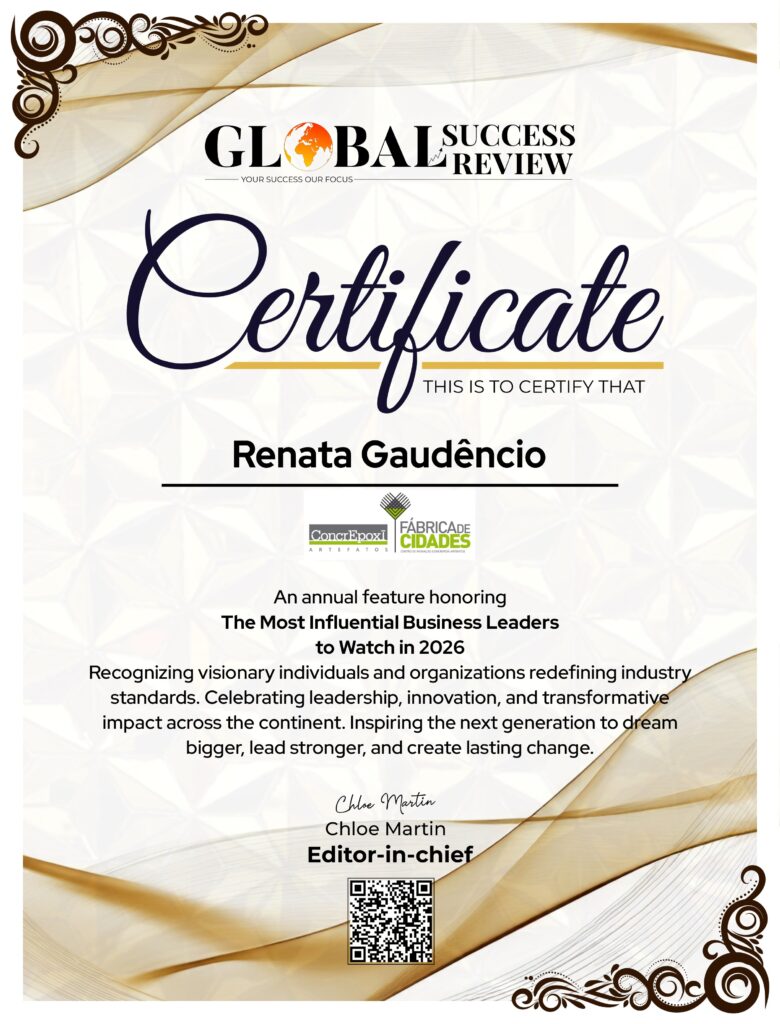
That philosophy has positioned Renata among The Most Influential Business Leaders to Watch in 2026, recognizing a leader whose work extends beyond business success toward shaping a future where innovation serves society.
Engineering Cities with Purpose
Entrepreneurship often begins with identifying a market opportunity.
Renata’s journey began with identifying a societal challenge.
With academic foundations in Architecture and Urbanism in Brazil and Spain, complemented by specialization in Project Management through PMI methodologies, she developed a rare ability to connect creative vision with disciplined execution.
Rather than viewing urban development as isolated construction projects, she saw cities as living systems.
This perspective inspired the creation of Concrepoxi Artefatos, a company designed not simply to manufacture concrete products but to rethink how public infrastructure could improve everyday life.
Her inspiration came from transforming market uncertainties into strategic opportunities.
Instead of accepting fragmented urban growth as inevitable, she envisioned a coordinated model where private-sector efficiency could strengthen public spaces while creating lasting social value.
That vision eventually evolved into what she proudly calls a “City Factory”, an ecosystem where ideas become infrastructure, innovation becomes policy, and construction becomes a catalyst for human development.
Leadership Built on Conviction
Every transformational leader possesses a defining characteristic.
For Renata, it is conviction.
She believes true leadership requires the courage to pursue long-term visions even when immediate results are uncertain or when others remain skeptical.
Rather than allowing short-term crises to dictate strategic direction, she focuses on what she calls the “master plan”, maintaining attention on future outcomes while carefully navigating present-day complexities.
Her leadership style combines strategic patience with systems thinking.
Instead of reacting to isolated problems, she seeks to understand how every decision influences broader urban ecosystems.
This ability to connect individual projects with larger societal objectives has become one of her defining strengths.
Integrity, transparency, accountability, courage, disciplined execution, sustainability, and long-term vision remain the values that consistently guide her decision-making.
These principles have not only shaped her organization but have also earned the trust of partners, municipalities, developers, architects, and communities seeking practical solutions for smarter urban development.
From Manufacturing Products to Building Cities
Concrepoxi Artefatos represents far more than an industrial manufacturer.
Under Renata’s leadership, the company evolved into an innovation platform for urban transformation.
Founded in 2011 and beginning industrial operations in Pernambuco in 2013, the organization deliberately shifted away from traditional concrete manufacturing toward integrated urban solutions.
Rather than selling isolated construction products, the company introduced complete systems connecting planning, manufacturing, installation, and long-term maintenance.
Its approach combines architecture, engineering, industrial automation, design thinking, and digital collaboration.
This transformation culminated in the creation of the Fábrica de Cidades, an innovation center designed to bridge the gap between ideas and implementation.
Its mission reflects Renata’s belief that cities should be designed not merely for efficiency but for people.
The organization has successfully completed more than a thousand contracts while continually expanding its focus from products to urban ecosystems.
Its roadmap, Smart Product, Smart Company, Smart City, illustrates a progressive journey toward digitally connected, collaborative, and sustainable urban development.
Solving the Missing Pieces
Throughout her career, Renata recognized one recurring problem within urban development.
Too many projects are disconnected.
Architects design.
Engineers build.
Manufacturers supply.
Contractors install.
Municipalities manage.
Citizens simply adapt.
Rarely do these stakeholders operate as a unified system.
This fragmentation inspired the foundation of her entire business model.
Her answer was to integrate every stage into one coordinated framework.
By connecting design, manufacturing, installation, technology, and long-term planning, Concrepoxi Artefatos minimizes inefficiencies while improving quality, accountability, and sustainability.
Rather than delivering individual products, the company delivers complete urban systems.
This integrated methodology distinguishes the organization within an industry often characterized by fragmented supply chains and disconnected execution.
Urban Innovation with a Human Face
Technology alone cannot build better cities.
People do.
Renata consistently emphasizes that public infrastructure must enhance human experiences rather than simply satisfy engineering requirements.
Her vision extends beyond roads, sidewalks, parks, and public squares.
She imagines environments where accessibility, beauty, environmental responsibility, and social interaction naturally coexist.
Every project seeks to answer a simple question:
How can this space improve daily life?
This philosophy transforms infrastructure into an instrument of community development.
Affordable public spaces become places of inclusion.
Sustainable materials become investments in future generations.
Urban design becomes a tool for strengthening social cohesion.
Her commitment to democratic access ensures that thoughtful urban environments remain available to everyone, not only those with significant financial resources.
Innovation Rooted in Sustainability
For Renata, sustainability is not an optional feature added to construction.
It is the foundation of every strategic decision.
Modern cities, she believes, possess extraordinary potential to reconcile urban growth with environmental restoration.
This belief drives Concrepoxi Artefatos’ investment in sustainable materials, circular economy principles, advanced concrete technologies, industrial automation, and environmentally responsible manufacturing systems.
Equally important is her commitment to biophilic urbanism.
Rather than treating nature as something separate from cities, Renata advocates integrating biodiversity directly into urban planning.
She draws inspiration from native ecosystems, believing that natural systems provide valuable lessons for designing resilient and efficient urban environments.
The objective is not simply to reduce environmental impact.
It is to create cities where technology and nature coexist in harmony.
Turning Challenges into Competitive Advantages
Innovation rarely follows a smooth path.
Building a disruptive company within a traditional construction industry required overcoming considerable obstacles.
Among the greatest challenges was introducing highly innovative solutions into limited-income markets where customers often prioritized immediate costs over long-term value.
Another significant obstacle involved assigning market value to an entirely original business concept that lacked comparable industry benchmarks.
Limited funding during the organization’s early stages further increased the complexity of transforming ambitious ideas into operational reality.
Instead of allowing these challenges to define the company’s future, Renata treated each one as an opportunity to strengthen its strategic foundation.
She shifted attention from selling products toward demonstrating long-term societal value.
She developed stronger frameworks for identifying customer needs.
She cultivated trust among partners willing to invest in a larger vision.
Most importantly, she created systems ensuring continuity between design and implementation, eliminating one of construction’s most persistent weaknesses.
Each challenge ultimately refined the organization’s identity.
Creating a Culture of Continuous Innovation
Innovation at Concrepoxi Artefatos is intentional rather than accidental.
Renata has built an organizational culture where learning, collaboration, and interdisciplinary thinking are daily practices.
Architects work alongside engineers.
Industrial specialists collaborate with designers.
Technology supports creativity rather than replacing it.
Employees are encouraged to think beyond manufacturing and recognize their contribution to broader human development.
Continuous education, global research, cross-cultural learning, and observation of natural ecosystems all influence the company’s innovation process.
Every obstacle becomes an opportunity to improve systems.
Every project becomes a source of learning.
Every employee becomes an active contributor to shaping future cities.
By aligning purpose with execution, Renata has created an environment where innovation becomes embedded within organizational culture rather than confined to individual initiatives.
Looking Beyond Today’s Cities
Few leaders discuss urban development with the long-term perspective that Renata consistently demonstrates.
She believes the next generation of cities will be defined by integrated ecosystems rather than isolated infrastructure.
Among the trends she finds most exciting are biophilic urbanism, advanced sustainable materials, industrial automation, scalable affordable construction, and digitally connected planning systems.
She is particularly enthusiastic about technologies capable of reducing carbon emissions while maintaining affordability.
Equally important is the growing recognition that successful cities require collaboration among governments, private companies, citizens, architects, engineers, investors, and innovators.
No single organization can transform an entire city alone.
Collective intelligence must replace fragmented execution.
Partnerships as the Foundation for Scale
Renata frequently emphasizes that meaningful urban transformation cannot occur in isolation.
Strategic partnerships form the backbone of scalable innovation.
Whether working with municipalities, developers, industrial partners, or local communities, collaboration accelerates implementation while improving long-term outcomes.
Her approach replaces transactional relationships with shared purpose.
Partners become co-creators.
Clients become collaborators.
Communities become active participants.
This ecosystem mindset enables infrastructure projects to generate broader economic, environmental, and social value.
By connecting diverse stakeholders through common objectives, Renata demonstrates how collaboration transforms ambitious visions into measurable impact.
Empowering the Next Generation
Beyond infrastructure, Renata hopes her work inspires future entrepreneurs, particularly women entering engineering, construction, and industrial innovation.
She encourages aspiring leaders to embrace technical expertise alongside creativity.
Meaningful social impact, she believes, requires disciplined execution supported by systems thinking.
She advises entrepreneurs to move beyond idealistic concepts and focus on building practical frameworks capable of delivering scalable solutions.
Continuous learning, global perspectives, resilience, and community building remain essential ingredients for sustainable leadership.
Her own journey demonstrates that purpose-driven entrepreneurship can successfully challenge established industries while creating entirely new categories of innovation.
The Road Ahead
The coming years represent an exciting new chapter.
Renata’s strategic priorities include expanding the Fábrica de Cidades innovation platform, strengthening partnerships with public and private stakeholders, attracting investment capital, advancing sustainable construction technologies, and accelerating affordable urban transformation.
She envisions a future where cities become collaborative ecosystems rather than fragmented developments.
Where technology enhances humanity instead of replacing it.
Where infrastructure strengthens communities while respecting nature.
Where thoughtful design becomes accessible rather than exclusive.
This vision extends well beyond Brazil.
Its principles offer valuable lessons for cities across the globe facing similar challenges of growth, sustainability, resilience, and inclusion.
A Legacy Beyond Concrete
When discussing legacy, Renata rarely speaks about buildings.
Instead, she speaks about people.
She hopes to leave behind more than innovative products or successful companies.
She wants future generations to inherit practical frameworks capable of transforming cities through collaboration, sustainability, and intelligent design.
She envisions affordable urban architecture becoming the global standard rather than the exception.
She hopes future leaders will continue bridging the gap between visionary planning and flawless execution.
Above all, she wants citizens to recognize that better cities begin with shared responsibility.
The physical structures may endure for decades, but the greatest legacy lies in empowering communities to shape environments that reflect their highest aspirations.
Building the Future Together
Recognition as one of The Most Influential Business Leaders to Watch in 2026 acknowledges far more than professional achievement.
It celebrates a philosophy that reimagines business as an instrument for societal progress.
Through Concrepoxi Artefatos – Fábrica de Cidades, Renata Gaudêncio continues demonstrating that sustainable urban development is neither an abstract ambition nor a distant possibility.
It is an achievable reality when vision is supported by structure, innovation is guided by purpose, and leadership remains firmly committed to collective progress.
Her journey reminds us that the future of our cities will not be determined solely by technology, investment, or infrastructure.
It will be shaped by leaders willing to think systemically, act courageously, and build environments where people, communities, and nature flourish together.
As urban populations continue to grow and global challenges become increasingly interconnected, Renata’s work offers a compelling blueprint for what responsible leadership can achieve.
Between the ideal and the concrete, she has built something far greater than a company.
She has created a movement dedicated to building cities, and futures, that truly belong to everyone.