
Top Most Influential Industrial Engineering Leaders to Watch in 2026
Founder and Managing Director| PROFLUID Group
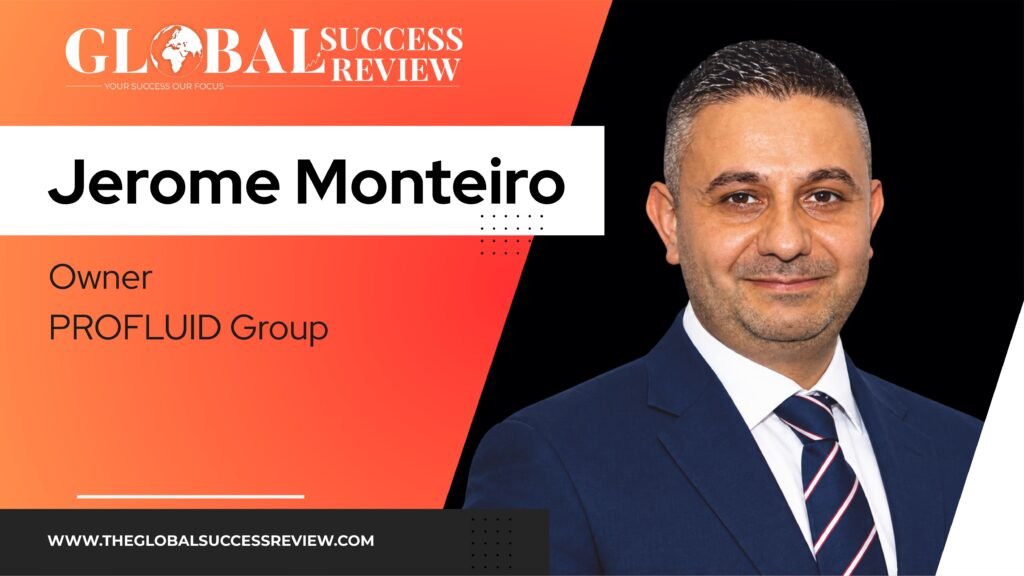
In modern industry, some of the most critical engineering work happens behind the scenes. The integrity of a valve, the reliability of a pressure system, the accuracy of a test result, or the successful commissioning of essential infrastructure can determine whether a major industrial asset operates safely, efficiently, and reliably. Leading this complex intersection of engineering, asset integrity, operational performance, and business responsibility is Jerome Monteiro, Owner of PROFLUID Group.
With more than 15 years of leadership experience spanning engineering, project management, business development, and executive leadership, Monteiro has built his career around a simple but powerful philosophy: technical excellence must be supported by accountability, disciplined risk management, and trust.
His journey reflects the evolution of an engineer into an entrepreneur and industry leader who understands that successful engineering is not simply about equipment or technical specifications. It is about people, processes, commercial realities, safety, compliance, and the long-term consequences of every decision.
Today, through PROFLUID Group, Monteiro is helping shape a specialist Australian engineering business serving demanding sectors including Defence, Mining, Energy, and Infrastructure. His leadership combines practical field experience with engineering judgement and a strong commitment to quality, innovation, and continuous improvement.
Suggestion to shorter intro paragraph:
In industrial engineering, some of the most consequential work is rarely visible. The integrity of a valve, the accuracy of a pressure test, or a technical decision made during commissioning can determine whether critical infrastructure operates safely and reliably.
For Jerome Monteiro, Founder of PROFLUID Group, that responsibility defines engineering leadership.
Over more than 15 years across engineering, project management, business development and executive leadership, Monteiro has developed a philosophy built around a straightforward principle: technical excellence must be matched by accountability, disciplined risk management and trust.
From Engineering Expertise to Entrepreneurial Leadership
Monteiro was initially drawn to industrial engineering because of its unique position between technical problem-solving, operational performance, and people.
Early professional experiences taught him that engineering outcomes depend on understanding much more than equipment alone. Engineers must understand the process surrounding an asset, the operational environment, commercial pressures, potential consequences of failure, and the people responsible for delivering and maintaining the system.
This perspective ultimately inspired him to establish PROFLUID Group.
The objective was never simply to create another equipment supplier. Monteiro envisioned an Australian specialist business capable of responding quickly to difficult engineering challenges while providing clients with confidence in the integrity of critical flow-control and pressure systems.
Under his leadership, PROFLUID has developed an integrated approach covering valve supply and engineering support, workshop repair, onsite testing, calibration, and pipeline pressure-testing services.
This model reflects Monteiro’s belief that clients increasingly need more than individual services. They need technically credible partners who can understand the broader asset lifecycle and support projects from workshop activities through to onsite execution and commissioning.
For Monteiro, sustainable growth is therefore about much more than revenue.
“People remain the epicenter of every organization,” he emphasizes, reflecting a leadership philosophy in which capability, culture, systems, and trust are fundamental to long-term success.
Leadership Grounded in Accountability
Monteiro describes his leadership style as practical, accountable, and collaborative.
Rather than positioning leadership as having every answer, he believes leaders should create an environment where the best answer can emerge. This means setting a clear direction, involving the right technical and operational people, encouraging constructive challenge, and remaining personally accountable for the final outcome.
In high-risk engineering environments, this philosophy becomes particularly important.
Safety and integrity are non-negotiable when working with pressurised assets and essential infrastructure. Monteiro therefore places significant emphasis on disciplined risk management, transparent communication, respect for technical expertise, and continuous improvement.
His approach is also shaped by a simple principle: urgency should never be confused with haste.
Complex engineering projects rarely provide perfect information. Decisions still have to be made, often under demanding schedules. Monteiro believes the answer is not to delay every decision, but to establish clear roles, evidence requirements, escalation paths, and decision points.
A disciplined decision can still be fast.
This mindset has helped him navigate the realities of major engineering projects while maintaining a strong commitment to client trust. His philosophy is straightforward: it is better to communicate constraints honestly than to promise an outcome that engineering evidence cannot support.
At PROFLUID, this principle is reflected in an approach that can be summed up as: under-promise and over-deliver.
Building Engineering Excellence Through Quality
The work undertaken by PROFLUID sits in areas where precision, traceability, safety, and documentation are essential.
To maintain consistent standards, the company connects competent personnel, controlled procedures, calibrated equipment, traceable records, defined acceptance criteria, review points, and independent assurance.
PROFLUID operates an ISO 9001-certified quality management system and maintains NATA accreditation for defined pressure-testing activities within its accredited scope, providing an important framework for reliable and defensible engineering outcomes.
Yet Monteiro views accreditation and certification as a baseline rather than a destination.
For him, genuine quality comes from the culture behind the systems.
Teams must be prepared to stop and escalate when site conditions differ from an approved plan, when data appears inconsistent, or when safety could be compromised. Project lessons, non-conformances, and client feedback are transformed into improvements in procedures, training, equipment selection, and preparation.
This creates a continuous feedback loop between experience and improvement.
Monteiro also contributes to Australia’s accreditation ecosystem through his work as a NATA Technical Assessor and as a member of NATA’s Physical Testing Accreditation Advisory Committee. These responsibilities provide exposure to evolving accreditation expectations and testing practices while reinforcing the importance of competence, impartiality, metrological traceability, and technical assurance.
His professional credentials further reflect this multidisciplinary approach. He holds a Master of Engineering (Mechanical) and Bachelor of Industrial Engineering, is a Graduate of the Australian Institute of Company Directors (GAICD), and holds Project Management Professional (PMP) credentials while being a member of Engineers Australia.
Together, these experiences have enabled Monteiro to bridge engineering expertise with governance, commercial understanding, project execution, and organizational leadership.
Innovation That Solves Real Industrial Problems
For Monteiro, innovation is not about adopting technology simply because it is new.
It must solve a defined problem, produce reliable evidence, and improve an outcome without compromising safety or compliance.
One important area of innovation is the use of advanced testing and diagnostic technologies that can enable certain valves and critical equipment to be assessed in situ, reducing the need for extensive disconnection, lifting, transportation, and reinstatement.
For major industrial facilities, this can have significant implications.
Every unnecessary intervention introduces additional work, coordination requirements, safety exposures, and potential downtime. By enabling appropriate assessments to occur closer to the operating asset, organisations can potentially shorten shutdown and commissioning periods while obtaining valuable integrity information.
PROFLUID combines such technology with calibrated digital instrumentation, structured test-data capture, specialist diagnostic systems, and reporting processes designed to strengthen traceability.
However, Monteiro remains clear that technology itself is never the complete answer.
An instrument reading must be interpreted in context. Engineering judgement remains essential.
His vision for the next decade is therefore one in which connected asset data, remote diagnostics, automation, predictive models, digital valve diagnostics, and risk-based maintenance work alongside experienced engineers rather than replacing them.
Artificial intelligence may increasingly assist with pattern recognition, planning, and document review, but accountable professionals will still need to validate inputs, understand limitations, and evaluate consequences.
In this environment, data integrity and cybersecurity will become increasingly important engineering considerations.
Turning Challenges into Capability
Like any growing specialist organization, PROFLUID has faced significant challenges.
One of the most pressing is the limited availability of experienced valve, pressure-testing, and mechanical specialists. At the same time, the industrial sector faces a broader knowledge-transfer challenge as fewer young people pursue highly specialised technical careers.
Monteiro’s response has been to invest in people, training, facilities, calibrated equipment, documented workflows, and technical oversight.
He believes experienced specialists must actively transfer knowledge to the next generation while younger technicians and engineers are given meaningful career pathways and practical exposure.
This is more than a workforce strategy. It is an investment in the future resilience of the engineering profession.
The company has also learned to navigate volatile project cycles and shutdown-driven demand through disciplined workforce and cash-flow planning.
Rather than pursuing growth at any cost, Monteiro advocates selective expansion, honest capacity management, and investment in capabilities that can serve multiple markets.
When challenges emerge, the objective is to identify the underlying cause, establish ownership, and strengthen the system rather than repeatedly relying on individual effort to compensate for structural weaknesses.
A Demonstration of Australian Engineering Capability
One of PROFLUID’s most significant examples of impact involved supporting a major American engineering, procurement, and construction company during the delivery and commissioning of an LNG facility in Australia.
PROFLUID initially entered the project with a relatively limited scope.
As the company demonstrated responsiveness, technical capability, and the ability to meet demanding quality and documentation requirements, its role expanded substantially.
The engagement ultimately involved several hundred valve repairs, including large and complex equipment weighing several tonnes. PROFLUID’s contribution subsequently extended beyond workshop repair into direct onsite collaboration during plant commissioning.
Its personnel worked alongside EPC and project teams to address valve and pressure-system issues within tightly constrained commissioning schedules.
The experience demonstrated the strength of an integrated specialist model: workshop capability, valve expertise, pressure testing, engineering judgement, documentation, and onsite execution operating together.
The project became an important milestone for PROFLUID, demonstrating that a specialist Australian SME could scale from a targeted workshop scope to direct commissioning support for a major international EPC contractor.
Leadership Beyond PROFLUID
Monteiro’s influence extends beyond his own organization.
He serves as President of the Western Australia Chapter and National Board Director of the French-Australian Chamber of Commerce and Industry (FACCI), where he engages with businesses, government representatives, diplomatic networks, industry partners, and fellow directors.
This experience has broadened his understanding of international collaboration and strengthened his approach to governance, stakeholder engagement, and coalition-building.
He believes international business relationships can generate tangible outcomes for SMEs through market access, investment, knowledge transfer, partnerships, and collaboration.
His chamber responsibilities have also reinforced an important leadership lesson: influence in a broader business community cannot simply be exercised through organizational authority. It must be earned through shared purpose, listening, trust, and effective collaboration.
Monteiro also sees responsible economic growth as inseparable from social and environmental responsibility.
He has supported initiatives involving bilateral trade, stakeholder engagement, reconciliation, Indigenous business networks, and sustainable industry practices.
For him, responsible leadership means creating economic value while considering the long-term consequences of business decisions for communities, the environment, and future generations.
Preparing Industry for the Next Decade
Looking ahead, Monteiro identifies several challenges that will increasingly shape industrial engineering.
Ageing infrastructure, the loss of experienced technical personnel, increasingly complex compliance expectations, supply-chain variability, energy-transition projects, and the pressure to extend maintenance intervals without increasing risk will all require stronger engineering assurance.
As industrial assets become more digitally connected, cyber and data-integrity risks will also become increasingly relevant.
At the same time, industries will need to balance efficiency with reliability.
For Monteiro, the central challenge is clear: organizations must modernize without allowing cost or schedule pressure to weaken engineering assurance.
His advice to organizations beginning this journey is equally practical.
Start with the operational problem and associated risk, not the technology.
Establish a reliable baseline of asset condition, failure history, maintenance cost, and data quality. Then prioritize improvements that genuinely strengthen safety, traceability, decision-making, and operational efficiency.
Modernization should be staged, measurable, and multidisciplinary.
Operators, engineers, maintainers, quality professionals, cybersecurity specialists, and leadership teams must all have a voice in the transformation.
Most importantly, human accountability must remain at the center.
A Vision for PROFLUID’s Future
Over the next three to five years, Monteiro intends to deepen PROFLUID’s specialist valve and pressure-testing capabilities, expand onsite and in-situ services, strengthen technical leadership, and improve digital traceability.
The company plans to grow selectively in areas where its combination of =engineering expertise, field execution and accredited testing capability creates meaningful value, including major maintenance, shutdown, commissioning, and infrastructure programs.
Developing people remains equally important.
Monteiro wants experienced specialists to transfer knowledge while creating stronger pathways for the next generation of technicians and engineers.
Internationally, he sees opportunities for Australian-developed expertise to support clients and partners beyond the country’s borders while maintaining the qualities that have defined PROFLUID’s growth: responsiveness, technical credibility, practical problem-solving, and quality.
Building a Legacy of Capability
For Jerome Monteiro, leadership is ultimately measured by more than personal achievement.
The legacy he hopes to create is one of technical credibility, opportunity, and responsible growth.
For PROFLUID, this means building an organization whose systems, reputation, and people are stronger than any single individual.
For the engineering profession, it means demonstrating that technical expertise, entrepreneurship, and governance can reinforce one another.
For industry, it means contributing to safer and more reliable assets, stronger evidence for engineering decisions, and a willingness to challenge practices that no longer serve clients or communities.
And for future engineering leaders, Monteiro’s message is one of curiosity, responsibility, and continuous development.
Technical expertise matters, but so does commercial understanding. Innovation matters, but so does professional judgement. Growth matters, but so does the capability created in others.
His leadership journey demonstrates that industrial engineering leadership is not defined solely by the scale of projects delivered or technologies adopted. It is defined by the quality of decisions made when the stakes are high, the discipline to maintain standards when pressure increases, and the ability to build people and systems that continue creating value long into the future.
As industries enter an era defined by digitalization, asset ageing, energy transition, advanced diagnostics, and increasingly complex infrastructure requirements, leaders like Jerome Monteiro represent an important model for the future: engineering leadership grounded in evidence, strengthened by people, enabled by innovation, and guided by integrity. That is the foundation upon which PROFLUID Group continues to build, and the reason Jerome Monteiro stands among the Top Most Influential Industrial Engineering Leaders to Watch in 2026.
