Engineering Industrial Growth Through Strategic Finance, Resilient Leadership, and Visionary Transformation
Engineering Success Beyond Blueprints
Industrial progress has never been built solely on groundbreaking engineering or sound financial planning. The most enduring organizations are those that successfully integrate technical excellence with strategic financial discipline, transforming challenges into opportunities while consistently delivering value to clients and stakeholders.
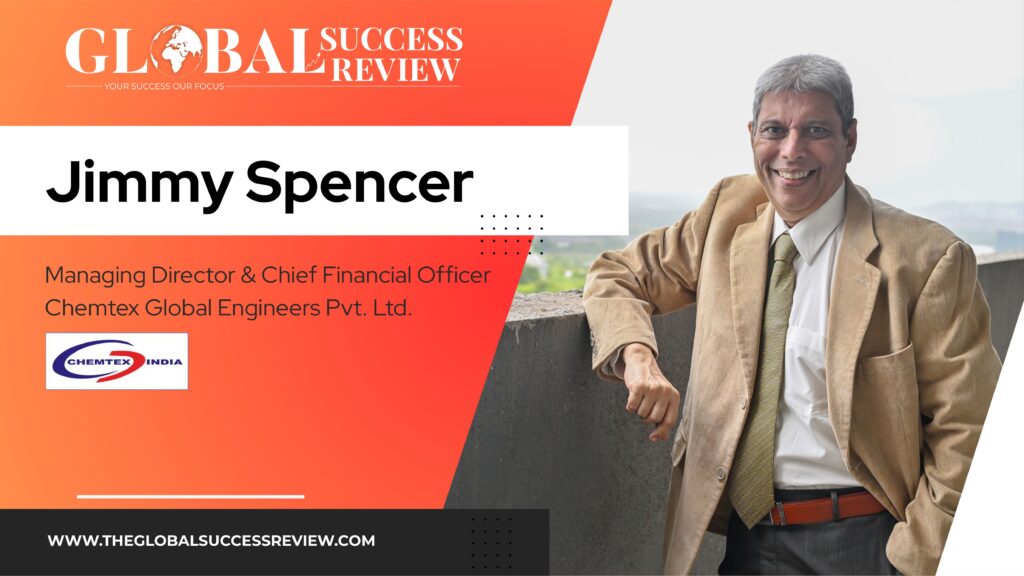
Among the leaders who have mastered this rare balance is Jimmy Spencer, Managing Director and Chief Financial Officer of Chemtex Global Engineers Pvt. Ltd. With over four decades of experience spanning manufacturing, engineering consulting, project management, finance, corporate restructuring, mergers and acquisitions, and executive leadership, Spencer has become a respected figure in India’s engineering industry.
His leadership philosophy is rooted in a simple but powerful belief: engineering brilliance without financial sustainability cannot build lasting enterprises. Every engineering solution must be commercially viable, every project must be strategically managed, and every business decision must create long-term value.
Today, under his stewardship, Chemtex Global Engineers continues to strengthen its position in global Oil & Gas and Petrochemical engineering while embracing digital innovation, operational excellence, sustainability, and prudent financial governance.
A Career Built Through Experience, Not Shortcuts
Jimmy Spencer’s professional journey began in 1978, when he entered the corporate world in a junior position. Rather than seeking rapid promotions, he concentrated on acquiring knowledge, mastering operational complexities, and developing a comprehensive understanding of business.
His dedication and continuous learning enabled him to join a multinational manufacturing organization as a manager in 1989, marking the beginning of a leadership journey that would eventually span manufacturing, finance, legal affairs, engineering, procurement, human resources, corporate governance, and business strategy.
In 1994, Spencer transitioned into the engineering consulting sector by joining a multinational engineering company. What followed was an extraordinary progression through increasingly influential leadership positions including:
- Cost Controller
- Chief Internal Auditor
- Head of Finance HR & Legal
- Vice President (Corporate Services)
- Joint Managing Director
Throughout these responsibilities, he supervised multiple corporate functions including finance, procurement, IT, legal, and human resources while simultaneously contributing to strategic business restructuring initiatives and major mergers and acquisitions involving global engineering organizations.
This multidimensional exposure gave him something few executives possess, a complete understanding of how engineering projects succeed from both technical and commercial perspectives.
Where Engineering Meets Financial Intelligence
Many engineering organizations traditionally emphasize technical execution while treating finance primarily as an administrative function.
Jimmy Spencer viewed this differently.
Early in his engineering career, he recognized that technically successful projects could still become financial failures if cost control, profitability, cash flow management, and commercial risks were not carefully integrated into project execution.
That realization fundamentally shaped his leadership philosophy.
According to Spencer, engineering excellence and financial strategy must operate as one unified discipline rather than two independent functions.
Large Engineering, Procurement and Construction (EPC) projects operate under extremely thin margins while carrying significant execution risks. Delays, design revisions, procurement inefficiencies, labour deployment challenges, foreign exchange fluctuations, and contractual penalties can rapidly erode profitability.
His approach therefore emphasizes:
- Comprehensive Project Budgeting,
- Continuous Financial Monitoring,
- Resource Optimization,
- Disciplined Cost Management,
- Technology-Driven Productivity,
- Proactive Risk Assessment, And
- Strict Milestone Tracking.
This integration enables engineering teams to maintain technical quality while ensuring commercial sustainability throughout the project lifecycle.
Leadership Built on People
Despite operating in one of the world’s most technically demanding industries, Spencer believes that engineering companies are ultimately people-driven organizations.
Technology may enable innovation, but people create it.
His leadership philosophy revolves around identifying exceptional talent, creating opportunities for growth, and fostering an environment where individuals are encouraged to accept greater responsibilities while continuously developing professionally.
He believes successful organizations must:
- Recruit The Right Talent,
- Invest In Continuous Learning,
- Empower Employees,
- Maintain Transparency,
- Encourage Open Communication,
- Reward Commitment,
- And Create Shared Ownership of Success.
Equally important is the willingness to listen to differing opinions.
For Spencer, leadership is not about authority but about bringing together diverse expertise to make stronger decisions. Professionalism, integrity, ethics, transparency, and collaboration remain the core values that guide every strategic decision.
Transforming Challenges into Strategic Growth
Throughout his career, Jimmy Spencer has navigated some of the engineering industry’s most demanding business environments.
Among the defining moments was the Asian Financial Crisis during the late 1990s.
Several major engineering projects across Southeast Asia were either cancelled or significantly affected by currency volatility. Foreign exchange fluctuations dramatically reduced project values, exposing engineering companies to unforeseen financial losses.
Rather than treating the crisis as a temporary setback, Spencer viewed it as a strategic lesson.
The experience prompted a comprehensive reassessment of business strategy.
Instead of concentrating operations within specific regions or industries, greater emphasis was placed on:
- Geographical Diversification,
- Diversified Customer Portfolios,
- Broader Industry Exposure,
- Foreign Currency Risk Management,
- Balanced Project Selection, And
- Stronger Business Resilience.
This philosophy continues to influence Chemtex’s strategic planning today.
For Spencer, diversification is no longer merely a growth strategy; it is an essential component of risk management.
Driving Engineering Excellence at Chemtex Global Engineers
As Managing Director and Chief Financial Officer of Chemtex Global Engineers Pvt. Ltd., Jimmy Spencer leads the company’s engineering operations within the global Oil & Gas and Petrochemical sectors.
Chemtex has established itself as a trusted engineering partner by executing complex design, engineering, EPC, and EPCM assignments for prestigious industrial clients across India and international markets.
The company has developed specialized expertise in engineering solutions including Sulphur Recovery Units and other critical infrastructure projects supporting the energy industry.
Its project philosophy combines engineering precision with operational efficiency, ensuring that clients receive technically robust solutions delivered within agreed timelines and commercial expectations.
For Spencer, client satisfaction extends beyond completing projects, it means consistently delivering predictable quality while maintaining financial discipline and operational excellence.
Innovation Through Digital Engineering
Industrial engineering is rapidly evolving through digital transformation, and Chemtex continues to embrace technological advancement as a competitive advantage.
The organization utilizes advanced engineering software, digital design platforms, simulation tools, project tracking systems, and integrated document management solutions to improve collaboration across multidisciplinary engineering teams.
These technologies enable:
- Faster Engineering Workflows,
- Improved Design Accuracy,
- Enhanced Project Coordination,
- Optimized Engineering Resources,
- Greater Productivity,
- And Stronger Quality Control.
Looking ahead, Spencer also sees tremendous potential in Artificial Intelligence.
Rather than viewing AI as a replacement for engineering expertise, he considers it a powerful productivity accelerator capable of improving engineering efficiency, optimizing resource utilization, reducing project costs, shortening delivery timelines, and enhancing customer value.
Financial Discipline as the Foundation of Sustainable Growth
Engineering companies often operate within highly competitive markets where even minor cost deviations can significantly impact profitability.
For this reason, Spencer maintains an unwavering focus on financial governance throughout every stage of project execution.
Chemtex continuously monitors:
- Project Budgets,
- Contract Milestones,
- Revenue Recognition,
- Engineering Productivity,
- Resource Utilization,
- Software License Optimization,
- Cash Flow Management,
- And Overall Project Profitability.
This disciplined financial framework allows the company to proactively identify risks before they escalate while protecting project margins and strengthening long-term business sustainability.
For Spencer, financial management is not about restricting engineering innovation; it is about enabling innovation responsibly.
Delivering Under Extraordinary Circumstances
One project particularly reflects Chemtex’s resilience and execution capabilities.
The company’s EPC execution of the DEF Project for Indian Oil Corporation Limited (IOCL) during the COVID-19 pandemic demonstrated its ability to perform under unprecedented global disruption.
The project encountered numerous challenges, including delayed inputs, logistical constraints, coordination complexities involving parallel contractors, and restrictions imposed during the pandemic.
Despite these obstacles, the Chemtex team-maintained focus, adapted rapidly, and successfully delivered the project according to schedule.
The achievement illustrated not only technical competence but also disciplined planning, agile leadership, and unwavering commitment to client expectations.
For Spencer, this project represents the collective strength of an organization capable of delivering excellence even under the most demanding circumstances.
Engineering Risk Before It Becomes Reality
Risk management remains central to Spencer’s leadership approach.
Large EPC projects involve risks across every phase:
- Engineering,
- Procurement,
- Vendor Selection,
- Construction,
- Resource Deployment,
- Site Execution,
- Quality Assurance,
- Insurance,
- Contract Administration,
- And Client Coordination.
Even small deficiencies in engineering design or procurement planning can trigger expensive rework, schedule delays, contractual penalties, and reduced profitability.
Consequently, Spencer advocates comprehensive project planning supported by:
- Realistic Budgeting,
- Experienced Technical Resources,
- Reliable Vendor Partnerships,
- Continuous Monitoring,
- Milestone Management,
- Contingency Planning,
- And Proactive Decision-Making.
His philosophy emphasizes anticipating challenges rather than reacting to them.
Sustainability as an Engineering Responsibility
Industrial growth must increasingly coexist with environmental responsibility.
At Chemtex, sustainability has become an integrated component of engineering philosophy rather than an independent initiative.
The organization actively promotes:
- Reduction Of Carbon Emissions,
- Waste Minimization,
- Efficient Energy Utilization,
- Water Conservation,
- Operational Safety,
- And Environmentally Responsible Engineering Practices.
By embedding sustainability into project planning, engineering execution, and operational processes, Chemtex contributes toward creating industrial infrastructure capable of supporting future generations.
Spencer believes sustainable engineering will become one of the defining competitive advantages for engineering organizations over the coming decade.
Preparing for Tomorrow’s Industrial Landscape
Looking ahead, Spencer expects the engineering industry to remain highly competitive.
Projects will continue to be awarded on increasingly narrow margins while contractual obligations become more demanding.
Simultaneously, geopolitical uncertainty, supply chain disruptions, currency volatility, and evolving regulatory environments will require engineering organizations to become more agile than ever before.
His vision for the future includes:
- Expanding Into Allied Industries,
- Strengthening Core Engineering Capabilities,
- Exploring New Geographical Markets,
- Increasing Digital Integration,
- Leveraging Artificial Intelligence,
- Maintaining Strong Cash Reserves,
- And Continuously Investing in Human Capital.
He believes organizations that combine technical innovation with financial resilience will define the next era of industrial growth.
The Characteristics of Visionary Leadership
For Jimmy Spencer, visionary leadership is neither about titles nor recognition.
It is about consistently preparing organizations for challenges that have not yet arrived.
A visionary leader thinks several steps ahead, develops multiple contingency plans, diversifies business exposure, strengthens financial resilience, empowers people, and creates an organizational culture capable of thriving during both prosperity and adversity.
Equally important is sharing success with employees, because organizations that celebrate collective achievement inspire loyalty when difficult times emerge.
This philosophy has guided Spencer throughout more than four decades of leadership and continues to shape Chemtex Global Engineers’ journey toward sustainable industrial excellence.
Building the Future Through Engineering, Strategy, and Integrity
Being recognized among “The Most Visionary Engineering and Finance Leaders Driving Industrial Growth, 2026” represents far more than an individual achievement for Jimmy Spencer.
He considers it a tribute to every colleague, engineer, project manager, finance professional, and employee who has contributed to the organization’s collective success over the years.
His remarkable career demonstrates that enduring industrial leadership requires far more than technical expertise or financial acumen alone. It demands strategic foresight, disciplined execution, unwavering integrity, continuous learning, and above all, the ability to unite people behind a common vision.
As industries worldwide navigate increasing complexity, digital transformation, sustainability expectations, and global uncertainty, leaders like Jimmy Framroze Spencer continue to demonstrate that engineering excellence achieves its greatest impact when guided by thoughtful financial stewardship and purpose-driven leadership.
Through resilience, innovation, and an uncompromising commitment to excellence, he continues to help shape the future of industrial engineering, one project, one strategy, and one generation of leaders at a time.