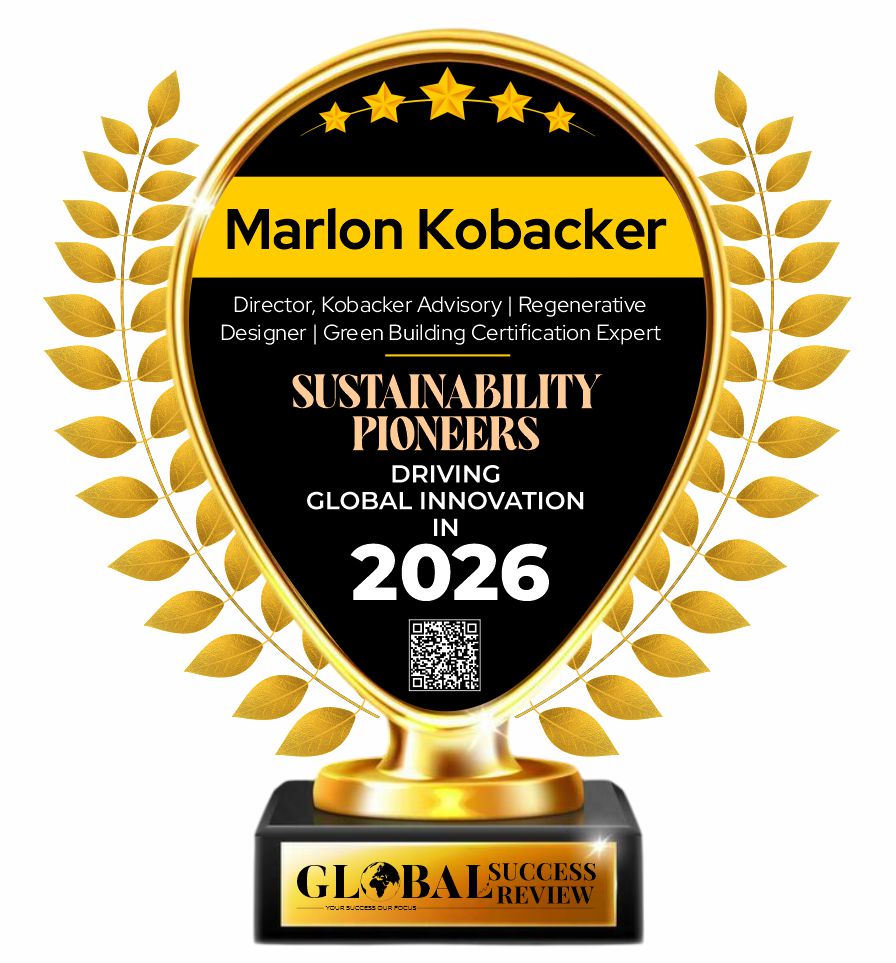
Our built environment must become a regenerative climate solution.
Across the world, cities are expanding at an unprecedented pace. Buildings and infrastructure are not only shaping economies, but they are also defining the environmental future of our planet.
For Marlon Kobacker, this reality has always been clear:
“The built environment has been one of the largest drivers of the climate crisis and must pivot to become a climate solution through regenerative design for ecological and social restoration at scale.”
With over 22 years of global experience and contributions to projects exceeding $50 billion in value, Kobacker has positioned himself at the intersection of engineering, sustainability, finance, and policy.
Today, as the Founder of Kobacker Advisory, he is redefining how sustainability is embedded, not as an afterthought, but as a core strategic driver of higher investment returns, climate resilience, and urban regeneration.
Embedded Ambition: A Defining Philosophy
At the heart of Kobacker’s work lies a powerful concept, Embedded Ambition.
Sustainability, in his view, is not a compliance layer. It is a design condition from day one.
Every engagement begins with understanding what truly matters to clients: investor confidence, operational efficiency, climate resilience, and long-term value. From there, Kobacker integrates ESG strategy, certification pathways, decarbonisation, and sustainable finance alignment into a cohesive framework.
Core Values Driving Leadership
- Intellectual Honesty – No sustainability claim without rigorous validation
- Commercial Realism – High performance without unrealistic cost burdens
- Long-Term Accountability – Performance beyond certification, across lifecycle
These principles define not just how Kobacker works, but why his work delivers lasting impact.
A Structured Approach to Sustainable Design Excellence
Kobacker’s methodology extends across the entire project lifecycle, ensuring sustainability is embedded at every stage:
- Project Kickoff: Align sustainability goals with financial and design strategy
- Design Phase: Integrate climate risk modelling, carbon analysis, and passive design
- Contract Documentation: Translate sustainability into contractual obligations
- Construction: Audit compliance and ensure certification readiness
- Operation: Monitor performance and align with green finance KPIs
This structured approach transforms sustainability from aspiration into measurable, finance-aligned performance.
Career Journey: From Technical Foundations to Global Influence
Kobacker’s journey began at the University of New South Wales (UNSW), where he studied Photovoltaics and Solar Energy Engineering, developing a systems-thinking perspective that continues to define his work.
His early academic contributions included:
- Lecturer in Solar Architectural Technologies (UNSW)
- Tutor in Photovoltaics in the Built Environment
These roles sharpened his ability to translate complex technical concepts into practical, real-world solutions.
Early Recognition
- New Achiever of the Year Nominee, CIBSE UK Building Services Awards (2009)
- Future Leader of the Year Nominee, Property Council of Australia (2011)
- First LEED Platinum certified project in the Southern Hemisphere (2008) under the US Green Building Council’s LEED rating scheme)
Global Thought Leadership & Conference Influence
Kobacker’s voice has shaped sustainability discourse across continents. His speaking engagements include:
- South African Green Building Convention (2008, 2009)
- Israeli Green Building Conference (2010)
- International Green Building Conferences in Serbia (2011), China (2011), Singapore (2012, 2015)
- GBCA Summit & Property Council of Australia forums (2011)
- United Nations Association of Australia SDG11 Forum (2016)
These platforms established him early as a global thought leader in sustainable design and cost optimisation.
Shaping Industry Standards: Contribution to the GBCA
Kobacker’s long-standing (20+ year) relationship with the Green Building Council of Australia (GBCA) reflects his role as an industry pioneer.
Key Contributions:
- Green Star Assessor (2024–Present)
- Expert Reference Panel – Green Star Fitouts
- Technical Advisory Groups & Working Committees
Landmark Achievements:
- First Green Star certified project in Australia to achieve 100% of available Innovation points
- First 5 Star Green Star Communities certified precinct in Australia
- First 6 Star Green Star Office certified buildings in Queensland, South Australia, and Victoria
- First Green Star Residential and Industrial certified buildings in New South Wales
- First 5 Star Green Star Communities certified precincts in Western Australia and New South Wales
He also authored the official GBCA case study on the Sydney Opera House, now a global benchmark.
Innovation in Sustainability & Regenerative Design
Innovation is a defining thread in Kobacker’s career, including the following key areas;
1. Global Collective of Sustainability Professionals
A pioneering initiative creating a decentralised global network of independent sustainability experts, enabling agile, conflict-free advisory for complex projects worldwide. The initiative is scheduled for a US and global launch in late 2026.
2. Sustainable Finance Integration
- Co-created Sydney Metro Green Bond Framework (2014)
- Enabled hundreds of millions in climate finance
- ESG frameworks across Asia & Africa
This work directly connects asset performance with capital markets and improved financing.
3. Circular Economy at Scale
- NSW Education Circular Economy framework (2,200 schools)
- Australian Open 2025 Circular Design Guidelines
Driving systemic transformation in materials, procurement, and reuse.
4. Regenerative & Climate Adaptive Design
- Sydney Metro climate adaptive design integration across 4 new lines and 40+ stations
- Brisbane 2032 Olympics precinct sustainability and climate adaptive design guidelines
- Sydney Opera House biodiversity regeneration
Integrating regenerative design to reduce urban heat, enhance resilience to extreme weather events, and increase biodiversity within the built environment.
Project-Level Innovation Highlights
Kobacker’s portfolio includes some of the world’s most complex and iconic developments:
South Beach, Singapore
• Green Mark Platinum certification
• First recipient of a S$1.6 million grant under BCA Green Buildings Innovation Cluster (GBIC) 2.0 Program
• Building-integrated PV canopy over naturally ventilated public outdoor spaces
Mitharsuu Center for Leadership and Justice, Thailand
- LEED Platinum certification
- Carbon neutral and chemical free in operation
- Circular, local, low-carbon construction
Western Sydney International Airport
- $3.5B infrastructure project
- 5 Star Green Star certification
- “Excellent” ISC Infrastructure Sustainability rating
Sydney Metro
- $50B infrastructure program
- 40+ station precincts
- Green bond ESG framework integration
High-Speed Rail (Newcastle–Sydney)
A transformative national infrastructure initiative, positioning sustainable transport as a climate solution at scale.
Sustainable Transport Planning Leadership
A distinct and highly specialized capability, Kobacker has delivered 30+ Sustainable Transport Plans for projects across major cities in the US, Asia and Australia.
These plans integrate:
- Mobility strategy for active and public transport mode switching
- Emissions reduction initiatives for building users
- Green building certification alignment
Reinforcing transport as a critical lever in decarbonisation.
The Three Shifts Defining the Future
As the built environment evolves, Kobacker identifies three major shifts that will fundamentally shape the next decade within the built environment.
Shift One: Sustainability Unlocks Cheaper Capital
High-performing assets now:
- Access lower-cost financing through sustainable finance mechanisms
- Achieve higher rental premiums and asset values
- Reduce insurance and operational risk
Sustainability is now viewed as a financial advantage, not a cost.
Shift Two: Transparency Drives Accountability
Global ESG frameworks (ISSB, CSRD, TNFD) are transforming sustainability into:
- Auditable data
- Investor-facing metrics
- Regulatory requirements
The rapidly expanding constellation of mandatory and voluntary ESG disclosure frameworks is fundamentally reshaping how the performance of buildings and infrastructure is measured, reported, and priced.
Shift Three: From Net Zero to Regenerative Systems
The future lies beyond net zero, as we necessarily evolve toward:
- Urban biodiversity regeneration and restoration
- Climate resilience and adaptation
- Nature-integrated urban systems
For many years, net-zero carbon targets have been widely viewed as the ultimate sustainability goal. Yet the industry is increasingly recognizing a deeper reality: a net-zero building located within a biodiversity-poor, heat-stressed, and ecologically fragmented urban landscape has not fully resolved its environmental responsibility.
It has simply stopped making things worse.
Regenerative design raises the bar significantly higher. Instead of merely minimizing harm, it seeks to create built environments that actively restore ecological systems, cool surrounding neighborhoods, support human health, and deliver net-positive environmental outcomes.
Concepts such as biodiversity net gain, urban greening, and ecological connectivity are rapidly moving from innovation initiatives to baseline expectations across many cities.
A Vision for the Future
Kobacker envisions a world where:
- Every building has verified sustainability performance with a strategy for continuous improvement
- ESG is fully integrated into capital and policy decisions and underpins project finance
- Regenerative design becomes the global baseline to restore ecological balance
Client Testimonials
“His creative approach consistently exceeds expectations…”
– Design Manager, Lipman Developments
“An asset to any project team, driving sustainability with passion…”
– Construction Manager, Buildcorp
“The best I’ve worked with for sustainability…” – Design Manager, Sydney Metro
Legacy: Making Sustainability Accessible
Beyond iconic projects, Kobacker’s true ambition lies in transforming everyday buildings.
His legacy is not just innovation, but accessibility, scalability, and real-world impact.
“The real impact lies in the thousands of projects that never make headlines but shape our future every day.”
Conclusion
Marlon Kobacker is not just contributing to sustainable development; he is redefining its foundation.
Through innovation, leadership, and unwavering commitment, he represents the future of a built environment where performance, purpose, and profitability coexist.