
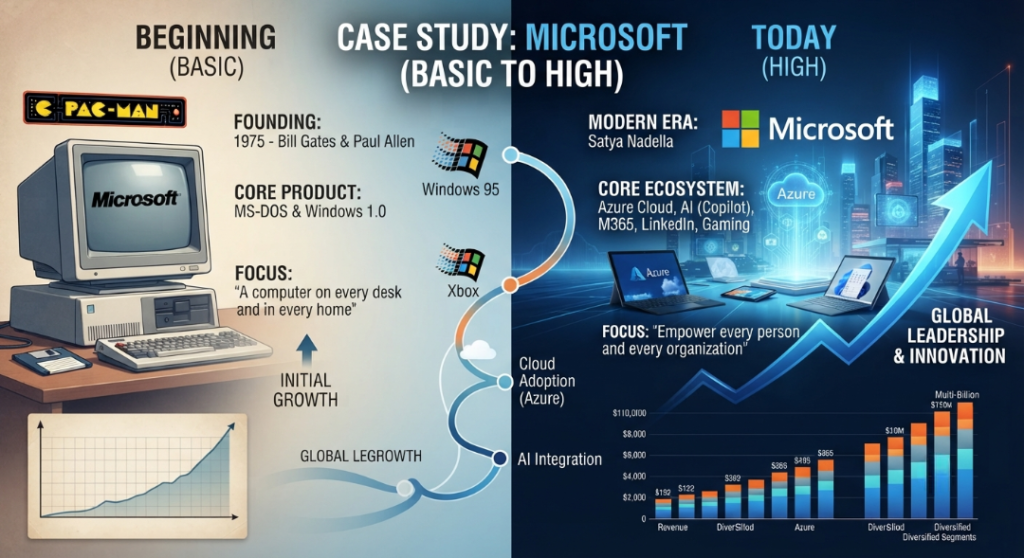
How long-term innovation, platform strategy, cloud transformation, and artificial intelligence helped Microsoft evolve from a software company into one of the world’s most influential technology enterprises.
Few technology companies have demonstrated the ability to reinvent themselves across multiple generations of computing as successfully as Microsoft. Founded in 1975, Microsoft began with a focused ambition to develop software for the emerging personal-computer industry. Over the decades, the company expanded from operating systems and productivity software into enterprise technology, cloud computing, gaming, cybersecurity, developer tools, and artificial intelligence.
Today, Microsoft stands at the center of the global technology ecosystem, combining software, cloud infrastructure, data, AI, and digital productivity into an integrated platform serving individuals, businesses, governments, and organizations worldwide.
The Challenge
Microsoft’s early success was built around Windows and Office, which became foundational products of the personal-computing era. However, the technology industry was changing rapidly.
The rise of mobile computing, cloud services, open-source development, software-as-a-service models, and new digital platforms created significant competitive pressure. A company that had dominated the desktop era needed to remain relevant as computing moved beyond the traditional PC.
The central challenge was therefore not simply to protect Microsoft’s existing businesses, but to transform the company while continuing to serve hundreds of millions of customers who depended on its established products.
The Strategy
Microsoft’s transformation was driven by a shift from a primarily software-licensing business toward a broader platform and subscription model.
A major turning point was the company’s investment in cloud computing through Microsoft Azure. Instead of treating cloud technology as a threat to traditional software, Microsoft increasingly positioned Azure as the infrastructure on which organizations could build, operate, secure, and scale their digital businesses.
At the same time, Microsoft transformed Office into Microsoft 365, creating a recurring cloud-based productivity ecosystem incorporating applications and services such as Word, Excel, Teams, SharePoint, Exchange, Power BI, security, and collaboration tools.
This strategy created an important competitive advantage: customers could increasingly obtain infrastructure, productivity software, data services, security, development platforms, and business applications from one interconnected technology ecosystem.
Microsoft also expanded its reach through businesses such as LinkedIn, Dynamics, GitHub, and Xbox, strengthening its position across professional networking, enterprise applications, software development, gaming, and digital entertainment.
The AI Transformation
The next major phase of Microsoft’s evolution has been artificial intelligence.
Rather than positioning AI as a standalone product, Microsoft has integrated AI across its technology stack. Azure provides AI infrastructure and services, while Microsoft 365 incorporates AI-powered productivity capabilities. The company has also developed platforms such as Azure AI Foundry to help organizations build and deploy AI applications and agents.
Microsoft’s 2025 Annual Report describes AI as a major platform shift affecting every layer of technology. The company is therefore investing simultaneously in cloud infrastructure, data platforms, models, developer tools, security, and AI-powered applications.
This approach allows Microsoft to monetize AI through multiple layers rather than relying on a single application.
Market Leadership
The scale of this transformation is reflected in Microsoft’s financial performance.
For fiscal year 2025, Microsoft reported revenue of $281.7 billion, up 15% from the previous year, while operating income increased 17% to $128.5 billion. Microsoft Cloud revenue reached $168.9 billion, representing 23% growth.
Azure became an increasingly important growth engine, surpassing $75 billion in annual revenue in fiscal 2025, with revenue growth of 34%. Microsoft also reported operating more than 400 datacenters across 70 regions, reflecting the enormous infrastructure investment required to support the global cloud and AI economy.
The Growth Engine
Microsoft’s strongest competitive advantage is the ability to connect its businesses into a reinforcing ecosystem.
A customer may begin with Microsoft 365, adopt Teams for collaboration, use Azure for cloud infrastructure, deploy Dynamics for business processes, use GitHub for software development, and increasingly integrate AI into its operations.
This creates a compounding growth model: more users create more demand for cloud services; more cloud usage encourages organizations to adopt additional Microsoft platforms; and AI capabilities increase the value of the overall ecosystem.
The strategy also enables Microsoft to remain relevant across different technology cycles—from personal computing and enterprise software to cloud computing and artificial intelligence.
Lessons for the Technology Industry
Microsoft’s journey offers several important lessons:
Reinvention is essential.
Long-term leadership requires the willingness to transform successful businesses before market forces make transformation unavoidable.
Platforms create compounding value.
Connecting products and services into an integrated ecosystem can create stronger customer relationships and recurring revenue.
Cloud creates the foundation for AI.
Microsoft’s AI expansion has been supported by years of investment in cloud infrastructure, data, developer tools, and enterprise relationships.
Scale must be matched by innovation.
Global infrastructure provides reach, but continuous investment in technology is necessary to remain competitive.
Enterprise trust matters.
For large organizations, security, reliability, compliance, and responsible AI are increasingly as important as technological capability.
Conclusion
Microsoft’s journey from a software startup founded in 1975 to a global cloud and AI powerhouse demonstrates the power of continuous reinvention.
Its success was not built around one product or one technological moment. Instead, Microsoft repeatedly expanded its capabilities, from Windows and Office to enterprise software, Azure, Microsoft 365, developer platforms, gaming, and now AI.
Ultimately, Microsoft’s story illustrates a powerful principle of modern business: the companies that survive technological disruption are not always those that predict the future correctly, but those that possess the scale, vision, and willingness to continually reinvent themselves.
