Building Pathways to Stability, Dignity, and Opportunity Through Resident-Centered Leadership
How one visionary leader is transforming affordable housing into a platform for health, wealth, and community empowerment
In every city, there are buildings that provide shelter. But only a few become true communities, places where families heal, seniors age with dignity, children discover possibility, and residents gain the tools to build brighter futures.
At Jubilee Housing, affordable housing is far more than a roof over one’s head. It is the foundation for economic mobility, personal well-being, and generational change.
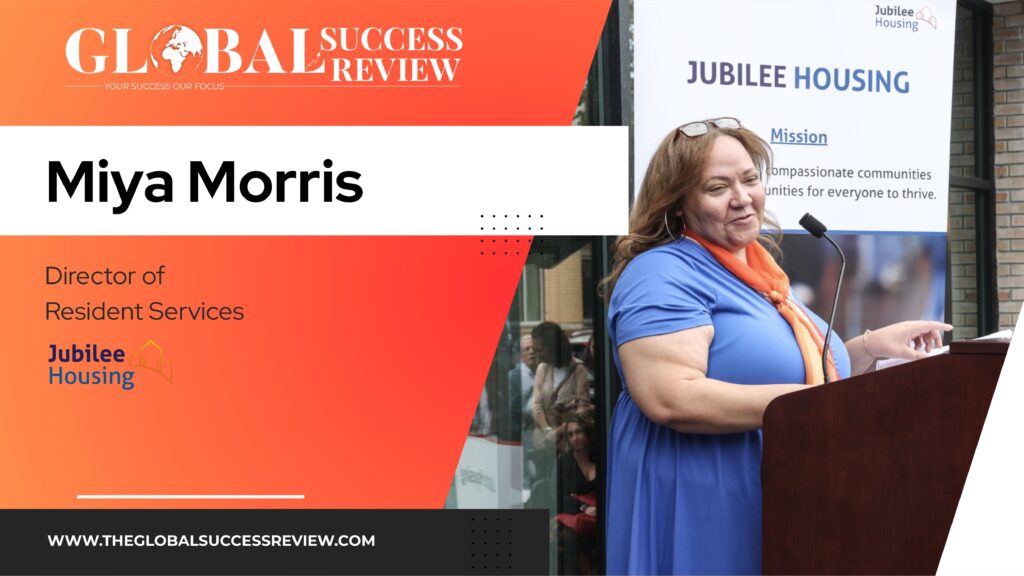
Helping bring that vision to life is Miya Morris, Director of Resident Services, whose leadership has transformed resident support into a powerful engine for social impact.
With more than 21 years of experience across counseling, mental health case management, organizational development, and community leadership, Morris has dedicated her career to understanding and addressing the root causes of housing insecurity, economic hardship, and social inequities. Her work sits at the intersection of housing, financial empowerment, health equity, and human connection.
Recognized as one of The Most Inspiring Leaders Driving Social Impact & Resident Empowerment, 2026, Morris exemplifies what happens when strategic leadership is paired with genuine compassion.
Her mission is both simple and profound: ensure that every resident has the opportunity not merely to survive, but to thrive.
Discovering the Power of Housing to Change Lives
Miya Morris began her professional journey as a community-based mental health counselor. Working closely with individuals in crisis, she noticed a recurring pattern.
The mental health challenges she encountered were often deeply intertwined with practical insecurities, housing instability, unemployment, food insecurity, and financial stress.
“I often found myself wanting to address the underlying insecurity and lack of resources that were driving the crisis,” she reflects.
As she advanced into leadership roles overseeing case management teams, Morris gained a broader view of the systemic factors affecting vulnerable populations. Again and again, one issue emerged as foundational: housing.
Without stable housing, progress in nearly every other area of life becomes significantly harder.
One story remains especially meaningful to her.
A client experiencing homelessness carried a photo of his two-year-old granddaughter wherever he went. After years of living in a tent, he finally moved into a small apartment.
His daughter told him that once he found stability, he could rebuild a relationship with his granddaughter.
That apartment did more than provide shelter.
It gave a little girl her grandfather back.
For Morris, that moment reinforced a truth she has carried ever since: stable housing can alter the trajectory of an entire family.
A Purpose-Driven Move to Jubilee Housing
After serving as an Organizational Development Director for a Maryland-based organization supporting four counties, Morris relocated to the Washington, DC metropolitan area.
She knew exactly what she wanted in her next chapter.
She sought an opportunity where she could directly impact health and wealth disparities for at-risk communities.
She found that opportunity at Jubilee Housing.
Founded on the principle of “Justice Housing®,” Jubilee Housing combines deeply affordable homes with robust resident services to help individuals and families achieve long-term stability.
For Morris, joining the organization in 2021 represented a natural progression in her career.
Her counseling background, operational leadership experience, and commitment to reducing systemic inequities aligned perfectly with Jubilee’s mission.
“What drove me,” she says, “was the opportunity to work on a micro scale on macro-level challenges.”
And there was no more relevant place to do this work than Washington, DC, a city with one of the largest wealth gaps in the United States.
Building a Department from the Ground Up
When Morris arrived at Jubilee Housing, she stepped into an extraordinary challenge.
The organization’s resident services programming had been heavily disrupted by the pandemic. In-person engagement had been paused for years, and the department lacked formal infrastructure.
There were no standardized job descriptions, limited staffing, insufficient funding, and no established operating framework.
The vision was ambitious.
The resources were modest.
For Morris, that combination was not discouraging, it was energizing.
She immersed herself in understanding the resident services field:
- Industry best practices
- Credentialing organizations
- Peer housing models
- Innovative service delivery frameworks
At the same time, she began laying the groundwork for an entirely new department.
She drafted roles, recruited staff, created processes, and most importantly, got to know residents.
Her approach was deeply practical.
Before implementing sophisticated financial empowerment programs, she first listened to what residents needed most.
The answer was clear.
Families were struggling with food insecurity. Seniors were isolated. Households were at risk of eviction.
The work had to begin with meeting basic needs.
Meeting Residents Where They Are
Morris often references Abraham Maslow’s hierarchy of needs.
You cannot ask a family facing hunger to prioritize savings goals.
You cannot discuss wealth building when residents are unsure if they can pay next month’s rent.
“You must know what your community is ready for,” Morris explains.
So her team focused first on:
- Food security
- Wellness checks for seniors
- Rent support
- Eviction prevention
- Resident engagement
This strategy built trust.
It demonstrated that Jubilee Housing genuinely cared about residents’ most immediate concerns.
Only after establishing this foundation could the team begin expanding into financial health, education, and digital empowerment.
This resident-centered sequencing remains one of Morris’s most important leadership principles.
Leadership Rooted in Service
Miya Morris believes the most important stakeholder in any nonprofit initiative is not the board, the funders, or the executive team.
It is the community being served.
“The work has to be people-centered,” she says.
Her leadership philosophy is guided by three core principles:
1. Resident Voice Comes First
Programs should reflect what residents want and need, not what organizations assume is best.
2. Genuine Care Builds Trust
Residents should feel that support comes from sincere concern, not simply from metrics or job requirements.
3. Work With, Not For
The goal is empowerment, not dependency.
This philosophy mirrors Jubilee Housing’s motto: with and not for.
Success belongs to residents themselves. The role of staff is to provide tools, encouragement, and partnership.
The Counselor’s Lens: Trauma-Informed Leadership
Morris’s counseling background profoundly shapes her leadership.
She approaches both residents and staff through a trauma-informed lens.
This means understanding that behaviors often reflect underlying experiences of adversity, fear, and instability.
Trauma-informed leadership emphasizes:
- Safety
- Trust
- Transparency
- Choice
- Collaboration
- Empowerment
In practice, this means allowing residents to build relationships at their own pace while maintaining clarity about responsibilities and consequences.
It also means caring for staff.
Morris is deeply committed to professional development and to recognizing burnout and compassion fatigue.
“Part of your role as a leader,” she says, “is to support the helpers.”
Language Justice as a Strategic Priority
One of the earliest lessons Morris learned at Jubilee Housing was the critical importance of language justice.
A significant portion of residents are monolingual Spanish speakers.
Without bilingual staff and translated materials, access to services would remain unequal.
Morris quickly recognized this gap and prioritized hiring bilingual coordinators and embedding multilingual communication into department operations. Growing up in Puerto Rico and being bilingual herself, she understood firsthand how language can shape a person’s sense of inclusion, trust, and access to opportunity.This decision was more than operational.
It was a statement of inclusion and respect.
By ensuring residents can engage in their preferred language, the organization strengthens trust and broadens participation.
Turning Innovative Ideas into Tangible Outcomes
Morris’s work demonstrates how strategic innovation can produce measurable impact.
One standout example is Jubilee Housing’s rent reporting initiative.
Rent reporting allows on-time rent payments to be reported to all three major credit bureaus, helping residents build credit histories similar to homeowners.
The concept was powerful.
The execution, however, revealed important barriers.
Many residents lacked email addresses, digital literacy, or access to registration materials in Spanish.
Rather than abandoning the initiative, Morris and her team adapted.
They provided personalized support, translated materials, and helped residents navigate enrollment.
The results have been remarkable:
- Over 300 residents enrolled
- 59% improved their credit scores
- Average increase of 25 points
The initiative gained national recognition, with The New York Times highlighting Jubilee Housing’s innovative efforts to help residents strengthen their financial footing through rent reporting.
For Morris, the project illustrates a key lesson: innovation succeeds only when designed around the realities of the people it intends to serve.
Housing Stability as a Health Intervention
Morris consistently emphasizes that housing is a health intervention.
Safe, stable housing affects:
- Mental health
- Physical well-being
- Employment stability
- Educational attainment
- Family relationships
Her perspective aligns with the growing recognition across healthcare and social services that social determinants of health profoundly shape outcomes.
As a panelist for the Washington Business Journal, Morris discussed the intersection of affordable housing and health, reinforcing that investment in housing is also investment in public health.
Preventing Falls, Preserving Independence
One of Morris’s most impactful initiatives focused on senior safety.
After learning that falls are the leading cause of injury among older adults, and after losing a resident due to a fall, her team launched a fall risk reduction effort.
Staff completed 101 screenings for residents aged 65 and older.
The findings were striking:
- 59 residents were identified as high risk.
Community resources were overwhelmed with waitlists stretching into the following year.
So Morris sought philanthropic funding.
The department secured support to provide:
- 50 shower chairs
- 50 toilet safety chairs
- 12 medical alert subscriptions
This initiative exemplifies Morris’s leadership style: identify a need, gather data, advocate relentlessly, and build solutions.
Most importantly, it helps seniors remain safely in their homes and communities.
Building an Ecosystem of Partnerships
Morris understands that meaningful resident support cannot be delivered in isolation.
Under her leadership, Jubilee Housing’s Resident Services Department expanded its network of partnerships from 29 to more than 80 organizations in a single year.
These collaborations include providers across:
- Financial services
- Healthcare
- Education
- Workforce development
- Legal aid
- Food assistance
Through community events like Jubilee Helps, the organization hosted resource fairs that served over 500 meals and connected residents and neighbors with 47 different partner organizations over one summer.
These efforts position Jubilee as both a housing provider and a community hub.
Celebrating Resident Leadership
For Morris, success is not measured solely by program metrics.
It is also measured by moments when residents are recognized for their own leadership.
One of her proudest achievements was nominating a Jubilee resident for Resident of the Year through the American Association of Service Coordinators.
The resident won.
Presenting the award and witnessing her emotional response was a defining moment.
“It reinforced our vision of uplifting residents as the change agents of their own community,” Morris says.
Professional Recognition and Continued Growth
Morris’s contributions have earned widespread recognition.
Among her notable achievements:
- Named one of the Top 10 Directors of Resident Services in the U.S. by Elder Care Review
- Selected as a Financial Health Fellow with Enterprising Ventures of Color
- Featured in The New York Times
- Panelist for the Washington Business Journal
Yet she remains grounded in service.
She credits mentors, colleagues, residents, and family for shaping her journey.
Financial Empowerment as a Pathway to Equity
Morris believes that financial health is essential to long-term housing stability.
Her team’s financial empowerment initiatives include:
- Credit building
- Savings education
- Budget coaching
- Banking access
- Asset development
Rather than presenting financial literacy as abstract education, Morris frames it as a practical tool for increasing choice and resilience.
By combining financial empowerment with housing support, Jubilee helps residents build stronger foundations for the future.
The Future of Resident Services
Looking ahead, Morris sees resident services evolving toward integrated, holistic models that combine:
- Housing stability
- Financial wellness
- Digital inclusion
- Education
- Health support
- Community engagement
She believes the future belongs to organizations willing to innovate while staying deeply connected to resident voice.
Technology, data, and partnerships will play important roles, but the heart of the work remains human connection.
What Truly Impactful Leadership Looks Like
In Morris’s view, impactful leadership in social services is distinguished by authenticity.
It means:
- Listening before acting
- Designing with the community
- Balancing strategy with compassion
- Building systems that outlast any one individual
- Remaining committed to measurable outcomes and human dignity
Leadership is not about being the hero.
It is about creating conditions where others can thrive.
A Legacy of Empowerment
For Miya Morris, every initiative, from rent reporting to senior fall prevention, is part of a larger mission.
Affordable housing should be more than shelter,” Morris says. “It should serve as a catalyst for generational transformation and greater health and wealth equity.
Her work demonstrates that when organizations invest in people, build trust, and align services with community needs, extraordinary outcomes are possible.
Residents gain more than housing.
They gain confidence.
They gain stability.
They gain opportunity.
And often, they regain relationships, hope, and a renewed sense of possibility.
In an era when communities across the nation are grappling with housing affordability, economic inequality, and social fragmentation, leaders like Miya Morris offer a compelling blueprint.
Lead with empathy.
Listen deeply.
Build collaboratively.
And never underestimate the life-changing power of a stable place to call home.