In early 2020, as the world was brought to a standstill by a global pandemic, a different kind of storm was quietly gathering momentum. Enterprises were accelerating digital transformation at unprecedented speed. Work-from-home became the norm. Cloud adoption surged. Containers, Kubernetes, microservices, APIs, and AI-driven systems became foundational to modern enterprise architecture.
Yet beneath this rapid innovation lay a fragile truth.
The new infrastructure powering the global economy was riddled with vulnerabilities.
Kubernetes environments were described by some security experts as “Swiss cheese”, porous, exposed, and vulnerable to sophisticated attacks. Highly publicised breaches, including the hijacking of Tesla’s Kubernetes containers for crypto mining, revealed the magnitude of the risk. Multi-million-dollar losses were not anomalies; they were warnings.
For Nat Natraj, this was not simply a technical gap. It was a systemic failure in how modern enterprises approached security.
And that was the moment AccuKnox was born.
The Genesis of AccuKnox: Building More Than Another Security Startup
Starting a cybersecurity company is, on the surface, straightforward. Identify an attack pattern. Develop a tool. Sell protection.
But Nat Natraj had no intention of building “just another” cybersecurity product.
With over 25 years of startup experience in Silicon Valley, Nat understood that point solutions rarely endure. Attack vectors evolve. Threat actors adapt. Signature-based systems become obsolete. Companies that chase individual attack patterns often find themselves perpetually reacting.
Instead, AccuKnox was conceived with a bold ambition:
To build a defensible, deeply innovative, IP-driven cybersecurity platform rooted in Zero Trust principles and powered by runtime protection.
The founding team reflected this ambition:
- Nat Natraj – CEO
- Rahul Jadhav – CTO
- Phil Porras – Chief Scientist, Director of Cybersecurity & Computer Science at SRI International
The partnership with Stanford Research Institute (SRI International) was transformative. Founded in 1946, SRI has played a foundational role in shaping modern computing, contributing to innovations such as the mouse, modem, internet technologies, intrusion detection systems, anomaly detection, and advanced cybersecurity frameworks.
AccuKnox didn’t just collaborate with SRI; it secured an R&D partnership and investment backing. This alliance created a deep intellectual property moat from day one.
The market noticed.
AccuKnox raised $5 million in seed funding in less than a week, a rare achievement for a deep-tech security startup.
The message was clear: this was not a conventional cybersecurity venture.
From IIT Bombay to Silicon Valley: The Making of an Entrepreneur
Nat Natraj’s journey reflects the arc of a global technologist shaped by rigour, risk, and relentless curiosity.
A graduate of IIT Bombay, he moved to the United States to pursue his Master’s degree at the University of Virginia. His early career included roles at large enterprises where projects were global in scope and technically complex.
Yet scale did not equal impact.
Silicon Valley offered something more intoxicating: the convergence of bold entrepreneurs, disruptive technologies, and venture capital willing to fund ambition.
For 25 years, Nat immersed himself in startup ecosystems, building teams, launching cutting-edge products, achieving market leadership, and delivering shareholder value.
Cybersecurity, however, posed a unique challenge.
Unlike traditional enterprise software markets, cybersecurity operates within an asymmetric battlefield:
- Defenders must be right every time.
- Attackers must be right only once.
Add to this the rise of boundaryless enterprises, public and private clouds, hybrid environments, edge computing, IoT devices, APIs as the lingua franca of communication, and AI-driven automation, and the complexity multiplies exponentially.
Nat recognised that enterprises required:
- Multi-layered security.
- Runtime protection against unknown threats.
- Zero Trust frameworks.
- Compliance support across SOC2, PCI, GDPR, HIPAA, NIST, and ISO.
- Solutions that enabled business, not hindered it.
AccuKnox would aim to deliver exactly that.
Leadership in a Fast-Moving Threat Landscape
Nat’s leadership philosophy is grounded not in hierarchy, but in empowerment.
He describes AccuKnox as a flat organisation organised around goals, not titles.
Several tenets define his approach:
1. Voice of the Customer
Customer insight overrides internal opinion. Every strategic decision, product, roadmap, and architecture is anchored in real-world enterprise pain points.
2. Radical Transparency
AccuKnox operates with an open-book culture. Transparency builds trust internally and with investors.
3. Energy and Attitude Over Credentials
In emerging domains like cloud-native security and AI governance, adaptability outweighs pedigree. The company actively recruits fresh talent and open-source contributors who demonstrate agility and hunger to learn.
4. No-Blame Postmortems
Mistakes are inevitable in innovation. The key is institutional learning. AccuKnox conducts structured reviews without fault-finding, fostering psychological safety.
5. Servant Leadership
Every team member must be capable of leading, and humble enough to follow.
This culture proved critical when COVID forced the company into a fully distributed work model shortly after inception.
Hierarchical decision-making failed.
Decentralised empowerment succeeded.
Inspired by remote-first pioneers like GitLab and Atlassian, AccuKnox embraced overcommunication, asynchronous workflows, and distributed leadership.
Runtime Security: The Missing Layer in Modern Defence
Security can broadly be divided into two categories:
- Static Security – Protection against known vulnerabilities.
- Runtime Security – Protection against unknown and zero-day threats.
Nat uses vivid analogies to explain the distinction.
Static security is like an airport scanner detecting known weapons. Runtime security is the full-body frisk that identifies hidden, unconventional threats.
In a world where attackers assemble malware in stages, like terrorists smuggling weapon parts separately, signature-based detection falls short.
Modern AI-enabled malware can:
- Self-modify.
- Operate autonomously.
- Blend into legitimate traffic.
- Strike during low-monitoring windows.
- Scale attacks massively with minimal human intervention.
Traditional security tools were not built for this era.
AccuKnox’s Zero Trust platform embeds in-line runtime protection that denies access by default and continuously monitors behavior in real time.
Zero Trust is not a product. It is a discipline.
And maintaining it requires lifecycle governance.
AI: Both Weapon and Target
The rapid adoption of GPT-3 and later ChatGPT made AI practical for enterprises. However, with power came vulnerability.
Recent data indicates:
- 13% of organisations have experienced AI-related breaches.
- 97% lack proper AI access controls.
Threat actors now leverage AI for:
- Hyper-realistic phishing campaigns.
- Deepfake scams.
- Executive impersonation fraud.
- AI-driven malware.
- Automated reconnaissance.
- Targeted ransomware campaigns.
AI systems themselves, models, weights, inference pipelines, and agentic workflows are enterprise assets requiring protection.
AccuKnox addresses this dual challenge by:
- Automating up to 80% of security operations tasks.
- Securing GPUs and AI workloads.
- Governing agentic AI engines.
- Integrating AI governance frameworks such as NIST AI RMF and ISO/IEC 42001.
The company recently introduced ModelArmor, an AI security platform complementing its widely adopted open-source project KubeArmor.
The Power of Open Source: Anti-Fragile Security
For AccuKnox, open source is not marketing, it is philosophy.
Proprietary “security by obscurity” models have repeatedly failed, as seen in incidents like the SolarWinds breach.
Open-source projects, supported by global communities, are anti-fragile:
- Transparent.
- Continuously tested.
- Rapidly patched.
- Peer-reviewed.
KubeArmor and ModelArmor are embraced by:
- Cloud Native Computing Foundation (CNCF)
- Linux Foundation
With over 2 million global users, AccuKnox established credibility long before monetization.
Only after achieving 1 million downloads did the company shift focus toward enterprise commercialization.
Version 1.0 was imperfect.
Version 2.0, released six months later, incorporated rapid customer feedback.
By Version 3.0 (June 2025), AccuKnox delivered one of the most comprehensive Zero Trust platforms spanning:
- ASPM (Application Security)
- CNAPP (Cloud-Native Application Protection)
- API Security
- AI Security
Across:
- Public cloud
- Private cloud
- Hybrid environments
- Air-gapped systems
- Edge and IoT
Overcoming Startup Realities: Cash, Focus, and Hard Decisions
Every startup faces crucibles.
AccuKnox confronted several:
Monetizing Open Source
RedHat remains one of the rare examples of scaling open-source monetization successfully. AccuKnox adopted an enterprise-platform strategy to convert community traction into commercial value.
Platformization Trend
Gartner predicted that by 2029, enterprises without unified cloud security platforms would lack visibility and fail to achieve Zero Trust goals.
AccuKnox responded by consolidating security layers into a unified architecture.
Focus Over Fragmentation
Initially pursuing both cloud security and data security, the team experienced limited traction. They made a hard choice: focus exclusively on cloud security first.
The lesson?
Don’t chase two rabbits.
Cash Discipline
Having raised $15 million across three funding rounds, the company still encountered moments of financial strain.
Salary adjustments.
Accelerated receivables.
Creative payment structures.
In Nat’s words: “Cash is king. For startups, it is the emperor.”
Real-World Impact
AccuKnox’s platform has:
- Prevented zero-day attacks at enterprise customers.
- Reduced false positives and alert volume by 90%.
- Secured workloads for clients including the US Department of Defense and EU defense organizations.
- Delivered runtime visibility across cloud-native and legacy infrastructures.
Its R&D collaboration with SRI spans:
- 5G security.
- IoT and Edge protection.
- Supply chain security.
- AI and Agentic AI governance.
- Post-Quantum Security.
These engagements reinforce AccuKnox’s position at the intersection of research and real-world deployment.
Culture as Competitive Advantage
In emerging domains like AI security, traditional hiring models can backfire.
Nat challenges credential bias.
He recalls a lesson from IIT Bombay professor KD Joshi:
“Just because IITians are smart does not mean non-IITians are not smart.”
AccuKnox prioritises:
- Open-source contributors.
- Young engineers fluent in cloud-native tools.
- Adaptable learners over rigid experience.
The company nurtures autonomy, clarity of goals, and distributed ownership.
Professionals perform best when empowered.
The Human Dimension
Behind the deep-tech intensity lies a grounded individual.
Nat credits:
- Supportive family.
- Physical discipline (hiking, running).
- Meditation.
- Community service.
- Mentorship networks.
He draws inspiration from:
- Sridhar Vembu (Zoho) – building global enterprise software from rural India.
- Travis Kalanick (Uber) – democratizing mobility and entrepreneurship.
- Steve Jobs – elevating product design into art.
He acknowledges that startups are not solo journeys.
“It takes a city, investors, employees, customers, and partners to build a company.”
Looking Ahead: $100 Million and Beyond
By 2026 and beyond, AccuKnox envisions:
- $100 million in revenue.
- Category leadership in AI and cloud security.
- Potential unicorn status.
- Expansion into deeper data security domains.
- Continued innovation in post-quantum protection.
Legacy vendors reliant on clumsy architectures may fade.
Platform-driven, AI-native security leaders will dominate.
AccuKnox aims to be among them.
But for Nat, success is not purely financial.
His deeper aspiration?
To mentor and graduate at least ten entrepreneurs from within AccuKnox who go on to build transformative companies of their own.
Final Reflections: Translating Vision into Value
Nat resists the label “tech visionary.”
He believes true visionaries reside in R&D labs and research institutions.
For commercial leaders, the mandate is different:
Translate breakthrough technology into tangible ROI.
Alleviate enterprise pain.
Enable innovation safely.
Deliver gain.
In an era where AI accelerates both creation and destruction, cybersecurity leadership demands courage, clarity, and continuous adaptation.
Nat Natraj embodies that balance between research and revenue, automation and governance, ambition and discipline.
As enterprises march deeper into AI-first architectures, one truth becomes undeniable:
Security cannot be an afterthought.
It must be foundational.
And leaders like Nat Natraj are ensuring that foundation is resilient, intelligent, and future-ready.
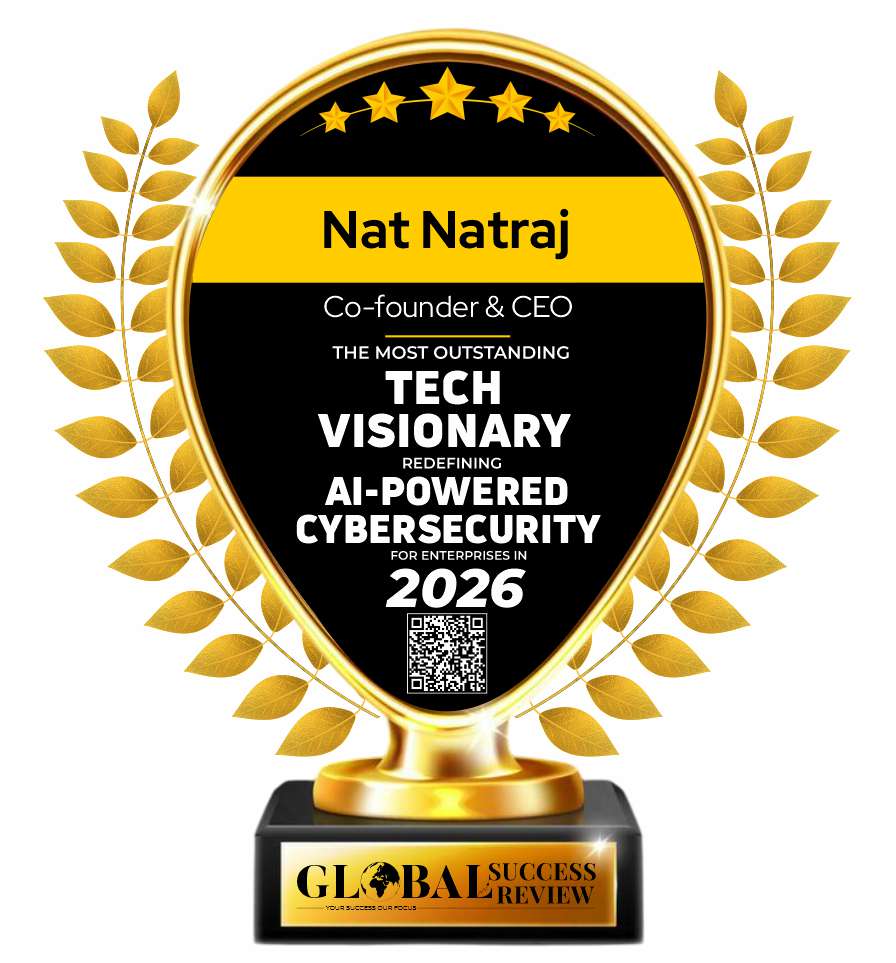
The Global Success Review Magazine proudly recognizes Nat Natraj as
The Most Outstanding Tech Visionary Redefining AI-Powered Cybersecurity for Enterprises in 2026
Because in the age of AI, protecting intelligence requires intelligence of the highest order.