
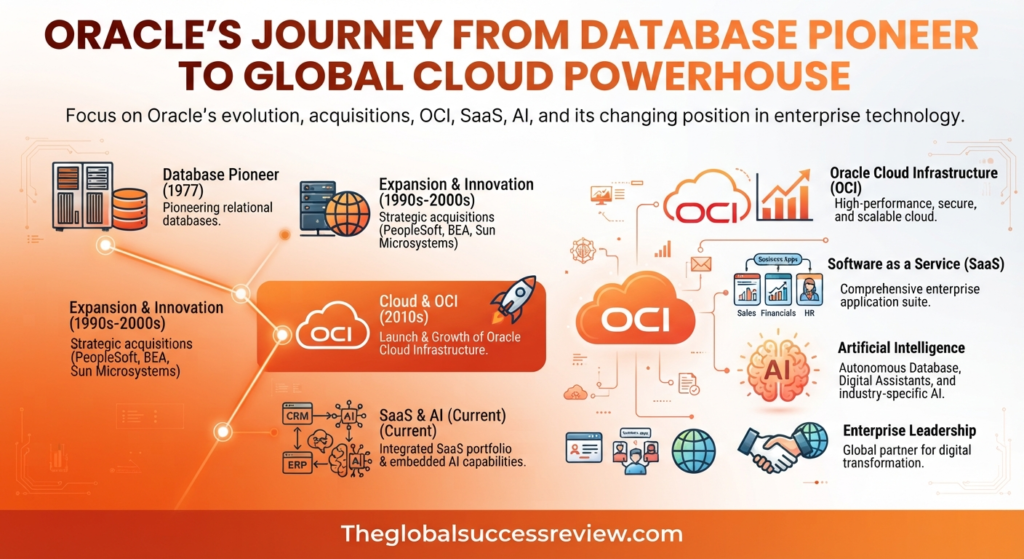
From pioneering enterprise databases to cloud infrastructure, SaaS, and artificial intelligence, Oracle’s transformation reflects how a technology leader can reinvent its future without abandoning the foundation of its past.
In technology, longevity is difficult. Remaining relevant through multiple generations of technological change is even harder. Oracle stands out as a company that has repeatedly reinvented itself as the enterprise technology landscape has evolved.
Founded on the promise of making information easier to manage and use, Oracle built its global reputation around database technology. Over time, however, the company recognized that the future of enterprise technology would extend far beyond databases. Cloud computing, enterprise applications, software-as-a-service (SaaS), and artificial intelligence were changing how organizations operated, and Oracle responded by transforming its business and technology portfolio.
Today, Oracle is positioned not simply as a database company, but as a broad enterprise technology provider spanning databases, cloud infrastructure, applications, data, and AI.
Building the Foundation: The Database Era
Oracle’s early success was built on enterprise database technology. As businesses became increasingly dependent on digital information, reliable databases became critical infrastructure for banking, telecommunications, government, manufacturing, retail, and countless other industries.
Oracle’s database technology became deeply embedded in mission-critical business operations. This created something more valuable than a successful product: a long-term relationship with enterprise customers and their data.
That installed base would later become one of Oracle’s greatest strategic advantages as the company entered the cloud era.
Acquisitions as a Vehicle for Transformation
Oracle’s evolution has been accelerated by an ambitious acquisition strategy.
The acquisitions of PeopleSoft and Siebel Systems expanded Oracle’s presence in enterprise applications and customer relationship management. The acquisition of Sun Microsystems broadened Oracle’s capabilities across hardware, Java, and related technologies. NetSuite strengthened Oracle’s cloud-based business software portfolio, while Cerner expanded its reach into healthcare technology.
These acquisitions were not simply about increasing market share. Collectively, they helped Oracle build a broader technology ecosystem connecting applications, infrastructure, databases, and industry-specific solutions.
The strategy demonstrated a fundamental principle of corporate transformation: growth can come not only from developing new capabilities internally, but also from acquiring capabilities that complement an existing platform.
The Cloud Inflection Point
The rise of cloud computing represented one of the greatest challenges and opportunities in Oracle’s history.
Companies increasingly wanted technology delivered as flexible, scalable services rather than as traditional on-premise systems. Meanwhile, hyperscale cloud providers such as Amazon Web Services, Microsoft Azure, and Google Cloud were reshaping enterprise IT.
Oracle responded by investing heavily in Oracle Cloud Infrastructure (OCI).
OCI became a critical part of Oracle’s strategy for bringing its enterprise technology expertise into the cloud. Rather than competing solely as a general-purpose infrastructure provider, Oracle has emphasized enterprise workloads, database performance, security, and integration with its applications and data technologies.
The company’s growing multicloud strategy is another important evolution. By making Oracle database capabilities available across major cloud environments, Oracle is adapting to an enterprise reality in which organizations increasingly use multiple cloud platforms rather than relying on a single provider.
SaaS: Reinventing Enterprise Software
Cloud transformation also required Oracle to rethink its software business.
Through Oracle Fusion Cloud Applications, the company expanded cloud-based solutions covering finance, enterprise resource planning, human resources, supply chains, and customer experience. NetSuite further strengthened Oracle’s cloud software presence among growing and mid-sized businesses.
The shift to SaaS represents more than a change in delivery mechanism. It changes the relationship between technology provider and customer, from periodic software purchases and upgrades toward continuously evolving services.
For Oracle, this creates a recurring business model while enabling customers to modernize core business processes without maintaining the same level of traditional IT infrastructure.
The AI Chapter
Artificial intelligence now represents the next major stage in Oracle’s transformation.
Oracle’s AI strategy is closely connected to one of its oldest strengths: enterprise data.
Businesses possess enormous quantities of financial, customer, operational, supply-chain, and workforce data. The challenge is turning that information into useful intelligence while maintaining security, governance, reliability, and control.
Oracle is increasingly embedding AI capabilities across its cloud infrastructure, databases, and enterprise applications. Generative AI and AI agents could further change how employees interact with enterprise systems, moving from simply retrieving information toward systems capable of assisting with or performing business processes.
This creates an important strategic opportunity for Oracle: positioning enterprise data as the foundation on which practical business AI can be built.
A New Position in Enterprise Technology
Oracle’s competitive identity has changed significantly.
It now operates at the intersection of several major technology markets. In cloud infrastructure, it competes with AWS, Microsoft Azure, and Google Cloud. In enterprise applications, it competes with companies such as SAP and Salesforce. Yet Oracle retains the database expertise that has defined its identity for decades.
Its strategic proposition increasingly rests on the combination of these capabilities:
Data + Database + Applications + Cloud Infrastructure + AI
That combination gives Oracle an opportunity to serve organizations across the technology lifecycle, from storing critical information to running business applications and applying AI to enterprise data.
The Strategic Lesson
Oracle’s transformation offers a valuable lesson for established businesses: reinvention does not always require abandoning the past.
Oracle’s database leadership created the enterprise relationships and data foundation that supported its expansion into applications and cloud. Acquisitions accelerated diversification. OCI established a stronger cloud position. SaaS transformed the software model. AI is now opening another frontier.
The challenge ahead is to integrate these capabilities into an ecosystem that delivers clear, measurable value to customers.
Oracle’s journey is therefore more than the story of a database company becoming a cloud company. It is a case study in strategic reinvention, ecosystem building, acquisitions, and long-term adaptation.
In an industry where technology can become obsolete within a few years, Oracle’s most significant achievement may be its ability to continually redefine what it means to be an enterprise technology company.
