Driving Innovation Through Science, Strategy, and Sustainable Industrial Leadership
In today’s rapidly evolving industrial landscape, innovation is no longer a luxury; it is a necessity. Industries across the globe are under increasing pressure to deliver higher performance, improve sustainability, navigate complex regulatory environments, and remain commercially competitive in an era defined by accelerated technological transformation. Amid these challenges, leaders who can combine scientific expertise with entrepreneurial vision are emerging as the true architects of the future.
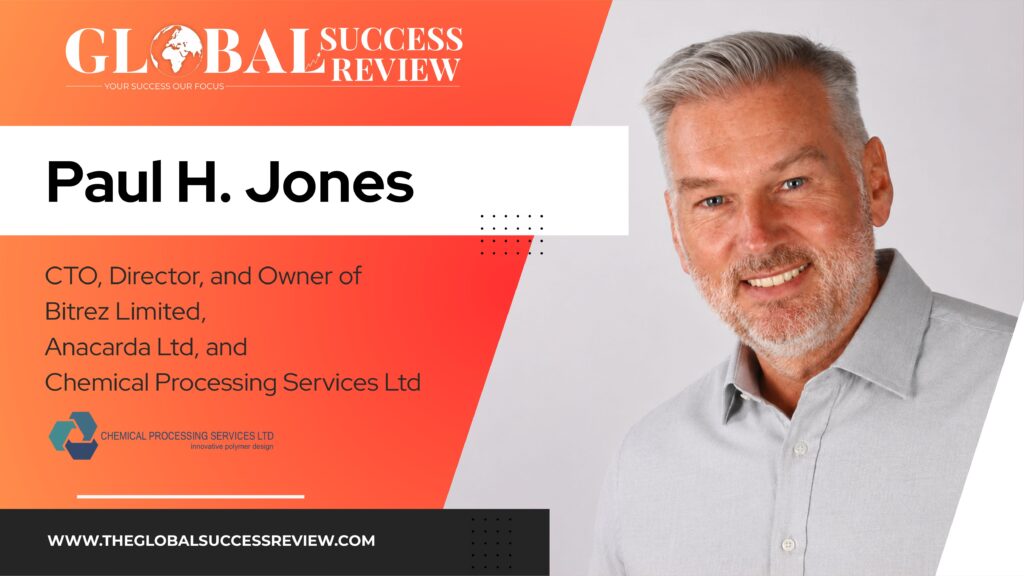
One such leader is Paul H. Jones, a distinguished entrepreneur, innovator, and business strategist whose work continues to influence the future of polymer science, advanced materials, and industrial chemistry. As the CTO, Director, and Owner of Bitrez Limited, Anacarda Ltd, and Chemical Processing Services Ltd, Paul has established himself as a visionary business leader capable of transforming complex scientific ideas into commercially successful industrial solutions.
Recognized in The Global Success Review Magazine’s prestigious edition, “The Most Influential Business Leaders Making an Impact in 2026,” Paul’s leadership journey reflects the powerful intersection of technical excellence, resilience, strategic thinking, and forward-looking innovation. His work spans groundbreaking chemistry, advanced polymer technologies, sustainability-focused industrial development, and patent-protected material science solutions designed to address some of the industry’s most pressing challenges.
Yet what truly distinguishes Paul is not only his technical expertise or entrepreneurial achievements, but his ability to lead with clarity, curiosity, and conviction in an increasingly uncertain world. He represents a new generation of industrial leaders, those who understand that long-term success requires more than profitability alone. It requires adaptability, trust, innovation, and the courage to challenge conventional thinking.
Building a Vision Rooted in Innovation
Paul’s entrepreneurial journey began with a deep fascination for polymer science and its transformative potential across industrial applications. Over the years, he developed a sophisticated understanding of advanced materials, research and development, commercial strategy, and market dynamics. Rather than limiting himself to traditional technical roles, Paul recognized an opportunity to create organizations capable of driving meaningful change through scientific innovation.
His decision to establish Chemical Processing Services Ltd, alongside his leadership involvement with Bitrez Limited and Anacarda Ltd, was motivated by a desire to create agile, technically focused businesses capable of addressing real-world industrial challenges with disruptive chemistry and advanced material solutions.
For Paul, entrepreneurship was never simply about building companies. It was about building platforms for innovation.
“I saw an opportunity to create businesses that not only deliver high-performance solutions but also challenge conventional thinking in the sector,” he explains.
That mindset has remained central to his leadership philosophy and strategic direction. From the beginning, Paul focused on combining scientific expertise with entrepreneurial agility, enabling his organizations to move quickly, innovate efficiently, and respond effectively to evolving customer and regulatory demands.
His ventures were designed to operate differently from conventional industrial businesses. Instead of relying solely on established methodologies, Paul sought to embed innovation directly into the organizational culture, encouraging scientific creativity, critical thinking, and rapid problem-solving.
This commitment to innovation continues to define the success of his companies today.
A Leadership Philosophy Centered on Empowerment
Leadership in highly technical industries requires more than operational oversight. It demands vision, adaptability, and the ability to inspire highly skilled teams toward shared objectives. For Paul, leadership is fundamentally about enabling others to succeed.
“I believe in leading with clarity, accountability, and curiosity,” he says. “Strong leadership is not about control; it’s about enabling others to perform at their best while aligning everyone toward a shared vision.”
This philosophy has shaped the culture across all his organizations. Paul fosters environments where technical expertise is valued, ideas are encouraged, and innovation thrives through collaboration rather than hierarchy.
At the heart of his leadership approach are several core principles:
- Integrity
- Innovation
- Technical excellence
- Customer-centric thinking
- Resilience
These values guide both strategic decisions and daily operations, creating consistency across diverse business functions and industry engagements.
Importantly, Paul emphasizes empowerment over micromanagement. He believes that organizations perform best when talented individuals are trusted to think independently, contribute meaningfully, and challenge assumptions constructively.
This culture of empowerment has allowed his businesses to remain agile and innovative, even within highly competitive and technically demanding markets.
Bridging Science and Commercial Impact
One of Paul’s greatest strengths lies in his ability to bridge the gap between scientific advancement and practical industrial application. Throughout his career, he has worked extensively across research, technical leadership, and commercial operations, giving him a uniquely balanced perspective on both innovation and market realities.
This interdisciplinary expertise proved instrumental in shaping his entrepreneurial success.
His career journey reflects years of experience in polymer science and industrial chemistry, where he observed firsthand how innovation could either flourish or become constrained depending on organizational culture and leadership priorities.
“These experiences gave me valuable perspective,” he explains. “I became increasingly motivated to create businesses where agility, creativity, and scientific thinking were embedded into the culture.”
That vision ultimately led to the creation of Chemical Processing Services Ltd, which serves as both a consultancy and a platform for disruptive chemistry development. The company focuses on patent-protected technologies and licensing opportunities designed to address industrial and regulatory challenges through innovative material science solutions.
This model allows Paul to combine deep technical consultancy with entrepreneurial flexibility, enabling rapid innovation while maintaining close collaboration with industry partners.
The result is an organization capable of solving complex industrial problems while remaining adaptable to changing market needs.
Innovation as a Competitive Advantage
Innovation is often discussed as a corporate buzzword, but for Paul , it represents a disciplined and measurable business strategy. Across his organizations, innovation is embedded not only in product development but also in operational thinking, customer engagement, and long-term growth planning.
One of the key differentiators of Chemical Processing Services Ltd is its ability to combine deep technical expertise with organizational agility.
“Our differentiation lies in our ability to develop tailored solutions quickly while maintaining a strong focus on performance and quality,” Paul explains.
This agility is particularly valuable in industries where regulatory requirements, customer expectations, and technological capabilities evolve rapidly. By maintaining close relationships with clients and continuously investing in research and development, Paul’s businesses can respond proactively rather than reactively.
His portfolio of patents and advanced technologies further strengthens this competitive advantage. Many of these innovations focus on addressing chronic health concerns and improving material performance while meeting increasingly stringent environmental and industrial standards.
In an industry traditionally characterized by slower development cycles, Paul’s emphasis on rapid innovation and tailored problem-solving positions his companies as forward-thinking market leaders.
The Role of Technical Credibility in Building Trust
In highly specialized industrial sectors, credibility is everything. Customers and partners seek more than suppliers; they seek trusted collaborators capable of delivering consistent performance and reliable expertise.
Paul understands this deeply.
“Trust is built through consistency, transparency, and delivering on promises,” he says. “We position ourselves as long-term partners rather than transactional suppliers.”
This relationship-driven approach has been instrumental in building strong client and stakeholder networks across multiple industries.
Rather than focusing solely on sales outcomes, Paul prioritizes understanding customer challenges at a fundamental level. This allows his organizations to develop highly tailored solutions that address not just immediate technical requirements but broader operational objectives as well.
Technical credibility plays a central role in this process. By maintaining rigorous scientific standards and prioritizing quality across every stage of development, Paul has established a reputation for reliability and expertise.
That credibility becomes especially important when navigating complex industrial challenges where customers require both innovation and risk mitigation.
Navigating Challenges Through Agility and Focus
Like any entrepreneur operating within complex global markets, Paul has faced significant challenges throughout his business journey. Economic uncertainty, evolving regulations, technological disruption, and competitive pressures are all realities of modern industrial leadership.
However, Paul approaches challenges with a mindset rooted in adaptability and informed decision-making.
“Maintaining focus, making informed decisions quickly, and providing innovative solutions have been key,” he explains.
One of the greatest strengths of his organizations is their ability to remain flexible without compromising technical excellence. This balance allows his companies to pivot effectively when necessary while continuing to deliver high-performance solutions.
Paul also recognizes that resilience is essential for long-term success.
Industrial sectors are increasingly influenced by geopolitical uncertainty, supply chain volatility, and rapidly evolving sustainability requirements. Leaders who cannot adapt quickly risk becoming obsolete.
For Paul, resilience means continuously investing in innovation, monitoring market trends closely, and maintaining organizational agility.
This forward-looking approach has enabled his companies to remain competitive and relevant in dynamic market environments.
Sustainability and the Future of Advanced Materials
The future of industrial chemistry and advanced materials will be defined increasingly by sustainability. Customers, regulators, and investors alike are demanding solutions that combine performance with environmental responsibility.
Paul believes this transformation will fundamentally reshape the industry over the next five years.
“The industry will continue to move toward high-performance, sustainable materials,” he says. “There will be increasing demand for solutions that combine functionality with environmental responsibility.”
This shift presents both challenges and opportunities.
On one hand, businesses must navigate stricter environmental regulations and evolving customer expectations. On the other, companies capable of delivering innovative sustainable solutions stand to gain significant competitive advantage.
Paul’s organizations are actively positioned within this evolving landscape through their focus on advanced materials, smart technologies, and sustainability-driven innovation.
He identifies several emerging trends likely to shape the future of the sector:
- Sustainability-focused material innovation
- Advanced composites
- Smart materials
- Digitalization in R&D and manufacturing
- Faster innovation cycles through data-driven processes
By staying ahead of these trends, Paul aims to ensure his organizations remain not only competitive but influential within the future industrial ecosystem.
Digital Transformation as a Strategic Necessity
Digital transformation is no longer optional for industrial businesses; it is essential for long-term survival and growth.
Paul recognizes this reality clearly.
“It’s critical,” he says. “Digital transformation enables better decision-making, faster innovation cycles, and improved operational efficiency.”
Across his businesses, digital tools are increasingly integrated into research, development, manufacturing, and operational processes. These technologies help accelerate innovation, optimize workflows, and improve responsiveness to customer needs.
Importantly, Paul sees digital transformation not simply as technology adoption, but as a strategic enabler of agility and innovation.
Organizations that fail to embrace digitalization risk falling behind competitors capable of moving faster, analyzing data more effectively, and adapting more rapidly to market shifts.
For Paul, digital transformation supports a broader vision of intelligent, future-ready industrial leadership.
Redefining Impact Through Scientific Entrepreneurship
The phrase “making an impact” is often overused in business conversations. Yet in Paul H. Jones’ case, impact is measurable through innovation, technical advancement, customer success, and industry influence.
One of the defining milestones in his entrepreneurial journey came when customers validated the real-world value of his technologies early in the development process.
“That demonstrated there was real demand for what we were developing,” he recalls. “It gave us the confidence to accelerate our growth strategy.”
That validation reinforced his belief that innovation must always connect back to practical industrial outcomes.
Today, his organizations continue to develop and commercialize advanced materials designed to solve complex performance challenges across demanding applications.
For Paul, success is not measured solely through financial growth, but through the ability to create meaningful solutions that improve industries and drive long-term value.
The Qualities of an Influential Modern Leader
As industries become increasingly complex and interconnected, leadership itself is evolving. Technical expertise alone is no longer sufficient. Modern leaders must combine vision with adaptability, innovation with execution, and ambition with trust-building.
Paul believes truly influential leaders share several defining characteristics.
“An impactful leader combines vision with execution,” he explains. “They inspire trust, embrace innovation, and are willing to challenge the status quo.”
Importantly, he also emphasizes the role of people and partnerships in long-term success.
No organization succeeds in isolation. Sustainable growth depends on collaboration, strong stakeholder relationships, and the ability to align talented teams around shared goals.
This people-centered perspective remains central to Paul’s leadership style and business philosophy.
A Vision for the Future
Looking ahead, Paul remains deeply focused on advancing innovation, sustainability, and technical excellence across all his ventures.
His vision extends beyond short-term growth objectives. He aims to continue building organizations capable of shaping the future of industrial materials and chemical technologies through disruptive innovation and customer-focused problem-solving.
As industries evolve toward smarter, more sustainable solutions, Paul sees enormous opportunity for organizations willing to think differently and invest boldly in research, agility, and collaboration.
At the same time, he remains committed to maintaining the values that have guided his leadership journey from the beginning: integrity, resilience, curiosity, and technical excellence.
These principles continue to shape not only his organizations but also the broader impact he seeks to create within the industry.
Creating a Legacy of Innovation and Trust
Recognition as one of “The Most Influential Business Leaders Making an Impact in 2026” reflects more than Paul’s’ entrepreneurial accomplishments. It reflects a career dedicated to advancing science, empowering teams, solving complex industrial challenges, and building businesses grounded in innovation and trust.
In a world where industries face mounting pressure to innovate responsibly and adapt rapidly, leaders like Paul are helping redefine what modern industrial leadership looks like.
Through his work at Bitrez Limited, Anacarda Ltd, and Chemical Processing Services Ltd, Paul continues to demonstrate that scientific innovation and commercial success are not opposing forces; they are complementary drivers of sustainable progress.
His journey serves as a powerful example of how visionary leadership, technical expertise, and entrepreneurial courage can come together to create lasting impact across industries and markets.
As the future of advanced materials and industrial chemistry continues to evolve, one thing is certain: Paul is not simply responding to change; he is helping shape it.