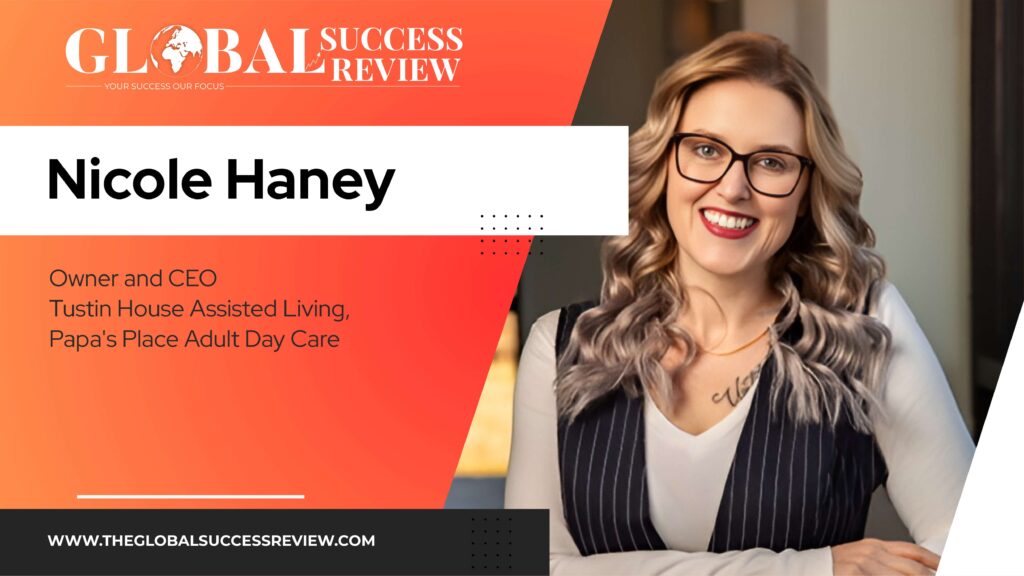
In an industry often defined by regulation, staffing shortages, and rising financial pressures, Nicole Haney stands apart for a very different reason: she refuses to separate compassion from systems, dignity from discipline, or growth from ethics.
As Owner and CEO of Tustin House Assisted Living, Papa’s Place Adult Day Care, and N. Haney Enterprises, Haney has quietly built a network of care models that families trust, caregivers stay loyal to, and peers increasingly study. Her work spans dementia-specific residential care, adult day services, non-medical home care, medication management, leadership consulting, and mentoring programs for operators across the United States.
Yet behind this multi-enterprise portfolio is not a traditional business origin story. It is a deeply personal one, rooted in family, grief, advocacy, and an unwavering belief that senior care can and must be delivered differently.
Recognised in this edition as one of “The Most Impactful Women Leaders in Assisted Living & Home Care, 2026,” Nicole Haney represents a new generation of healthcare leadership, leaders who refuse to normalise burnout, fragmentation, or dignity-compromising shortcuts, and who instead build repeatable systems that protect humanity.
From Personal Crisis to Industry Calling
For Haney, senior care was never a calculated career move.
The turning point came in 2018, when her grandfather, affectionately known as “Papa”, was diagnosed with Alzheimer’s disease. Watching her family navigate disjointed systems, inconsistent services, and emotionally exhausting decision-making reshaped everything she thought she knew about healthcare delivery.
She had already spent years professionally protecting vulnerable populations, working in investigative oversight roles for children and adults with developmental disabilities and mental illness. She understood regulations, compliance, and institutional systems. But Alzheimer’s made her understand something else entirely: the fear families feel when care becomes fragmented, and the quiet devastation that occurs when dignity gives way to expediency.
Those two realities collided.
“I realized I couldn’t just advocate from the outside anymore,” Haney explains. “I needed to build something better from within.”
What began as a personal mission soon became Papa’s Place Adult Day Care, followed by home-care services, medication management programs, and eventually a purpose-built memory-care residence. Adult day services emerged as a cornerstone of her work because she saw how transformative they were, not only for seniors, but for caregivers desperate for meaningful respite without guilt.
Over sixteen years, that initial spark evolved into something far larger.
“I stopped focusing only on filling gaps,” she says. “I started rebuilding systems.”
That mindset ultimately produced her now-signature BrainWave Dementia Care Philosophy, a framework centred on intentional routines, dignity in daily details, behavioural understanding, and treating cognitive decline not as a problem to manage, but as a human experience to support.
A Leadership Philosophy Built on Clarity and Courage
Ask Nicole Haney to describe her leadership style, and she does not speak of charisma or command.
Instead, she speaks of accountability, clarity, and dignity.
“I don’t believe leadership is about control,” she says. “It’s about creating systems that let other people succeed without sacrificing integrity or humanity.”
Early in her career, she learned to be tough, healthcare environments can be unforgiving, and mistakes carry serious consequences. Over time, however, she recognised that urgency without intention erodes trust, and strength without self-awareness becomes reactivity.
Her leadership matured into something more disciplined and sustainable: clear expectations instead of assumptions, consistency instead of impulse, accountability without intimidation.
Dignity, she emphasises, is built in details, how residents are addressed, how staff are trained, how policies are implemented, how leaders behave when no one is watching.
“Compassion without structure fails people,” she says. “Structure without compassion dehumanizes them.”
Today, she builds organizations designed to function without heroic overextension or chronic crisis. She develops leaders rather than micromanagers and measures success not only in revenue or occupancy, but in staff retention, consistency of care, and the quiet confidence families feel when they entrust her organizations with someone they love.
Recognition Rooted in Responsibility
Being named among the most impactful women leaders in her sector does not feel celebratory to Haney; it feels grounding.
Personally, the honour brings her back to the families who trusted her early on, to moments when ethical decisions were harder and slower than profitable ones, and to her grandfather, whose legacy continues to guide every enterprise she runs.
Professionally, the recognition carries weight rather than pride.
“Impact isn’t about how loud your platform is,” she reflects. “It’s about how many people are better off because you exist in the space.”
For Haney, the designation reinforces her obligation to challenge industry norms, particularly the normalisation of burnout, chaotic operations, and dignity-compromising shortcuts.
It also affirms her approach as a woman leader in a field where firmness is often confused with harshness.
“You can be decisive without losing humanity,” she says. “Compassionate without being permissive.”
Visibility, she believes, must always be used in service of something larger: better care models, stronger leaders, and futures where families do not have to fight so hard for ethical options.
Where Operations Protect Compassion
Perhaps the most distinctive element of Haney’s leadership is her insistence that compliance, growth, and compassion are not competing priorities.
In her view, they either exist together or they all fail.
She builds systems with clear roles, measurable standards, consistent training, and embedded regulatory safeguards. Compliance is not treated as paperwork; it is operationalised into daily workflows, protecting clients, staff, and organisations alike.
Her background in investigative oversight deeply shaped this philosophy.
“When compliance is done right,” she explains, “it becomes invisible and effective.”
Growth, too, is intentionally disciplined. She tracks staff retention, incident trends, continuity of care, and client satisfaction alongside financial performance.
“Growth that sacrifices dignity or safety isn’t growth,” she says. “It’s erosion.”
In her organisations, operational excellence functions as a shield, allowing caregivers to focus on relationships instead of chaos, and families to feel stability rather than anxiety.
Building Tustin House: Continuity, Not Expansion
When the opportunity to acquire Tustin House Assisted Living arose, Haney was not chasing her next venture.
Papa’s Place and home-care services were already established, and she had spent years watching families struggle when dementia progressed beyond what community-based services could support.
Meeting the home’s original owners, the Fitzgeralds, revealed immediate alignment. They respected the heart of the residence and shared her belief that traditional assisted-living models no longer met the cognitive needs emerging in the community.
Tustin House became her bridge between adult day services and residential care, a way to preserve familiarity, trust, and dignity even as needs intensified.
Early milestones included restructuring staffing models, introducing predictable daily rhythms, and redesigning environments to reduce anxiety rather than trigger it. These efforts later crystallised into the BrainWave framework.
The goal, she emphasises, was never to overwrite what existed, but to honour the home’s foundation while elevating dementia-specific practice.
“When vision, timing, and values align,” she reflects, “growth doesn’t dilute care. It deepens it.”
Papa’s Place and the Birth of Consulting
Papa’s Place was created because Haney saw families struggling in the in-between, when loved ones were no longer safe at home but not yet ready for residential placement.
Adult day services, she believed, were vastly underutilised.
Her model emphasised therapeutic structure, engagement, dignity, and caregiver respite without guilt. It became the backbone of her ecosystem.
As the program grew, other operators began asking questions, not about marketing, but about systems, compliance integration, leadership structures, and sustainability.
That demand led to the creation of N. Haney Enterprises, her consulting and mentoring arm.
Unlike traditional advisory firms, it is grounded entirely in lived operations.
“I don’t consult from theory,” she explains. “Everything I teach is something I actively run.”
Her mission is not to create dependency, but to help operators build organisations that can function without constant crisis, emotional exhaustion, or ethical compromise.
Leading Through Loss and Crisis
One of the most defining chapters of Haney’s journey unfolded during the COVID-19 pandemic, when she lost her grandfather while simultaneously leading regulated healthcare operations under unprecedented scrutiny.
Families needed reassurance. Staff needed stability. Regulations changed weekly. And grief had no space to surface.
“There is no handbook for that,” she says quietly.
That season reshaped how she defines strength. Rather than absorbing everything herself, she doubled down on systems, delegation, and leadership development.
She built organisations capable of resilience rather than perfection and stopped equating endurance with isolation.
Today, she scales with emotional sustainability in mind, recognising that behind every metric stands a human being, including the leader.
When Care Transforms Lives
Haney resists the idea of a single defining moment when she realised her work was transformational.
Instead, she sees it daily, residents becoming more present after years of heavy sedation, friendships forming, laughter returning, and families witnessing loved ones re-emerge.
She hears it in staff language too, when caregivers speak fluently in BrainWave concepts such as “Day Ready,” “Night Reset,” and “Dignity in the Details.”
“That’s when I know the philosophy has taken root,” she says.
These quiet moments affirm that her organisations are not merely compliant, they are restorative.
The BrainWave Legacy
Among all her achievements, the BrainWave program remains the most meaningful.
It is fully operationalised, shared language, daily practices, structured approaches, not a theoretical philosophy.
It reframes behaviour as communication, reduces reliance on heavy medication, strengthens caregiver confidence, and restores calm to homes.
At its core, BrainWave honours the person behind the diagnosis.
“That,” Haney says, “is the legacy worth building.”
Preparing for the Future of Senior Care
Looking ahead, Haney predicts a decade of reckoning for the industry.
Rising costs, workforce instability, payer diversification, and dementia prevalence will reshape everything.
She is positioning her enterprises accordingly, integrating adult day services, home care, medication management, and residential models into connected ecosystems; investing heavily in workforce development; and preparing to franchise Papa’s Place and Tustin House to aligned operators nationwide.
“The future belongs to organizations that collaborate,” she says, “not ones that compete themselves into isolation.”
A Legacy Beyond Buildings
For Nicole Haney, legacy is not about scale or recognition.
It is about people, leaders equipped to challenge outdated norms, caregivers supported rather than depleted, families spared from constant crisis, and communities offered ethical options.
She hopes emerging women entrepreneurs see in her story permission to lead with courage rather than fear.
On a personal level, her work is also for her daughter, an example of purposeful leadership and principled persistence.
“If we raise the standard together,” she says, “the legacy won’t belong to me alone. It will belong to everyone who chooses to do this work differently.”