Leading with Stewardship: How Rizwana and The SOL Foundation Are Restoring Hope, Communities, and the Planet
“True leadership is measured not by the number of people who follow you, but by the number of lives empowered to flourish long after you have stepped aside.”
In an era defined by climate uncertainty, widening social inequalities, and growing humanitarian challenges, visionary leadership demands more than compassion, it requires courage, collaboration, and an unwavering commitment to creating sustainable change. Around the world, communities continue to grapple with water scarcity, environmental degradation, food insecurity, and limited access to education. While these challenges may appear overwhelming, a new generation of purpose-driven leaders is proving that meaningful transformation begins with listening, understanding, and empowering people to shape their own future.
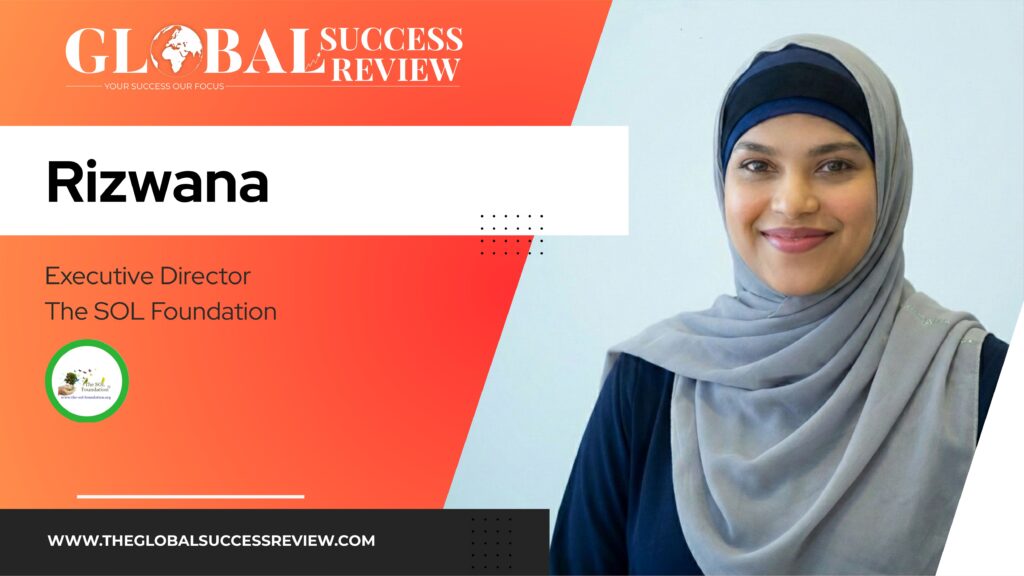
Among these remarkable changemakers is Rizwana, the visionary force behind The SOL Foundation, whose work has earned international recognition for advancing environmental restoration, community resilience, and sustainable development. Recognized as one of The Most Visionary Social Impact Leaders to Watch in 2026, Rizwana represents a leadership philosophy that prioritizes stewardship over status, long-term regeneration over short-term charity, and collaboration over control.
Rather than measuring success by the number of projects completed or funds raised, Rizwana evaluates impact by a more enduring question: Will communities continue to thrive long after the organization has stepped away? This perspective has become the defining principle of The SOL Foundation’s mission and distinguishes its approach from conventional models of philanthropy.
For Rizwana, social impact has never been about delivering temporary relief. It is about restoring dignity, strengthening local capacity, and building resilient ecosystems where both people and nature can prosper together.
Purpose Born from Observation
Every transformative journey begins with a moment of realization.
For Rizwana, that realization came through firsthand experiences witnessing the close relationship between environmental health and human wellbeing. While working across communities in South Asia and East Africa, she observed that poverty was rarely the result of a lack of determination. Instead, it stemmed from limited access to fundamental resources such as clean water, sustainable agriculture, education, and economic opportunity.
She recognized that these challenges could not be solved independently. Water affected education. Environmental degradation influenced food security. Climate instability impacted livelihoods. Every issue was interconnected.
These observations inspired the creation of The SOL Foundation, an organization founded on the belief that lasting social progress must restore both communities and the natural systems that sustain them.
The organization’s name carries profound symbolism. “SOL,” representing the sun, reflects life, hope, renewal, and the universal connection shared by every community on Earth. It serves as a reminder that no society should remain hidden in the shadows of inequality or environmental decline.
Today, The SOL Foundation works to restore balance by integrating environmental conservation, water security, education, regenerative agriculture, and community empowerment into holistic development initiatives that address root causes rather than symptoms.
A Philosophy of Servant Leadership
Leadership is often associated with authority, decision-making, and strategic vision. Rizwana offers a different perspective.
Her philosophy centers on servant leadership, an approach grounded in humility, active listening, and shared ownership.
“We don’t arrive with answers,” she explains. “We arrive with questions.”
Rather than imposing external solutions, Rizwana believes communities possess valuable knowledge shaped by generations of lived experience. The role of leadership, therefore, is not to dictate change but to create opportunities for local voices to guide development according to their own priorities and cultural contexts.
This philosophy rests upon four enduring values that influence every initiative undertaken by The SOL Foundation:
- Dignity, recognizing every individual’s right to agency and self-determination.
- Stewardship, honoring humanity’s responsibility to care for the Earth’s natural resources.
- Integrity, ensuring transparency in both intention and measurable impact.
- Courage, challenging systems that perpetuate inequality while advocating for sustainable alternatives.
These principles have enabled the organization to cultivate trust among communities, partners, volunteers, and supporters across diverse regions of the world.
Building Trust Before Building Projects
One of the defining characteristics of The SOL Foundation is its commitment to relationships before infrastructure.
Many development initiatives prioritize rapid implementation, often measuring success by the number of wells drilled, trees planted, or schools constructed. While these achievements are important, Rizwana believes genuine transformation cannot be rushed.
Instead, trust becomes the first investment.
Her teams spend significant time engaging community members, listening to local concerns, understanding cultural traditions, and identifying existing strengths before launching any project.
This collaborative process ensures that solutions belong to the communities themselves rather than external organizations.
For Rizwana, sustainable development means that local leaders eventually become the primary decision-makers, allowing projects to continue independently for years to come.
It is an approach that replaces dependency with empowerment.
From Charity to Regeneration
Perhaps the most distinctive aspect of Rizwana’s work is her emphasis on regeneration rather than charity.
Traditional aid often focuses on addressing immediate needs. While emergency assistance remains essential during crises, long-term progress requires restoring the systems that support healthy communities.
This philosophy is clearly demonstrated through The SOL Foundation’s integrated development model.
Rather than simply installing a water source, the organization combines clean water access with soil restoration, native tree planting, regenerative agriculture, women’s economic participation, and environmental education.
The result is not merely improved water availability but stronger food security, healthier ecosystems, increased household income, and greater climate resilience.
One particularly inspiring example comes from a community in Kenya that had previously been considered uninhabitable because of advancing desertification.
Through years of community-led water harvesting, ecosystem restoration, and sustainable agricultural practices, the village gradually transformed its landscape.
Today, crops grow where barren land once existed, families remain together instead of migrating for survival, and local elders now mentor neighboring communities seeking similar transformation.
For Rizwana, stories like these reaffirm an important lesson: lasting change occurs when communities become owners rather than recipients of development.
Listening to the Voices That Matter Most
Among the many experiences that have shaped Rizwana’s leadership, one encounter continues to influence her mission.
While visiting a drought-stricken region in Tanzania, she met a group of young girls who walked several kilometers every day to collect water.
The journey consumed hours that should have been spent in school. It exposed them to illness, violence, exploitation, and lost opportunities.
When one twelve-year-old girl quietly said, “We don’t need pity. We need help,” those words became impossible to forget.
For Rizwana, the statement represented more than a request.
It became a call to pursue justice rather than charity.
The experience reinforced her conviction that sustainable solutions must preserve dignity, expand opportunity, and empower communities to determine their own future.
That belief continues to guide every initiative undertaken by The SOL Foundation today.