Building a Global Infrastructure of Knowledge and Opportunity for NGOs
In a world where social challenges are becoming increasingly complex, the organizations working closest to communities are often the ones operating with the fewest resources. Across developing and developed regions alike, grassroots nonprofits and social enterprises are addressing poverty, inequality, climate challenges, public health, education, gender equity, and countless other pressing issues. Yet, behind many powerful ideas lies a persistent challenge: access.
Access to funding information. Access to donor intelligence. Access to fundraising knowledge. Access to the systems and tools required to transform a promising idea into sustainable action.
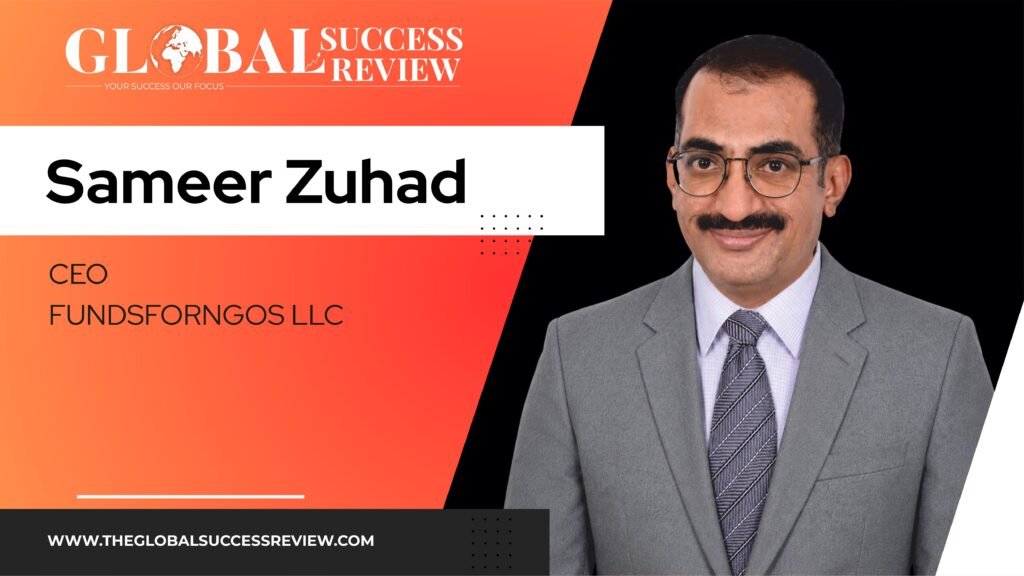
For Sameer Zuhad, CEO of FUNDSFORNGOS LLC, addressing this imbalance has become the defining purpose of his professional journey.
Since launching fundsforNGOs as a modest blog in 2008, Zuhad has helped build what has evolved into a global information and capacity-building platform designed to make the funding landscape more accessible to nonprofits, NGOs, and social enterprises. What began as an effort to simplify the search for funding opportunities has developed into a broader ecosystem of searchable databases, alerts, guides, webinars, training, eBooks, sample resources, and practical fundraising support.
Today, his work reflects a larger idea: that knowledge itself can be an important form of infrastructure for social change.
As The Global Success Review Magazine™ recognizes Sameer Zuhad in its edition, “The Most Influential Nonprofit Leaders in New York to Watch in 2026,” his story offers an important perspective on leadership, innovation, independence, and the role technology can play in widening access to opportunity.
A Mission Born from an Unequal Landscape
Sameer Zuhad’s journey into the social-impact ecosystem began with a simple but powerful observation. Many organizations working on some of the world’s most important problems did not necessarily lack commitment, ideas, or community understanding. What they often lacked was access to the information and skills needed to secure resources.
Funding opportunities were frequently scattered across institutional websites, foundation announcements, embassy pages, donor portals, and professional networks. Larger organizations could dedicate staff and systems to monitoring these opportunities. Smaller and grassroots organizations often had to rely on chance, personal relationships, or incomplete information.
This created a fundamental imbalance.
In 2008, Zuhad launched fundsforNGOs as a blog with the goal of making funding information easier to find and understand. Over time, conversations with NGO leaders and changemakers around the world reinforced what he had initially observed: the challenge was often not a shortage of capable people or meaningful initiatives, but unequal access to opportunity.
That realization became the foundation of a mission that continues to guide the organization today, to democratize access to resources so that capable organizations are not excluded because of geography, organizational size, or limited professional networks.
The evolution of the platform also mirrors Zuhad’s own evolution as a leader. Establishing FUNDSFORNGOS LLC in the United States in 2011 provided the initiative with a more durable institutional foundation. A further defining moment came in 2020, when the organization became fully founder-owned again.
For Zuhad, this was more than a structural change. It provided greater clarity about the future.
The organization could grow at its own pace, remain independent, reinvest in research and technology, and make decisions based on long-term user value rather than short-term external pressures.
It also reinforced one of his most important leadership beliefs: growth matters only when it strengthens the original purpose.
Leadership Beyond the Spotlight
Sameer Zuhad’s approach to leadership is grounded in purpose, independence, and practical service.
Rather than viewing leadership as the process of occupying the center of every decision, he believes in building systems, teams, and knowledge structures that enable others to succeed.
This philosophy is particularly relevant in the nonprofit-support ecosystem, where the ultimate impact of an organization may extend far beyond its own internal operations. The success of fundsforNGOs is not simply measured by the number of people visiting a platform or receiving an alert. Its deeper value lies in whether a small organization can discover an opportunity, prepare more effectively, strengthen its systems, or develop greater confidence in navigating the funding environment.
Under Zuhad’s leadership, the organization combines a social mission with the discipline of a sustainable enterprise.
That independence has allowed FUNDSFORNGOS to remain focused on several enduring principles: making useful information accessible, earning trust through accuracy and transparency, and designing for long-term value rather than short-term attention.
At the heart of this philosophy is a respect for local and grassroots knowledge.
Communities understand their own realities. Local organizations often possess deep knowledge of the people and issues they serve. The role of a global platform, therefore, should not be to prescribe every solution. Instead, it should help organizations gain access to relevant information, strengthen their capacity, and make more informed decisions.
This distinction is central to Zuhad’s vision.
FUNDSFORNGOS does not position itself as a donor, nor as an intermediary that submits applications on behalf of organizations. Instead, it focuses on information and capacity-building, helping users understand the funding landscape and develop the tools needed to navigate it.
From Finding Grants to Building Capacity
One of the most important lessons in nonprofit resource mobilization is that discovering a funding opportunity is only the beginning.
An organization may identify a highly relevant grant and still face significant challenges. Does it meet the eligibility criteria? Is the proposed project clearly designed? Can the organization develop a realistic budget? Does it have the evidence, systems, monitoring framework, and institutional readiness required by the funder?
These questions led FUNDSFORNGOS to expand beyond simple funding discovery.
The platform now encompasses a wider range of resources intended to support different stages of the fundraising journey. Searchable grant and donor databases, funding alerts, deadline tracking, webinars, guides, eBooks, proposal resources, and practical training all contribute to a broader approach to resource mobilization.
The objective is not simply to help organizations submit more applications.
It is to help them make better decisions.
Zuhad emphasizes the importance of treating resource mobilization as a continuous organizational function rather than an occasional exercise in proposal writing. This requires NGOs to develop realistic funding pipelines, research donor alignment, document their impact, strengthen financial systems, cultivate relationships, and diversify sources of support.
For smaller organizations, this can be transformative.
A recurring form of impact described by users of the platform is the experience of discovering opportunities that they previously believed were beyond their reach. When relevant funding intelligence is combined with practical guidance on donor expectations and proposal development, organizations may be better positioned to prepare stronger applications and develop more credible fundraising pipelines.
Yet Zuhad is careful about claiming ownership of those outcomes.
The work, leadership, and community knowledge belong to the organizations themselves.
FUNDSFORNGOS aims to reduce some of the information and capacity barriers surrounding them.
That philosophy reflects a broader understanding of empowerment: meaningful support does not replace the agency of an organization; it strengthens its ability to act independently.
Technology as an Equalizer
The digital transformation of the nonprofit sector has fundamentally changed how organizations discover opportunities, communicate with donors, collaborate, and build capacity.
According to Zuhad, technology has helped move resource mobilization away from being an episodic and relationship-limited activity toward a more continuous and data-informed process.
Today, organizations can monitor opportunities across borders, research donors, receive alerts, participate in global training, collaborate remotely, and access knowledge that previously might have required significant institutional resources.
But greater access to information has also created a new challenge: information overload.
The future is not simply about generating more data. It is about improving discovery, verification, relevance, matching, and decision-making.
This is where technology, data analytics, automation, and artificial intelligence may play an increasingly important role.
Artificial intelligence, in particular, has the potential to reduce the administrative burden carried by small nonprofit teams. It can help users scan large volumes of information, identify potentially relevant opportunities, summarize complex guidelines, support early-stage proposal development, analyze feedback, and facilitate communication across languages.
Data analytics can help organizations understand fundraising performance, donor retention, program outcomes, and where limited staff resources may generate the greatest value.
Automation can improve deadline tracking, reporting processes, and routine workflows.
However, Zuhad remains clear that technology should augment human judgment, not replace it.
For the nonprofit sector, the responsible adoption of technology must include questions of privacy, bias, affordability, accessibility, security, and digital inclusion.
A sophisticated tool that excludes smaller organizations or creates new barriers cannot truly be considered an equalizing force.
For this reason, FUNDSFORNGOS approaches innovation through practical user needs. The organization looks at recurring challenges: time lost searching across multiple websites, missed deadlines, uncertainty about eligibility, and the need for guidance at critical moments during the fundraising process.
A useful tool, Zuhad believes, should reduce effort, improve the quality of a decision, and remain understandable to users who may not have specialist fundraising or technical expertise.
Innovation with a Mission-First Mindset
As artificial intelligence and automation become increasingly integrated into organizational life, nonprofit leaders face an important responsibility: ensuring that technology serves the mission rather than allowing technology to define it.
Zuhad advocates a mission-first framework.
Before adopting a new tool, organizations should ask fundamental questions: What problem does it solve? Who benefits? What data does it require? What risks does it create? Can staff and communities use it fairly?
Accessibility must include practical considerations such as mobile-friendly design, low-bandwidth access, plain language, disability inclusion, multilingual support, and realistic pricing.
Transparency is equally important, particularly when artificial intelligence or automation influences decisions and communications. Sensitive work requires meaningful human review, while organizations must maintain accountability when systems make mistakes.
In Zuhad’s view, innovation becomes valuable when it strengthens relationships, improves outcomes, and gives people more time to focus on meaningful work.
It becomes a distraction when it distances organizations from the communities they exist to serve.
This balanced perspective may become increasingly important as the social-impact sector enters a period of rapid technological change.
The Changing Future of Philanthropy
Looking toward 2026 and beyond, Sameer Zuhad sees several interconnected trends shaping philanthropy, international development, grantmaking, and social entrepreneurship.
One is the continuing emphasis on locally led development and the need to shift greater decision-making power toward communities.
Another is the growing recognition of flexible and multi-year funding. Short-term and highly restricted grants can make it difficult for organizations to build institutional resilience, retain talent, and plan effectively for the future.
At the same time, expectations around evidence and measurable outcomes are likely to continue growing. Funders increasingly want clearer insight into results, data, learning, and organizational effectiveness.
Major global challenges are also becoming more interconnected.
Climate resilience, public health, gender equality, digital rights, and the ethical use of artificial intelligence can no longer be viewed entirely as separate issues. They increasingly intersect within the realities faced by communities and the organizations serving them.
Cross-sector partnerships may therefore become even more important. Governments, nonprofits, businesses, universities, foundations, and social enterprises will need to collaborate in addressing challenges that exceed the capacity of any single institution.
Technology will also continue reshaping funding discovery and due diligence.
But the most important question, Zuhad believes, will be whether these changes reduce inequity, or simply reproduce it in new digital forms.
The future of the sector should not be measured only by the sophistication of its technology, but by whether smaller and locally rooted organizations gain greater access to opportunity.
Resilience, Independence and Long-Term Thinking
Building an independent organization with a global audience is not without challenges.
Zuhad’s leadership journey has included the transition from a founder-led initiative to a structured enterprise, while navigating technological changes, market uncertainty, and the evolving needs of a diverse international user base.
Operating independently and without debt required discipline.
The organization had to prioritize carefully, grow within its means, and avoid opportunities that could compromise or dilute its mission.
The transition to full founder ownership in 2020 became another important test of long-term thinking. It brought greater freedom, but also greater responsibility, particularly during a period of global disruption.
These experiences reinforced a critical lesson: resilience does not mean preserving every original plan.
True resilience means protecting the purpose while remaining flexible about the method.
It also requires what Zuhad describes as reserves of trust, within the team, among users, and through transparent decision-making.
In difficult periods, sustainable leadership is often less about dramatic gestures and more about the patient practice of making responsible decisions repeatedly.
Building Institutions That Empower Others
For Sameer Zuhad, truly influential leadership is not defined by visibility alone.
It is defined by the ability to build trust, clarify purpose, and expand the capacity of others.
The most effective nonprofit leaders combine empathy with practical competence. They understand the importance of moral courage, but also recognize the need for financial discipline, governance, evidence, communication, and responsible decision-making.
They listen to communities without romanticizing challenges. They engage with funders without allowing funding to replace their mission. They measure progress without reducing human lives to numbers.
Perhaps most importantly, they create institutions that can continue beyond their own personal presence.
This belief also informs Zuhad’s approach to organizational culture.
At FUNDSFORNGOS, learning and innovation are connected to real user needs. Team members are encouraged to identify patterns, challenge inefficient processes, test new approaches, and share knowledge across research, editorial, technology, marketing, and customer support.
But innovation operates within clear boundaries.
Accuracy, usefulness, data responsibility, and respect for the audience remain non-negotiable.
A clearer article, an improved database, or a faster customer-support response may appear to be small operational improvements. Yet for an NGO facing a funding deadline, those details can determine whether valuable information becomes practical action.
This is where purpose becomes operational.
Every improvement can have a human consequence.
A Vision for Greater Access
Over the next three to five years, Sameer Zuhad’s priorities for FUNDSFORNGOS center on making funding intelligence more personalized, timely, and actionable.
The organization aims to continue improving search and discovery while strengthening the ability to match opportunities with an organization’s geography, mission, size, and level of readiness.
Responsible applications of artificial intelligence may help reduce research and administrative burdens, allowing nonprofit teams to devote more energy to program quality and community impact.
Capacity-building will remain another major focus.
Through webinars, guides, proposal resources, and practical tools, FUNDSFORNGOS seeks to support organizations throughout the funding cycle, from donor research and planning to application development and long-term sustainability.
Multilingual and mobile accessibility will also become increasingly important as the organization works to reach users beyond traditional professional networks.
Yet the ambition is not to become a donor or replace professional fundraisers.
The broader vision is to become a more intelligent, trusted infrastructure layer for the social-impact sector, helping organizations navigate complexity, make informed decisions, and focus their energy where it matters most.
The Legacy of Access
Recognition as one of The Most Influential Nonprofit Leaders in New York to Watch in 2026 is, for Sameer Zuhad, not simply an individual distinction.
He sees it as recognition of a wider nonprofit-support ecosystem and of the people who have helped transform a small blog into a global platform.
It also reflects a model of digitally enabled leadership that crosses borders.
His legacy, however, is centered on a far more fundamental idea: access.
A promising community organization should not be prevented from creating change simply because essential knowledge is hidden behind geography, privilege, or exclusive professional networks.
Through FUNDSFORNGOS, Zuhad hopes to contribute to a world in which information becomes easier to access, fundraising becomes more strategic, and organizations become more capable and resilient.
His message to nonprofit leaders, social entrepreneurs, and changemakers is both practical and enduring: protect the clarity of your purpose, but remain flexible in how you pursue it.
Build systems, not only projects.
Document impact. Invest in people. Diversify relationships. Embrace technology, but never surrender human judgment.
Progress may not always arrive quickly.
But credible work, shared knowledge, and stronger institutions have a compounding effect.
And when access expands, ideas that might once have remained unseen gain the opportunity to become action, and action gains the potential to become lasting change.
Sameer Zuhad’s journey demonstrates that influence in the nonprofit world is not only about leading an organization. It is about creating the conditions that enable thousands of other organizations to lead, grow, and make a difference. Through a mission rooted in access, independence, innovation, and long-term value, he continues to help build bridges between changemakers and the opportunities they need to transform communities and create a more sustainable and equitable future.