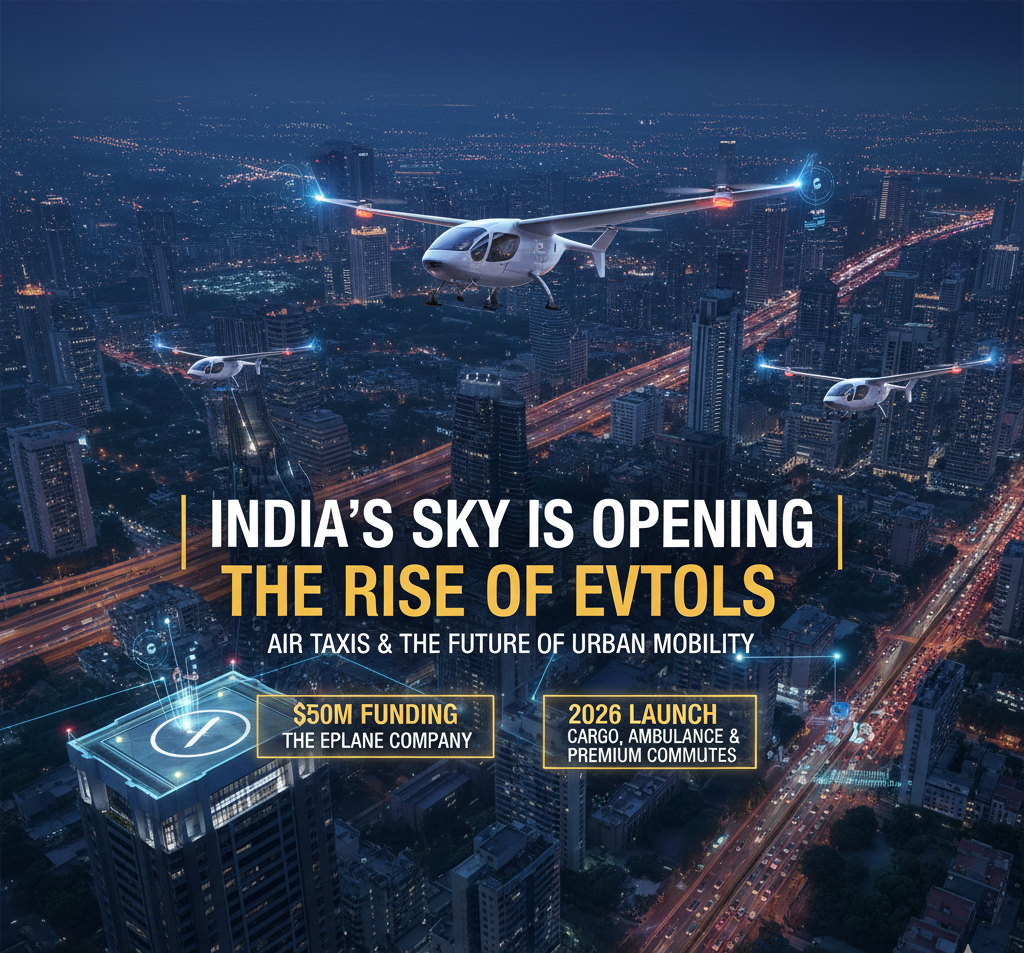
Imagine bypassing the grueling traffic of Pune or Mumbai by simply hopping into a quiet, electric aircraft that lifts off vertically from a nearby rooftop. What once sounded like a scene from The Jetsons is rapidly becoming India’s new infrastructure reality.
As we move through 2026, the Electric Vertical Take-off and Landing (eVTOL) sector is witnessing a massive surge in investor confidence, signaled by landmark funding rounds and cutting-edge technological milestones.
The $50 Million Bet on Indian Air Taxis
The most significant headline this week comes from Chennai-based The ePlane Company. Incubated at IIT Madras, the startup is reportedly in the final stages of raising $40–50 million in a Series C funding round.
This capital injection, co-led by Speciale Invest, is a clear indicator that deep-tech hardware in India is no longer a “niche” play. The funds are earmarked for:
- Accelerating Certification: Pushing the e200X through the DGCA (Directorate General of Civil Aviation) Type Certification process.
- Engineering Expansion: Scaling their manufacturing facility in Chennai to support commercial-ready prototypes.
- Commercial Deployment: Preparing for a 2026 launch, initially focusing on cargo and air ambulance services before moving to passenger transport.
Why India is the Ultimate eVTOL Testing Ground
India faces unique urban mobility challenges that make it a “natural fit” for air taxis. With some of the world’s most congested cities, the economic cost of traffic is staggering.
| Feature | Traditional Helicopter | eVTOL (e.g., ePlane e200X) |
| Noise Level | High (Disruptive in cities) | Ultra-Quiet (Silent at cruising altitude) |
| Emissions | High (Carbon-intensive) | Zero (All-electric) |
| Operational Cost | Expensive (High maintenance) | Low (Fewer moving parts) |
| Infrastructure | Large Helipads | Compact “Vertiports” on rooftops |
More Than Just a “Flying Car”
While the ePlane Company is grabbing headlines, they aren’t alone in this race. The Indian ecosystem is heating up with several key players:
- Sarla Aviation: Recently secured $10 million in funding from giants like Accel and Zerodha’s Nikhil Kamath. They are targeting a “Shunya” air taxi service to cut airport-to-city travel times down to 19 minutes.
- Archer Aviation & InterGlobe: The parent company of IndiGo has partnered with U.S.-based Archer to launch an all-electric air taxi service in Delhi, aiming for a 7-minute route from Connaught Place to Gurugram by late 2026.
The Digital Twin Revolution
A fascinating trend in 2026 is the use of AI and Digital Twins to speed up safety trials. ePlane recently announced a collaboration with NVIDIA to build a high-fidelity digital twin of their aircraft using the NVIDIA Omniverse. This allows engineers to simulate millions of flight hours in extreme weather and emergency scenarios virtually, ensuring that when the aircraft finally takes flight with passengers, it is the safest vehicle in the sky.
The Roadmap Ahead: 2026 and Beyond
The transition to air mobility will be phased. We expect to see the first “Vertiports” operational in major metros by the end of this year, primarily serving:
- Emergency Medical Services (EMS): Transporting organs and trauma patients faster than any ambulance.
- High-Value Cargo: Last-mile delivery for critical industrial components.
- Premium Commutes: Airport transfers for business leaders to whom time is the most valuable currency.
At The Global Success Review Magazine, we believe the “IP-Nation” shift is happening right above our heads. These startups aren’t just building planes; they are building a sovereign aerospace capability that will redefine how India moves.