
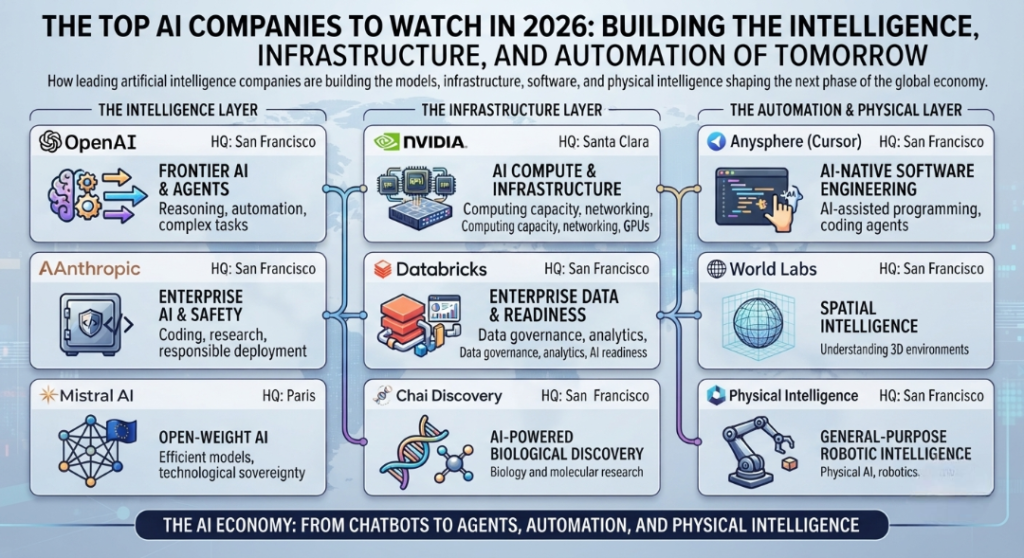
The Top AI Companies to Watch in 2026: Building the Intelligence, Infrastructure, and Automation of Tomorrow
How leading artificial intelligence companies are building the models, infrastructure, software, and physical intelligence shaping the next phase of the global economy.
Published by The Global Success Review Magazine
Artificial intelligence is entering a new chapter in 2026.
The first generation of generative AI transformed how people create content, search for information, write software, and interact with technology. The next phase is broader. AI systems are increasingly being designed to reason across complex tasks, operate as agents, interact with software and physical environments, support scientific discovery, and automate increasingly sophisticated workflows.
At the same time, the infrastructure supporting this transformation is becoming increasingly important. Advanced AI requires specialized processors, enormous computing capacity, sophisticated data platforms, high-performance networking, and software capable of deploying intelligent systems securely at scale.
This means the AI economy is no longer defined by foundation models alone. It is becoming a multilayered ecosystem spanning intelligence, infrastructure, applications, automation, robotics, and scientific discovery.
The following companies represent notable activity across these areas and offer a view into where artificial intelligence may be heading next.
AI Companies to Watch in 2026
From frontier intelligence to physical AI and scientific discovery.
01 • Frontier Artificial Intelligence
OpenAI
Frontier AI • Reasoning • AI Agents • Automation
OpenAI remains one of the most closely watched companies in frontier artificial intelligence.
Its development increasingly extends beyond conversational systems toward models capable of reasoning through complex problems, using tools, writing software, and supporting multi-step workflows.
This evolution represents a major shift in how businesses may use AI. Instead of simply asking a system for information, organizations can increasingly envision AI participating directly in research, software development, analysis, customer operations, and other knowledge-intensive processes.
The company’s continued development of increasingly capable models and agentic systems makes it an important company to watch as AI moves from generating answers toward completing tasks.
Visit Official Website → Key area: Frontier intelligence and agentic AI.
02 • Enterprise AI
Anthropic
Enterprise AI • Reasoning • Coding • AI Safety
Anthropic has become a significant force in the frontier AI market through its Claude family of models.
The company has placed strong emphasis on enterprise applications, coding, research, and professional workflows. Its developer-oriented tools demonstrate how foundation models can become integrated directly into software engineering and other knowledge-work environments.
Anthropic’s emphasis on AI safety and responsible development is also notable as AI systems become more capable and autonomous.
For enterprises, the challenge is not simply accessing powerful models. Organizations increasingly need AI that can operate within appropriate security, governance, and control frameworks.
Visit Official Website → Key area: Enterprise intelligence and responsible AI deployment.
03 • AI Infrastructure
NVIDIA
AI Computing • GPUs • Networking • Infrastructure
Every advanced AI system depends on computing infrastructure.
NVIDIA has become a central player in this layer through its accelerated-computing platforms, GPUs, networking technologies, and AI software ecosystem.
Its infrastructure supports model training and inference as well as scientific computing, robotics, autonomous systems, enterprise AI, and other demanding applications.
As AI adoption expands, the industry’s focus is increasingly shifting from simply building powerful models to operating those models efficiently and economically at scale.
NVIDIA therefore represents a critical part of the physical infrastructure underlying the AI economy.
Visit Official Website → Key area: AI compute and infrastructure.
04 • Open-Weight Artificial Intelligence
Mistral AI
Open-Weight AI • Efficient Models • Enterprise Deployment
Mistral AI represents an important European approach to artificial intelligence.
The company’s emphasis on efficient and open-weight models provides organizations with greater flexibility around deployment, customization, and infrastructure.
This approach is particularly relevant to enterprises and governments concerned with data sovereignty, privacy, regulatory requirements, and technological independence.
The continued development of open-weight AI also demonstrates that the future AI ecosystem may include multiple approaches rather than a single dominant model architecture.
Visit Official Website → Key area: Open-weight AI and technological sovereignty.
05 • AI-Native Software Development
Anysphere / Cursor
Coding Agents • AI Software Engineering
Anysphere, the company behind Cursor, illustrates how AI can reshape an entire software category.
Rather than adding an AI assistant to a conventional development environment, Cursor is designed around AI-assisted programming.
AI can increasingly help developers understand codebases, generate code, identify problems, test applications, and work through multi-step development tasks.
The significance extends beyond developer productivity. It points toward a future in which software itself is increasingly designed around collaboration between humans and AI agents.
Visit Official Website → Key area: AI-native software engineering.
06 • Enterprise Data & AI
Databricks
Enterprise Data • Analytics • AI Infrastructure
AI systems require more than sophisticated models. They require reliable data.
Databricks operates at the intersection of enterprise data management, analytics, machine learning, and AI application development.
As organizations adopt agentic AI, they need secure access to organizational information, appropriate permissions, data governance, and reliable infrastructure.
This makes enterprise data platforms an increasingly important part of the AI value chain.
The Databricks model highlights a fundamental reality: successful enterprise AI depends heavily on the quality of the data environment surrounding it.
Visit Official Website → Key area: Enterprise data and AI readiness.
07 • Spatial Intelligence
World Labs
Spatial AI • 3D Environments • Physical Intelligence
The next generation of AI will not be limited to language.
World Labs is focused on spatial intelligence, the ability of AI systems to understand and reason about three-dimensional environments.
Founded by AI researcher Fei-Fei Li and other researchers, the company’s work represents an emerging area of AI research with potential applications in robotics, simulation, design, autonomous systems, gaming, and immersive computing.
Spatial intelligence could become increasingly important as AI moves from digital information toward interaction with the physical world.
Visit Official Website → Key area: Spatial and physical-world intelligence.
08 • Robotics & Physical AI
Physical Intelligence
Robotics • General-Purpose Physical AI
Robotics represents another major frontier for artificial intelligence.
Traditional robots are frequently designed for specific tasks and controlled environments. Physical Intelligence is pursuing a broader model in which AI systems can provide adaptable intelligence across different robotic platforms and physical tasks.
The potential applications range from manufacturing and logistics to agriculture, healthcare, and household automation.
The significance of this work is straightforward: it seeks to extend AI beyond computers and into the physical economy.
Visit Official Website → Key area: General-purpose robotic intelligence.
09 • AI for Science
Chai Discovery
AI for Biology • Molecular Discovery
Artificial intelligence is also becoming a tool for scientific discovery.
Chai Discovery applies machine learning to biological and molecular modeling, addressing challenges associated with understanding biological structures and exploring potential therapeutic possibilities.
The broader significance of this field is substantial. AI can help researchers analyze complex biological systems and explore enormous spaces of potential molecular structures.
This represents a shift from AI as a productivity technology toward AI as a potential research partner.
Visit Official Website → Key area: AI-powered biological discovery.
The AI Ecosystem at a Glance
| AI Layer | Representative Companies | 2026 Focus |
|---|---|---|
| Frontier Intelligence | OpenAI, Anthropic | Reasoning, agents and enterprise AI |
| AI Infrastructure | NVIDIA | Computing, networking and AI deployment |
| Open-Weight AI | Mistral AI | Flexible and sovereign AI |
| AI-Native Software | Anysphere / Cursor | AI-powered software development |
| Enterprise Data | Databricks | Data, governance and AI readiness |
| Spatial AI | World Labs | 3D and physical-world understanding |
| Robotics AI | Physical Intelligence | General-purpose robotic systems |
| AI for Science | Chai Discovery | Biology and molecular discovery |
The Road Ahead
The AI industry is moving from generation to reasoning, from reasoning to agency, and increasingly from digital intelligence toward physical and scientific intelligence.
Stage 01
Generation
AI creates text, images, code and other digital content.
Stage 02
Reasoning
AI increasingly handles complex problems and multi-step analysis.
Stage 03
Agency
AI systems increasingly use tools and complete workflows.
This evolution will require more than increasingly capable models. It will require infrastructure, data, security, governance, specialized applications, and reliable mechanisms for humans to supervise increasingly autonomous systems.
For enterprises, the key question is therefore changing.
It is no longer simply whether AI can generate useful content.
The more consequential question is whether AI can reliably understand context, make decisions, use tools, complete workflows, interact with physical environments, and contribute to measurable business and scientific outcomes.
The companies shaping these different layers of the ecosystem will influence how quickly that transition occurs.
From NVIDIA’s computing infrastructure to OpenAI and Anthropic’s frontier intelligence, from Mistral AI’s open-weight approach to Cursor’s AI-native development environment, and from World Labs and Physical Intelligence to Chai Discovery’s scientific applications, the AI landscape is becoming increasingly diverse.
The result is an emerging technology stack in which intelligence is being built into the foundations of software, infrastructure, science, and physical systems.
Conclusion:
The most important AI companies to watch in 2026 are not necessarily pursuing the same technological path.
Some are developing foundation models. Others are building the chips and computing systems required to operate them. Some are transforming software development, while others are applying AI to robotics, spatial computing, enterprise data, and biological research.
Together, they illustrate the next stage of the AI revolution.
Artificial intelligence is moving beyond the chatbot and becoming an increasingly integrated layer of the global digital economy.
The companies building that layer today could play an important role in defining how organizations work, how software is created, how scientific discoveries are made, and how intelligent machines interact with the world tomorrow.
The defining AI question of 2026 may therefore no longer be:
“What can AI generate?”
It is increasingly becoming:
“What can intelligent systems understand, automate, discover, and accomplish?”
That question will help shape the next era of technology, and the future of the global economy.
Editorial Note: This feature is intended for editorial and informational purposes. Company names, trademarks and logos belong to their respective owners. Inclusion in this feature does not imply endorsement, ranking, partnership or sponsorship. Readers should visit each company’s official website for the latest corporate, product and contact information.
© The Global Success Review Magazine . All rights reserved.
Global Business • Leadership • Technology • Innovation • AI
